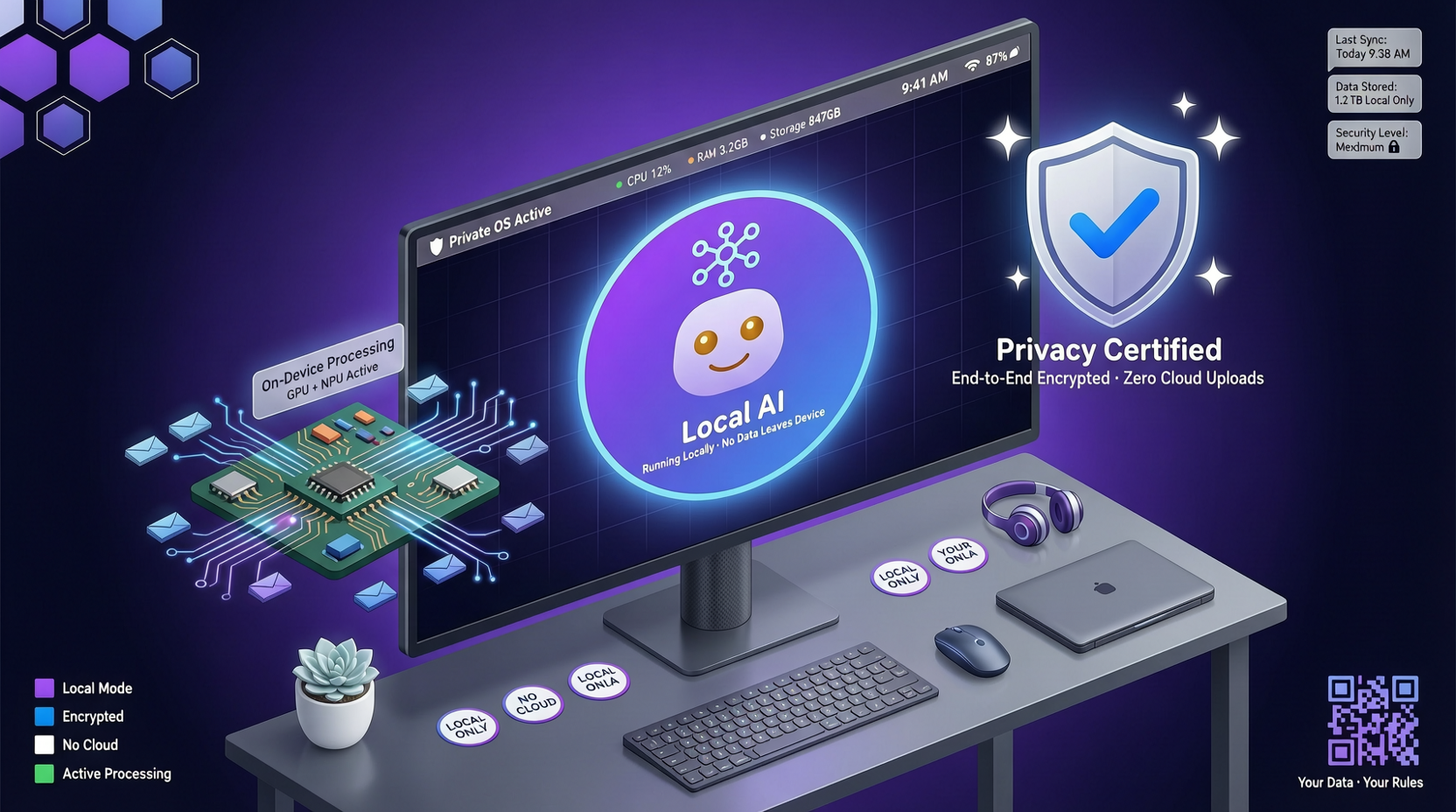
"Your Personal AI super intelligence."
That's what openhuman's README claims. Private AI super intelligence—sounds like the opening of a sci-fi movie. But strip away the marketing, and there's something worth looking at.
What it actually is
openhuman is a local-first personal AI framework. The core idea: your AI assistant should run on your own device, data stays local, you pick the model, you control the behavior.
Unlike Ollama or LM Studio—which are local inference loaders—openhuman has its own agent architecture, memory system, skills mechanism, and even a desktop mascot (that little icon on your screen that sleeps by default and wakes on hover).
1,671 commits, 47 tags, merging PRs as recently as 3 minutes ago. The team iterates fast.
Points worth noting
CEF Architecture: The project uses CEF (Chromium Embedded Framework) for the desktop app, not Electron. This choice shows awareness of resource consumption—CEF is typically lighter than Electron. For a "local-first" product, this matters. You can't claim privacy-friendliness while eating 2GB of RAM.
Skills System: The .agents/agents directory has a skills mechanism—plugin-style capability extension. Similar to Claude Code's skills concept, but openhuman is open source, meaning the community can write their own skills.
Multi-platform support: Commits show Android and MediaPipe LLM integration traces, suggesting the team is expanding to mobile. If personal AI can run on phones, the positioning becomes truly viable.
Mascot interaction: A recently merged PR adds "sleep by default, wake on hover/click." The desktop icon sleeps by default and wakes when you hover over it. This design finds a balance between "always-on AI assistant" and "don't bother the user."
The reality gap
1.3k stars, 45 open issues, 12 open PRs—the project is still early.
"Super intelligence" is just a vision for now. The actual AI capability depends on which model you attach. openhuman doesn't provide models—it's a shell. Give it Qwen 3.6, and it has Qwen 3.6's capabilities; give it Gemma 4, and it has Gemma 4's capabilities.
So what really determines whether it's good is two things:
First, local inference efficiency. How big a model can it run on consumer hardware? What's the response latency? Memory usage? The docs don't have clear benchmark data.
Second, agent framework maturity. How does the memory system work? How is cross-session context maintained? How reliable is skill invocation? You need to actually run it to know.
Who it's for
- People who care about data privacy and don't want to send conversations to the cloud
- People who want a "always available" AI assistant running locally without opening a browser
- Developers interested in agent frameworks who want to write their own skills
Who it's not for:
- People who want the strongest out-of-the-box AI experience (just use Claude Pro or ChatGPT Plus)
- People without a local GPU (pure CPU inference will be painful)
- People with too high expectations for "super intelligence" (it's currently a framework, not a product)
Judgment
openhuman's direction is right. Local-first, data-private, model-selectable—these concepts are an important complement in a trend where AI assistants are increasingly cloudified.
But "super intelligence" still needs time to materialize. A more accurate description right now: an ambitious local AI agent framework, iterating fast.
Worth watching, but don't make it your main tool yet. Come back when it hits 5k stars.
Main sources: