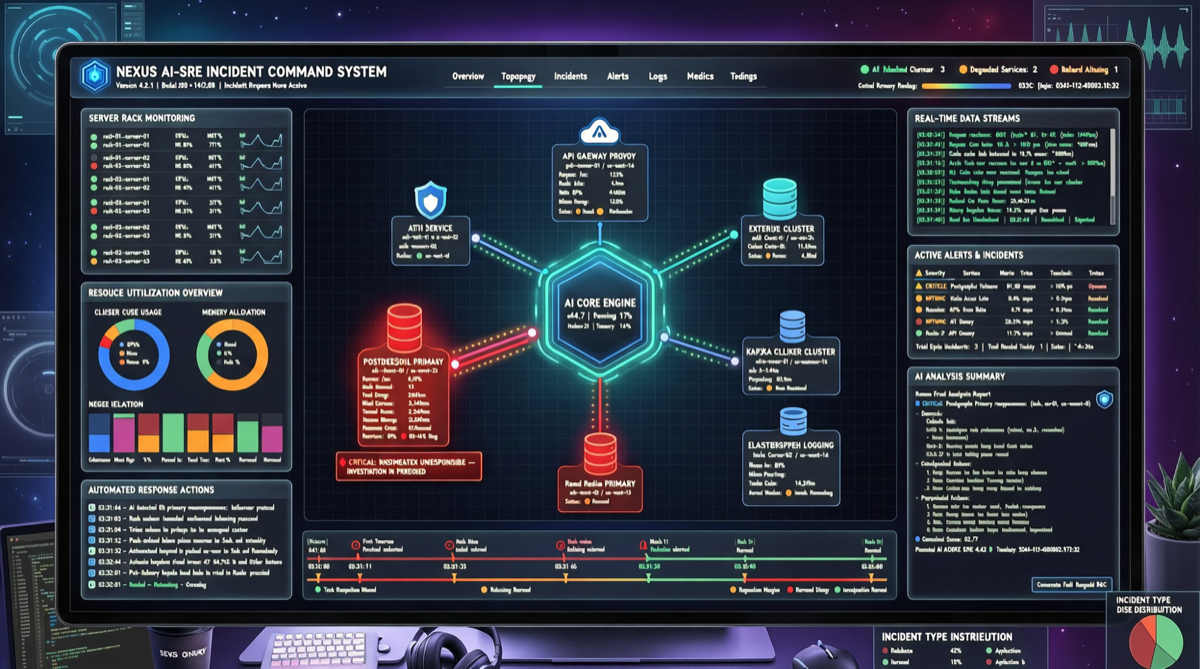
An intriguing project appeared on this week’s GitHub Trending: Tracer-Cloud/opensre (4,291 stars, +1,199 this week, 1,525 commits). Its positioning is clear — build your own AI SRE Agent for production incident investigation and root cause analysis.
Why Does SRE Need a Dedicated Agent Framework?
When something breaks in production, evidence is scattered across logs, metrics, traces, runbooks, and Slack threads. Traditional monitoring tools can tell you “something’s wrong,” but pinpointing the root cause still requires engineers to manually hop between systems.
OpenSRE’s core insight comes from the success of SWE-bench: coding agents evolved rapidly because they had scalable training data and clear feedback loops. The production incident response domain still lacks equivalent training infrastructure.
Distributed failures are slower, noisier, and harder to simulate and evaluate than local code tasks — which is why AI SRE remains unsolved.
OpenSRE is building that missing infrastructure layer.
Core Capabilities
60+ Tool Integrations
OpenSRE doesn’t try to replace your existing ops stack — it connects the 60+ tools you already run. Kubernetes, EC2, CloudWatch, Lambda, ECS Fargate, Flink, Datadog, and other cloud-native components all have dedicated integration support. The agent can autonomously navigate between these systems, collecting evidence chains.
Synthetic Incident Training Environment
This is OpenSRE’s most distinctive design. It provides two categories of test scenarios:
- Synthetic RCA suites (
tests/synthetic): Simulated failure scenarios with known root causes, complete with scoring mechanisms that evaluate the agent’s root cause accuracy, evidence collection completeness, and deliberately planted “red herring” distractors to test judgment - End-to-end real cloud scenarios (
tests/e2e): Tests running on real Kubernetes, EC2, CloudWatch, and other cloud infrastructure
This “exam plus real-world practice” dual-track approach makes AI SRE agent capabilities quantifiable, rather than relying on “it feels pretty smart” as a metric.
REPL Interactive Mode
Run opensre without arguments to enter a persistent REPL session — styled similarly to Claude Code’s terminal experience. You describe an alert in natural language, and the agent streams its investigation in real-time, then you can follow up with questions:
opensre
# › MongoDB orders cluster has been dropping connections since 14:00 UTC
# ...real-time streaming investigation output...
# › why was the connection pool exhausted?
# ...context-grounded follow-up answer...
# › /status
# › /exit
Supports slash commands: /help, /status, /clear, /reset, /trust, /exit. Ctrl+C cancels an in-flight investigation while keeping session state intact.
Official Deployment: LangGraph Platform
OpenSRE’s official deployment path is LangGraph Platform. This means:
- Create a deployment on LangGraph Platform and connect the OpenSRE repository
- Configure your LLM provider via environment variables (Anthropic, OpenAI, Gemini, OpenRouter all supported)
- Corresponding API keys activate automatically
# Minimum LLM environment configuration
LLM_PROVIDER=anthropic
ANTHROPIC_API_KEY=sk-...
Railway self-hosted deployment is also supported (requires Postgres + Redis backing services).
Quick Start
# One-click install (latest stable)
curl -fsSL https://install.opensre.com | bash

# Initialize
opensre onboard

# Investigate a pre-built Kubernetes alert scenario
opensre investigate -i tests/e2e/kubernetes/fixtures/datadog_k8s_alert.json

# Or enter interactive mode
opensre
Also available via Homebrew:
brew install Tracer-Cloud/opensre/opensreSignal vs Noise
Signal:
- OpenSRE is not another “use LLM to search logs” demo — it’s building evaluable, trainable, scalable AI SRE infrastructure. The combination of synthetic incident scenarios, scoring mechanisms, and real-cloud E2E testing has almost no parallel in the open-source world
- 1,525 commits signal an extremely rapid development pace; the project is in a fast iteration phase
- The pragmatic route of connecting 60+ existing tools is far more likely to land than “rebuild everything from scratch”
- LangGraph as the official deployment path means graph-structured agent workflows are first-class citizens
Noise:
- The project is currently Public Alpha — core workflows are usable but APIs and integrations are still in flux, not yet production-ready
- Dependency on LLM providers means token costs need consideration — complex incident investigations may require substantial API calls
- The gap between synthetic scenarios and real production still exists: real-world failures often stack multiple independent factors, while synthetic scenarios have predetermined root causes
Who Should Care
| Role | Use Case |
|---|---|
| SRE / DevOps Engineers | Use OpenSRE for preliminary alert investigation, accelerating MTTR |
| AI Agent Developers | Leverage the synthetic training environment to test and optimize agent strategies |
| Ops Tool Vendors | Integrate the OpenSRE interface to get your tool into the agent’s callable toolbox |
| Tech Team Leaders | Evaluate AI SRE maturity and plan future ops automation roadmaps |
Summary
OpenSRE represents a clear trend: AI Agents are expanding from “writing code” to “operating infrastructure.” Coding agents solved the software construction problem, but software runtime failure diagnosis — equally important and often more impactful on business continuity — is only now seeing systematic open-source solutions emerge.
OpenSRE’s value isn’t that it can immediately replace SRE engineers, but that it provides an evaluable, trainable, and scalable infrastructure for this direction. When SWE-bench drove the explosion of coding agents, OpenSRE could become the equivalent benchmark for AI SRE.
Source: Tracer-Cloud/opensre | Quickstart Docs