Most AI assistants today still operate in "you say, it does" mode. You open a chat window, type a command, it returns a result. Quiet, obedient, efficient.
But a truly useful assistant shouldn't just wait for commands. It should be able to guess what you might want to do when you open an app; after you switch between several windows, proactively ask "are you looking for something?"
This shift from "passive response" to "active anticipation" is the core next step for personal AI assistants. But here's the question: how do you evaluate a "proactive" assistant? How do you score when it gets it right? How do you penalize when it oversteps?
The π-Bench paper submitted today on Hugging Face Daily Papers by the Simplified Reasoning team attempts to answer this.
Evaluating "Proactive" Is Much Harder Than Evaluating "Passive"
Evaluating a passive assistant is simple: give a command, check if the output is right. But evaluating a proactive assistant, you need to answer trickier questions:
When should it be proactive? When should it stay quiet? Is its anticipated intent correct? Did its suggestion help or create more trouble?
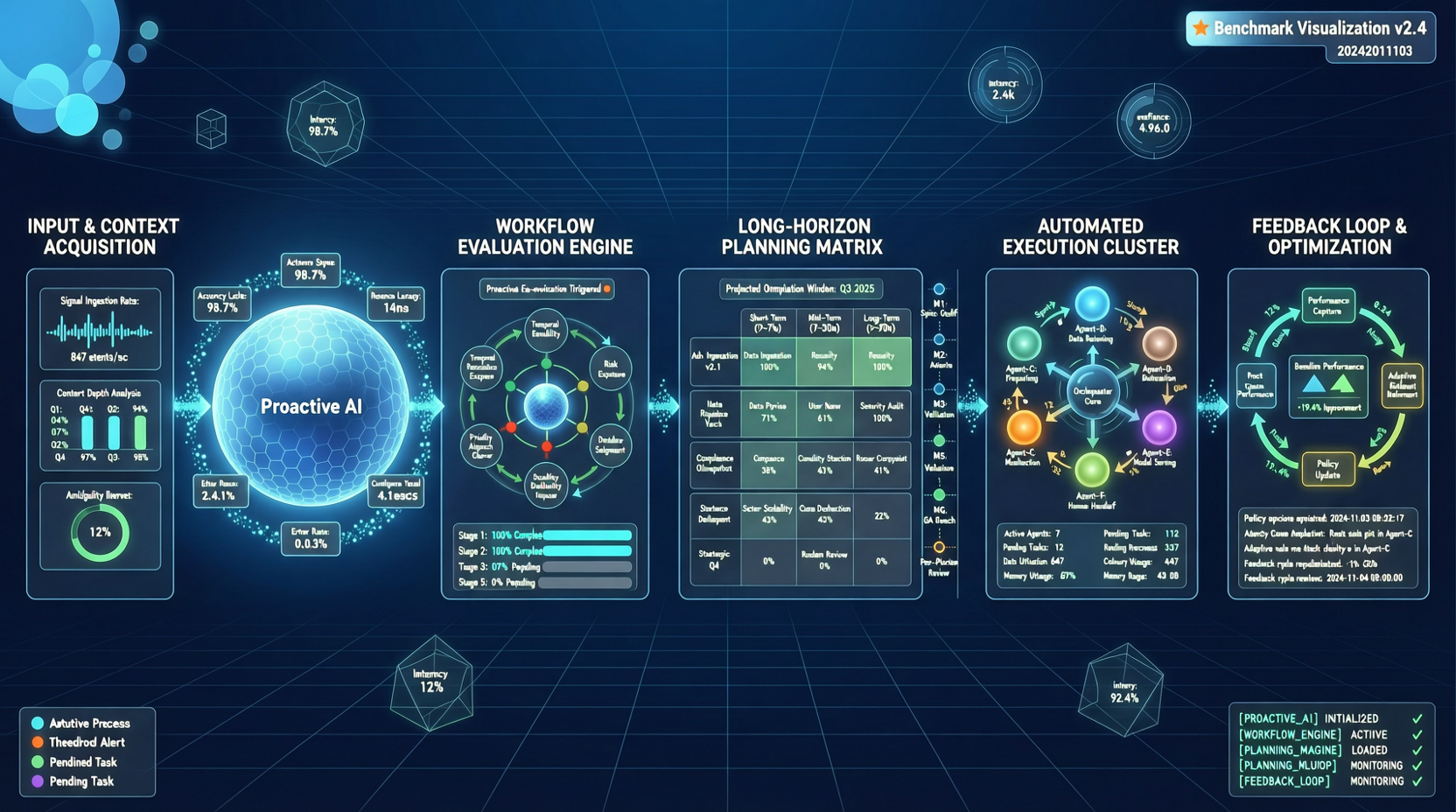
π-Bench puts evaluation in the context of long-horizon workflows. Not "one command, one response" single-turn interaction, but the complete process of an assistant continuously observing user behavior, making predictions, and providing suggestions over a period of time.
Core Challenge: Signal in the Noise
Users' daily screen activity is full of noise. You open a document, change two lines, close it. Open a browser, search a question, close it again. Which of these operations are signals the assistant should pay attention to, and which are background noise it can ignore?
More complex: users may be handling multiple tasks simultaneously. Replying to emails, editing slides, searching for information—several threads intertwined. The assistant needs to make judgments under uncertainty, based only on a sequence of screenshots.
45 Upvotes—Direction Matters More Than Numbers
This paper got 45 upvotes on Hugging Face today. Not high, but the direction hits a blind spot in current Agent evaluation.
Existing Agent evaluations are mostly task completion rate statistics—give 100 tasks, see how many it completes. But "proactive anticipation" can't be measured by task completion rate. It needs an entirely new evaluation framework: accuracy of timing judgment, relevance of suggestions, actual impact on user workflow.
A Real-World Concern
The biggest risk of a proactive assistant isn't "not proactive enough" but "too proactive." Imagine you're focused on coding, and the assistant pops up a suggestion every two minutes—"do you want to look up this API's documentation?", "I think you could use a different function here."
That assistant isn't helping—it's interrupting.
If π-Bench can provide quantitative evaluation standards in this area—like defining thresholds for "proactive interruption," measuring the net impact of suggestions on work efficiency—its practical value to the industry would be much greater.
Primary sources:
- π-Bench paper (Simplified Reasoning, May 22, 2026)
- Hugging Face Daily Papers (45 upvotes)