The short video赛道 has always had a pain point: no shortage of creativity, but production is too slow.
Writing scripts: 2 hours. Finding materials: 3 hours. Editing: 4 hours. Color grading and sound effects: another hour. A one-minute short video, from idea to publish, takes most of a day.
Pixelle-Video's ambition is to compress this entire process into automation.
What It Is
Pixelle-Video is AIDC-AI's open-source fully automated short video engine (AI Fully Automated Short Video Engine).
15,545 stars, up 4,480 this week. 2,247 forks — this fork ratio shows many people are seriously trying it, not just starring.
From the project name and description, it covers the complete pipeline from copywriting to video output.
Workflow Breakdown
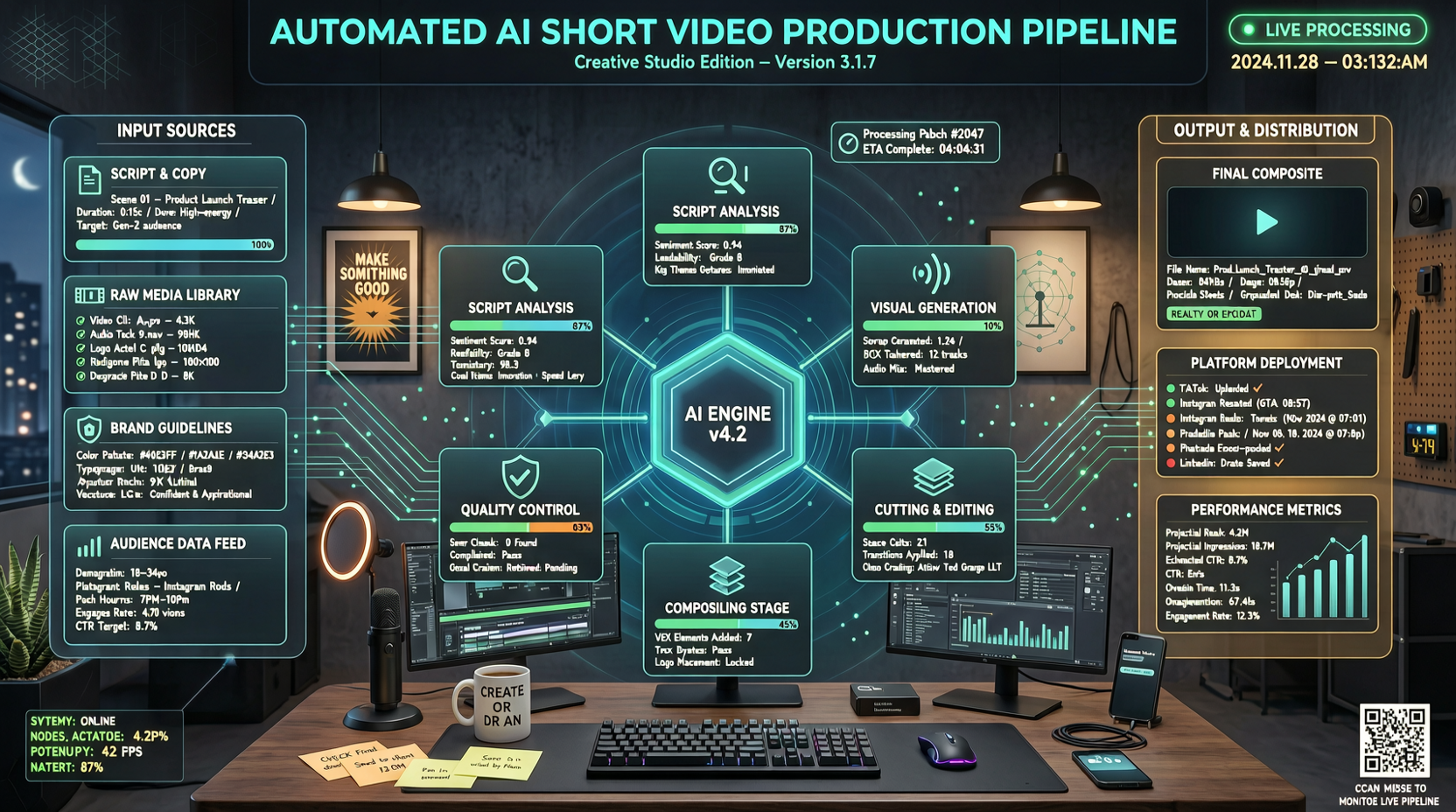
The core value of this type of tool isn't how strong any single step is, but the automation level of the entire chain. A typical Pixelle-Video workflow:
Input topic → auto-generate script → generate/match visuals → voiceover → subtitles → output video.
Each step relies on different AI capabilities:
- Script: LLM (GPT/Claude/domestic models)
- Visuals: text-to-image/text-to-video models
- Voiceover: TTS (text-to-speech)
- Subtitles: ASR (speech recognition) + timeline alignment
Stringing these together isn't hard. What's hard is making each step's output reliably pass to the next step. Pixelle-Video's value is making this chain into an out-of-the-box solution.
Who It's For
Self-media operators. If you need to produce multiple short videos daily, manual production cost is too high. Automation tools can shift your time from "making videos" to "thinking about topics."
Content matrix teams. Teams running multiple accounts needing batch content production see the most scale effect from automation.
People who want to try short video but can't edit. Technical barriers are drastically lowered — no need to master Premiere or Jianying, input a topic and get a video.
Things to View Calmly
- Quality ceiling. Fully auto-generated short videos currently have a clear quality gap vs. manually refined videos. Suitable for "daily update" content, not "premium" content.
- Platform review risk. Short video platforms are tightening policies on AI-generated content. Some require "AI-generated" labels, some may throttle pure AI content.
- Homogenization problem. If everyone uses the same tool and templates, output becomes increasingly similar. Differentiation still depends on creativity and topic selection.
- Dependency on upstream models. Script generation depends on LLMs, visual generation depends on text-to-image/video models — upstream model quality changes directly affect your output.
My Take
Pixelle-Video represents the next phase of AI content production: from "assistive tool" to "autonomous production line."
Two years ago, AI's role in short video was "help you write scripts" or "help you generate a few visual clips." Now it's "give me a topic, I'll deliver the finished product." This leap is real.
But the stronger the tool, the more human judgment matters. Topic direction, content tone, brand consistency — these are parts AI still can't replace.
If you're in short video content, Pixelle-Video is worth deploying and testing. But don't expect it to fully replace humans — treat it as an "efficiency amplifier," not a "replacement," and your mindset will be healthier.
Main sources:
- GitHub - AIDC-AI/Pixelle-Video (repository analysis)
- GitHub Trending Weekly (popularity tracking)
- AI video generation tool comparison (Runway/Pika/Kling)