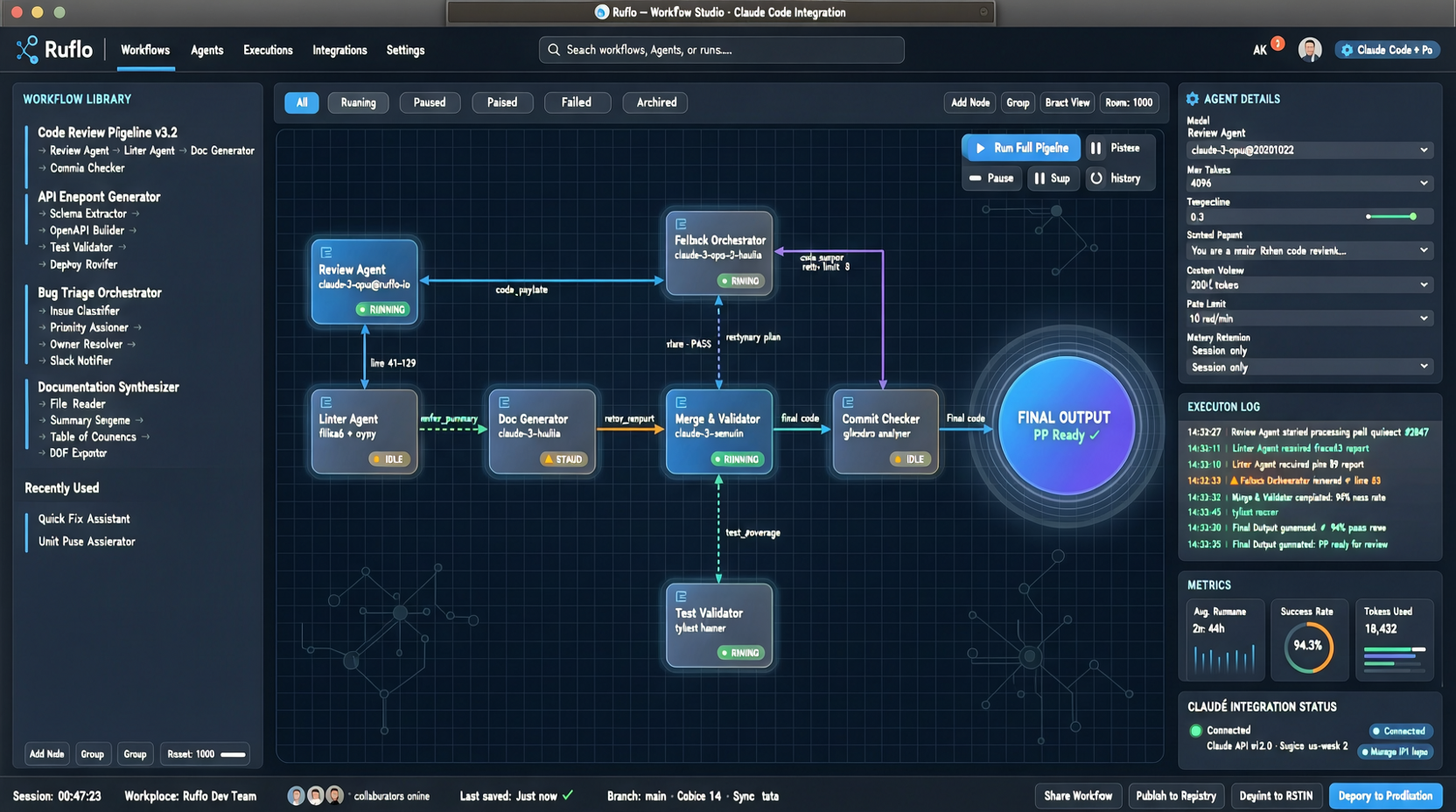
48.6K stars, up by 10,779 in a single week. 6,387 commits, 230 branches, and 1,474 tags.
This isn't an internal tool open-sourced by a tech giant. It was built by an independent developer named rUv. Originally called Claude Flow, it was later renamed Ruflo—"Ru" comes from the author's name, and "flo" stands for flow state, the kind of state where you're still coding at 3 AM.
What Ruflo does can be summed up in one sentence: It gives Claude Code a nervous system.
Not a Framework, But Infrastructure
Most agent orchestration tools follow the "learn our API" approach. Ruflo does the opposite—once installed, you don't need to learn anything new.
After running npx ruflo init, Claude Code gains a suite of new capabilities: agents automatically form swarms to collaborate, cross-session memory, learning from successful patterns, and even secure communication with agents on other machines in federated mode. You keep coding with Claude Code as usual, while Ruflo coordinates everything in the background.
It offers two installation paths:
- Lite Mode: Installs only the Claude Code plugin with zero file writes to your workspace, providing a few slash commands and skill definitions. Ideal for testing the waters.
- Full Mode: Brings in the complete
.claude/,.claude-flow/, andCLAUDE.mdsetup, activating 98 agents, 60+ commands, 30 skills, an MCP server, hooks, and a daemon.
The core architecture is a pipeline: User → Ruflo → Router → Swarm → Agents → Memory → LLM Providers, with a self-learning loop continuously optimizing routing strategies in the middle.
32 Plugins Covering the Full Pipeline from Testing to Security
Ruflo's plugin system is no gimmick. The 32 plugins are divided into several key areas:
Orchestration Layer: Swarm coordination, autonomous autopilot execution, scheduled tasks, reusable workflow templates, and cross-machine federated communication.
Memory Layer: Vector databases, hybrid search (vector + graph traversal + diversity ranking), cross-session memory persistence, GPU-accelerated search, and knowledge graphs.
Intelligence Layer: Learning from historical success patterns, dynamic agent behavior adjustment, local LLM routing (e.g., Ollama), goal decomposition, and progress tracking.
Engineering Quality Layer: Automatically identifying and generating missing tests, Playwright browser automation, git diff risk scoring, and automated documentation generation.
Security Layer: CVE vulnerability scanning, prompt injection defense, and PII detection.
Methodology Layer: Architecture Decision Records (ADR), Domain-Driven Design scaffolding, and the 5-stage development methodology SPARC.
For a single project to pack all of this in, it's either genius or a case of aggressive feature stacking. Judging by the commit frequency—updates were still rolling in just two hours ago—it leans more toward the latter.
Points of Skepticism
48.6K stars is no small number. However, I have a few reservations:
First, commit quality. Out of 6,387 commits, how many are substantive changes versus configuration tweaks? Looking at the file tree, the .claude/ directory was still updating tool description prompts ("Use when...") just two hours ago. This indicates that a large portion of the commits are focused on tuning prompts and configurations rather than writing core code. This isn't necessarily bad—prompt engineering is indeed central to the project—but it creates a gap between the reality and the impression given by the "6K commits" figure.
Second, 1,474 tags. Having 1,474 tags on a project means version iterations are extremely frequent. The latest is 3.7.0-alpha.22—still in the alpha stage. API stability is questionable.
Third, 398 open issues and 130 PRs. For a 48K-star project, this isn't a disaster, but I haven't individually verified the response speed and quality of the issue tracker.
My Take
Ruflo's core value doesn't lie in its sheer number of features—it lies in choosing the right entry point. It doesn't try to replace Claude Code; instead, it makes Claude Code stronger. This is a smart strategy: Claude Code's user base is already established, and Ruflo delivers incremental value.
If you're a heavy Claude Code user, work in a team of three or more, and have projects requiring cross-module collaboration, Ruflo's full mode is worth spending an afternoon testing. The federated communication feature in particular—enabling agents on different machines to collaborate without leaking data—addresses a real pain point for distributed teams.
If you're just working on a solo side project, a few plugins from the lite mode will suffice. Don't be intimidated by the 32 plugins; you likely won't need most of them.
If the next release can drop the alpha tag and stabilize the API, this project will become much more compelling.
Primary Sources:
- ruvnet/ruflo — Official Repository
- GitHub Trending weekly — Weekly Trending Rankings