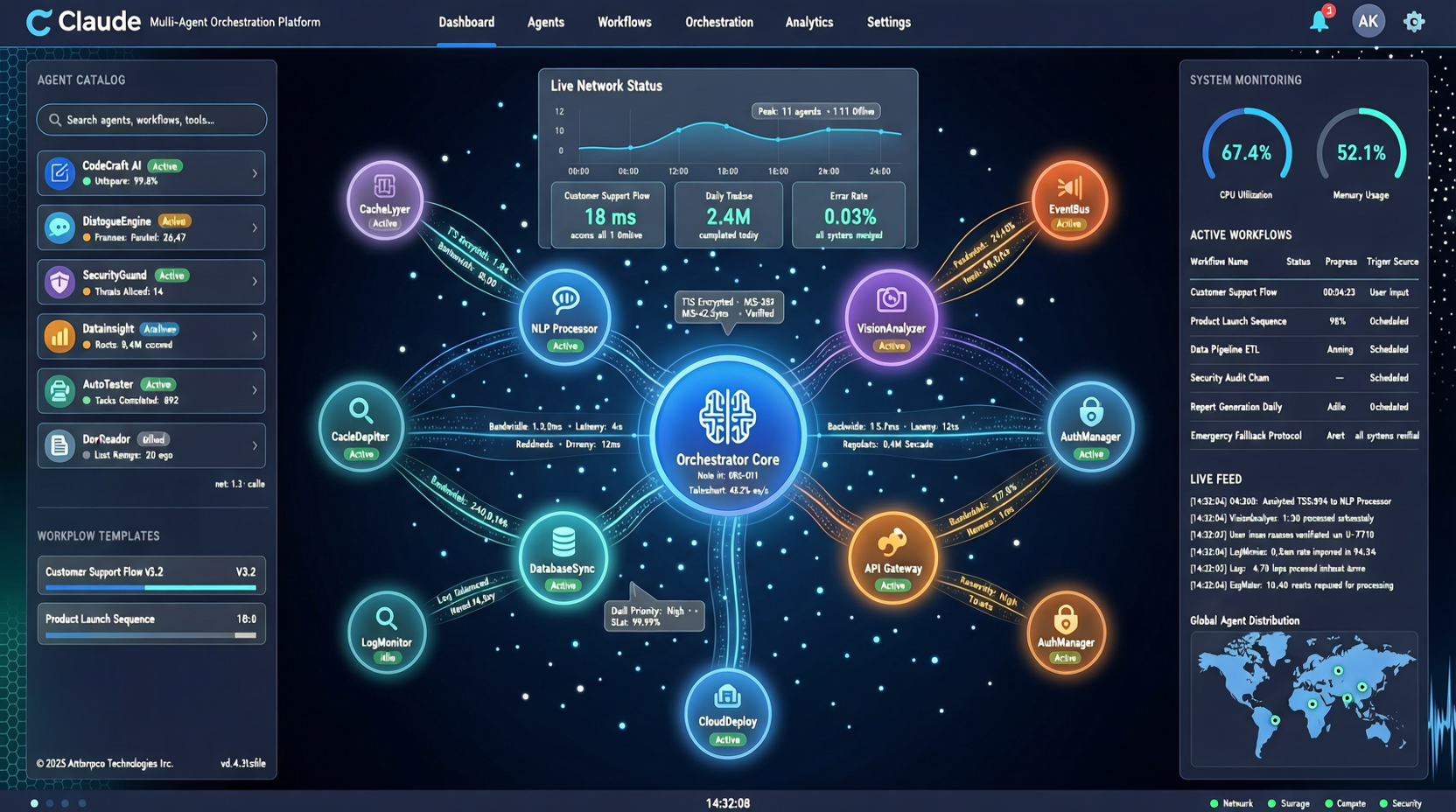
A single Claude Code is already powerful. But if you need to run ten Claude Agents simultaneously, have them分工协作, communicate, and auto-correct — the previous answer was "write your own orchestration logic."
The new answer is called ruflo.
49,546 stars, up 8,660 this week. This number places it at the top of GitHub's AI projects — it's not a toy that burns hot for two weeks and dies.
What ruflo Actually Does
In one sentence: it's an Agent orchestration platform for Claude, letting you deploy and manage multi-agent swarms, coordinate autonomous workflows, and build conversational AI systems.
Sounds grand, but the core logic is actually quite grounded:
- Swarm Intelligence. Multiple agents each execute sub-tasks, but can learn from and coordinate with each other. When one agent hits a wall, another won't make the same mistake.
- Self-learning mechanism. The system automatically optimizes task allocation strategies based on historical execution — which agents are good at what, which combinations are most efficient — not configured by humans, but learned by running.
- RAG integration. Built-in retrieval-augmented generation, so agents can access your private knowledge base for decisions without calling the general model every time.
- Enterprise-grade architecture. Self-learning, permission management, log tracking — the things essential in production environments, ruflo considered from the design stage.
How It Differs from Existing Solutions
There are plenty of multi-agent orchestration frameworks: CrewAI, AutoGen, LangGraph. ruflo's differentiation:
It's not a "universal framework" but a "Claude-optimized" orchestration layer. This means it directly adapts to Claude's capabilities in prompt strategy, tool calling, and context management, rather than going the "one abstraction fits all models" route.
The upside: faster onboarding, better results. The downside: you're locked into the Claude ecosystem — if you use GPT or other models, ruflo isn't for you.
Real-World Scenarios I Can Think Of
Codebase maintenance. One agent reads issues, one writes code, one runs tests, one writes commit messages. Clear division of labor, no interference, an order of magnitude more efficient than a single agent.
Content production pipeline. Research agent gathers materials, writing agent generates drafts, review agent fact-checks, publishing agent pushes to platforms. Each agent specializes in one stage.
Data analysis workflow. Data cleaning agent, feature engineering agent, model training agent, report generation agent — each runs independently, upstream output automatically triggers downstream execution.
Some Real-World Considerations
- Cost. Multi-agent = multi-times API calls. If your task is simple, a single agent is enough — no need to stack agents just to "look cool."
- Complexity. Inter-agent communication and conflict resolution isn't easy. As swarm numbers grow, debugging difficulty increases exponentially.
- Claude dependency. As mentioned, ruflo is deeply tied to Claude. If Anthropic changes API strategy or pricing, your workflow could be affected.
My Take
ruflo represents one direction of 2026 AI workflows: the evolution from single-agent to multi-agent swarms.
Like going from solo development to team development — it needs coordination, division of labor, and management. ruflo encapsulates this management layer's complexity, letting you focus on "what to do" rather than "how to coordinate."
If your work naturally breaks into multiple independent sub-tasks, and you're already using Claude Code, ruflo deserves serious consideration.
But if you only occasionally use AI-assisted coding, or your tasks are inherently indivisible, a single-agent solution (Claude Code itself) is already sufficient.
The next thing to watch is whether ruflo can support models beyond Claude. The value of multi-agent orchestration correlates with the breadth of the model ecosystem.
Main sources:
- GitHub - ruvnet/ruflo (repository analysis)
- GitHub Trending Weekly (popularity tracking)
- CrewAI / AutoGen / LangGraph multi-agent framework comparison