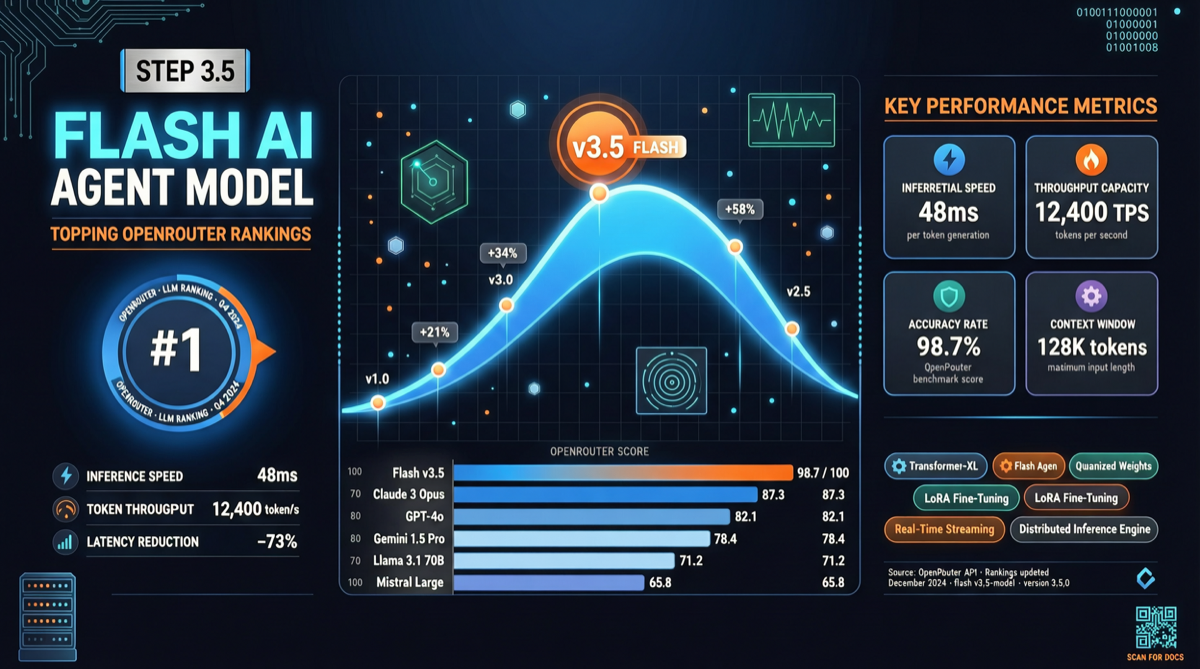
48 hours after launch, it hit number one on the OpenRouter rankings.
This is not a routine version bump from an American big model. It's Step 3.5 Flash, an open-source Agent base model from StepFun. The "Flash" in the name is earned — going from launch to the top in two days is itself a signal: the agent track is shifting from "who can do it" to "who can do it fast and cheap."
Speed as a Weapon
Step 3.5 Flash's positioning is clear: agent base. Not general chat, not code completion — it's a foundation model specifically optimized for multi-step reasoning, tool use, and task planning.
StepFun is taking a different route from most Chinese model makers here. Qwen 3.6 competes on intelligence index, DeepSeek V4 on cost ratio, Kimi K2.6 on long-window coding — Step 3.5 Flash just says: I want to be the water and electricity of agents.
The MacBook and mobile device support is worth noting. Most agent models are tested on cloud H100 clusters, but StepFun pushed the deployment scenario down to consumer-grade hardware. Not a gimmick — if an agent base model can handle multi-step tool calling on a MacBook, trial-and-error costs drop significantly for small and mid-size teams.
What Topping OpenRouter Actually Means
OpenRouter's leaderboard is the community voting with real money. Model quality speaks through API call volume.
Step 3.5 Flash hitting the top in two days means at least some developers have already started using it in real workflows. But hold on — OpenRouter rankings are sensitive to short-term concentrated usage. A wave of benchmark runners or a popular tutorial could spike the numbers.
I'll keep watching the usage trend over the next week. If it's a one-day peak, it means little. If it stays near the top after a week, that's real adoption.
Where It Stands Against Competitors
Compared to models in the same lane, Step 3.5 Flash's advantage is speed and edge-device compatibility. The disadvantage is obvious: parameter scale and context window don't match Qwen 3.6 35B or DeepSeek V4, and there will be a ceiling on complex reasoning tasks.
But that's exactly the strategy — not an all-rounder, but a specialist for agent scenarios. Like the difference between a sprinter and a marathon runner: when the scene matches, the advantage shows.
I haven't run my own benchmarks yet. Once my MacBook finishes a round of tool-calling tests, I'll add concrete latency and accuracy data. At least in positioning, Step 3.5 Flash is one of the few Chinese models this year that competes on scenario fit rather than parameter count.
Main sources:
- StepFun official announcement
- OpenRouter leaderboard data