Bottom Line First
TradingAgents is a research-oriented, multi-agent LLM framework for financial trading—not an “automatic profit generator.” Its greatest value lies not in realized returns, but in offering a rigorously decomposable, study-ready architecture where financial decision-making is distributed across specialized agents.
Architecture Breakdown
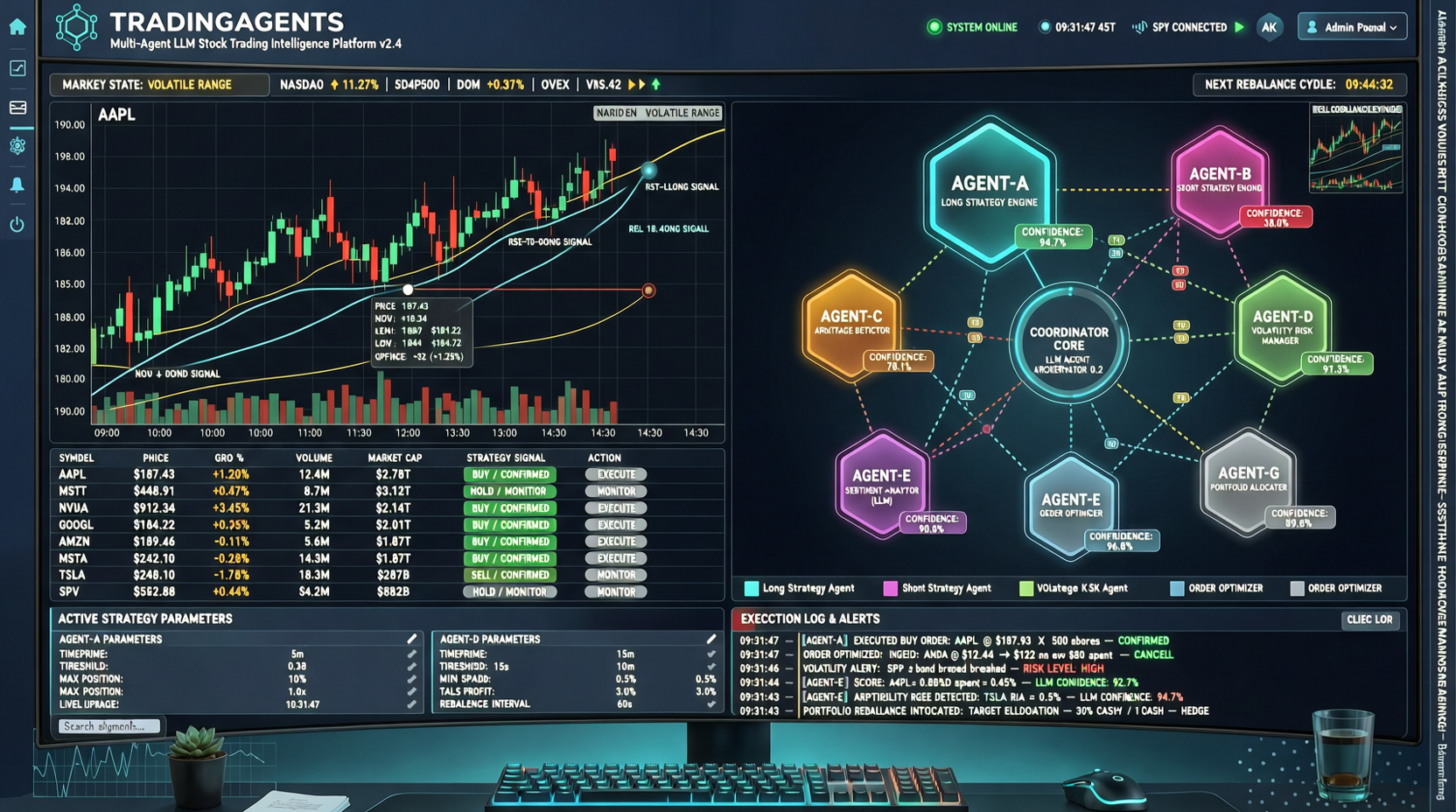
TradingAgents’ core design principle is specialization: rather than relying on a single LLM to handle all trading decisions—as most LLM-based trading solutions do—it decomposes the trading workflow into distinct, role-specific agents:
- Analyst Agent: Performs fundamental and technical analysis
- Sentiment Analysis Agent (new in v0.2.5): Processes news and social media sentiment
- Risk Control Agent: Manages position sizing and risk exposure
- Execution Agent: Generates precise buy/sell orders
This modular structure enables independent evaluation and optimization of each agent. For instance, you can swap out the sentiment analysis module without affecting other components.
Technical Highlights
Several engineering aspects merit attention:
1. Multi-Model Backend Support
The project supports OpenAI, DeepSeek, Qwen, GLM, Azure OpenAI, and locally deployed models via Ollama. This flexibility allows users to run identical strategies across different models for controlled comparative experiments.
2. Structured Agent Architecture (introduced in v0.2.4)
Recent iterations have been highly active: v0.2.4 introduced structured agents, checkpointing, and memory logging; v0.2.5 added the sentiment analyst and environment-variable configuration. With 6,432 commits, the project reflects strong community engagement.
3. Reflection Mechanism
A recent feat(reflection) commit confirms the integration of a self-reflection capability—enabling agents to retrospectively evaluate the quality of their trading decisions. This is a critical advancement in LLM trading frameworks: without a feedback loop, no trading strategy can sustain long-term effectiveness.
The 74.4K-Star Paradox
The contrast between 177 commits and 74.4K stars is telling. The exceptionally high star count—relative to modest commit volume—suggests broad interest and passive observation, rather than deep contributor involvement. Likewise, 205 open issues and 132 open PRs signal meaningful maintenance pressure.
More critically: the project does not publish any verified backtested return data. The GitHub README emphasizes architectural capabilities—not investment performance. That’s actually responsible practice: any project claiming “guaranteed profits from LLM-powered trading” warrants immediate skepticism.
Who Should Use It?
- Quantitative researchers: Ideal for experimenting with LLMs in signal generation or sentiment analysis—this framework provides a ready-made, multi-agent testbed.
- LLM agent researchers: Financial markets offer a rich, high-stakes environment to evaluate agent collaboration, reasoning, and coordination.
- Individual investors: Can serve as a decision-support tool—but must never be entrusted with fully autonomous trading decisions.
Who Should Not Use It?
- Anyone expecting to “deploy and earn passively.” This is not that tool.
- Those lacking foundational knowledge of quantitative trading. The framework supplies infrastructure—not prebuilt strategies.
Relationship with AI-Trader
Also trending this week is HKUDS’s AI-Trader (16.5K stars), which shares conceptual overlap but emphasizes “100% fully-automated” execution. The two projects pursue divergent paths: TradingAgents leans toward a research-grade framework; AI-Trader aims for end-to-end automation. Which is superior depends entirely on your goal—academic inquiry versus live trading deployment.
Primary Sources:
- TauricResearch/TradingAgents GitHub
- Version history: v0.2.5 (2 days ago), v0.2.4 (2 weeks ago)
- HKUDS/AI-Trader GitHub