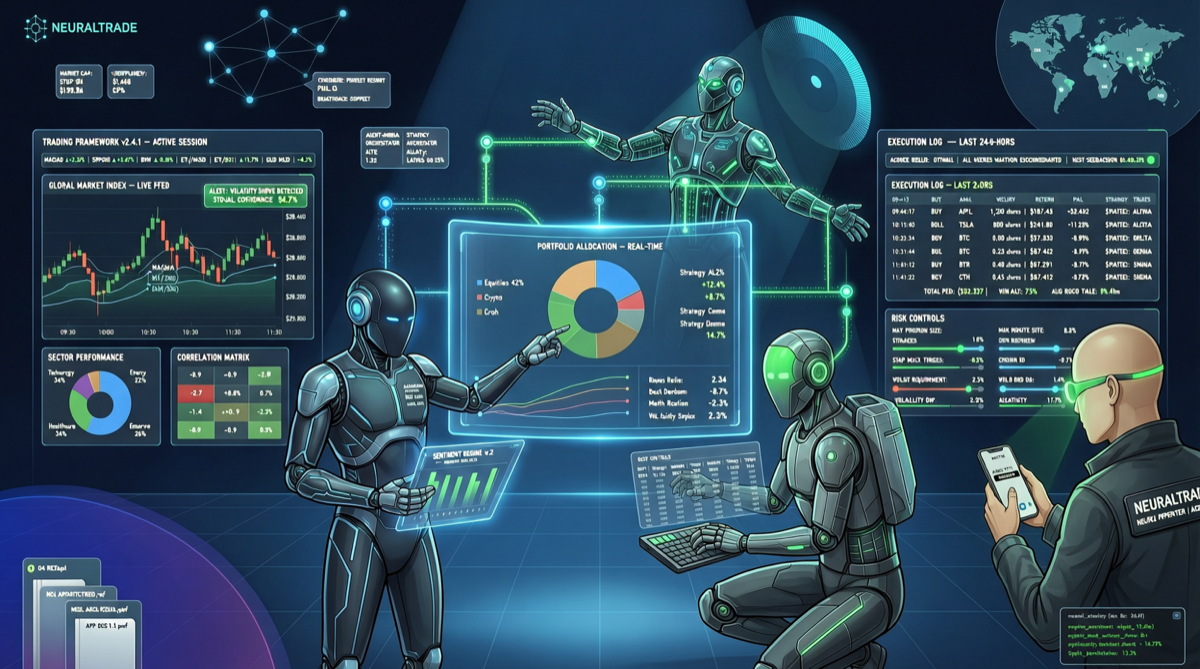
Number one on GitHub Trending, gaining 2,115 stars today, surpassing 59,000 total. TradingAgents is not just a quantitative trading tool—it is the most complete multi-agent financial trading framework available. Last week’s v0.2.4 release did something significant: it officially elevated Qwen, DeepSeek, and Zhipu GLM to first-class citizens alongside GPT, Gemini, and Claude.
What does this mean? An open-source AI trading system that mirrors the operations of a Wall Street research team can now be powered by Chinese domestic models.
Architecture: Encoding an Investment Research Team into Code
TradingAgents’ core design philosophy is straightforward: real trading decisions are not made by one person—they are the result of team collaboration.
The framework decomposes trading decisions into four specialized teams:
Analyst Team:
- Fundamentals Analyst: Evaluates financial statements, assesses intrinsic value, and identifies risk signals
- Sentiment Analyst: Scrapes social media sentiment and uses quantitative scoring to gauge short-term market mood
- News Analyst: Monitors macro events and global news, interpreting their transmission paths to markets
- Technical Analyst: Identifies trading signals based on technical indicators like MACD and RSI
Researcher Team: Composed of bull and bear researchers who structurally debate the analysts’ conclusions. This is not decorative—the number of debate rounds is configurable, forcing the model to examine every judgment from both sides.
Trader Agent: Synthesizes all reports to decide timing and position sizing.
Risk Management + Portfolio Manager: Evaluates market volatility, liquidity, and other risk factors. The Portfolio Manager holds final approval authority—trade proposals must pass review before entering the simulated exchange for execution.
Key Changes in v0.2.4
This update is not just about adding a few API key options. Here are the substantive changes:
1. Domestic Models as First-Class Citizens
DEEPSEEK_API_KEY=...        # DeepSeek
DASHSCOPE_API_KEY=...       # Qwen (Alibaba DashScope)
ZHIPU_API_KEY=...           # GLM (Zhipu)
The llm_provider config option directly includes qwen, deepseek, and glm. It also supports routing via OpenRouter, local deployment with Ollama, and enterprise-grade Azure/AWS deployment. This is not token-level compatibility—it is architecture-level multi-provider support.
2. Persistent Decision Memory
TradingAgents maintains a decision log at ~/.tradingagents/memory/trading_memory.md. After each run, the system:
- Calculates actual returns and alpha relative to SPY
- Generates a reflection summary
- Injects historical decision experience into the Portfolio Manager’s prompt for the next run
This means the system remembers its own mistakes. Past judgments for the same ticker are passed in as context, and cross-ticker lessons are also referenced.
3. LangGraph Checkpoint Resume
Enabled via the --checkpoint flag. LangGraph saves state after each node execution, allowing crashed or interrupted runs to resume from the last successful step rather than starting over.
4. Structured Output Agents
v0.2.4 upgraded Research Manager, Trader, and Portfolio Manager to structured-output agents, ensuring consistency in output format—critical for downstream decision reliability.
Quick Start
git clone https://github.com/TauricResearch/TradingAgents.git
cd TradingAgents
conda create -n tradingagents python=3.13
conda activate tradingagents
pip install .

# Set your API Key
export DASHSCOPE_API_KEY=your-qwen-key

# Interactive CLI
tradingagents
Or one-command Docker:
cp .env.example .env  # Fill in API keys
docker compose run --rm tradingagents
Local model support:
docker compose --profile ollama run --rm tradingagents-ollamaPython Integration
from tradingagents.graph.trading_graph import TradingAgentsGraph
from tradingagents.default_config import DEFAULT_CONFIG

config = DEFAULT_CONFIG.copy()
config["llm_provider"] = "qwen"
config["deep_think_llm"] = "qwen-max"
config["quick_think_llm"] = "qwen-plus"
config["max_debate_rounds"] = 2

ta = TradingAgentsGraph(debug=True, config=config)
_, decision = ta.propagate("NVDA", "2026-05-01")
print(decision)
Signal vs. Noise
Signal: TradingAgents’ architecture is genuinely solid. Multi-role debate, persistent memory, checkpoint recovery, structured output—these are not gimmicks, they are engineering practices that tangibly improve multi-agent system reliability. Domestic model integration brings it closer to Chinese users.
Noise: The framework explicitly states it is for research purposes only and not investment advice. LLM performance in finance depends heavily on model choice, temperature, data quality, and many non-deterministic factors. While TradingAgents’ academic pedigree (arXiv paper 2412.20138, UCLA team) gives it credibility above most open-source projects, do not use it to manage real money.
Why It Matters
TradingAgents represents a trend: vertical multi-agent frameworks are moving from demos to production-grade. It is not “let an LLM pick stocks for you”—it encodes a complete investment research workflow into a configurable, extensible, and auditable agent collaboration graph.
For Chinese developers, native Qwen/DeepSeek/GLM support means running the entire pipeline with domestic models—offering practical advantages in API cost, compliance, and data sovereignty.
If you are exploring AI + finance, TradingAgents is one of the most complete reference implementations in the open-source world today.
Source: TauricResearch/TradingAgents | arXiv Paper Disclaimer: This article is for technical introduction only and does not constitute any investment advice.