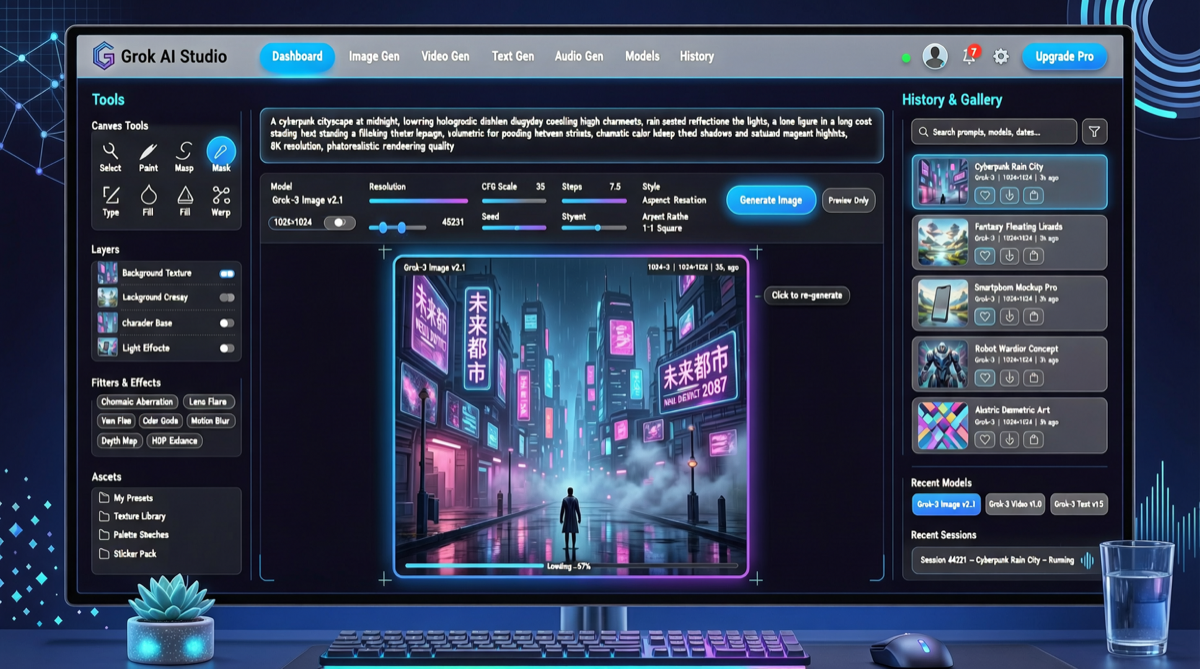
xAI announced today that Grok's image generation Quality Mode is now available on the API.
This is not a "we also built a text-to-image model" story—this model has already generated 300 million images on the Grok platform. Validating on their own product first, then opening to the public. That rollout cadence is more credible than a lot of AI company launches.
Three Improvement Areas
xAI listed three focus points:
Higher realism. No need to overexplain—every image generation model is competing here. The key is Grok's training data and methods. If it can approach Midjourney v6 level on skin, lighting, and materials, the API market has a real contender.
Stronger text rendering. This has been the persistent pain point in image generation. DALL-E 3 leads here, Midjourney v6 caught up, Stable Diffusion 3 also improved. If Grok enters the top tier on this dimension, it is real value for enterprise customers doing posters, ads, and e-commerce imagery.
Better creative control. Meaning controllability—style transfer, composition control, local editing. These capabilities matter much more for B2B customers than for consumer users.
The 300 Million Images Data Advantage
This is the most noteworthy point.
What does 300 million generated images mean? It means Grok's image model has already run enough data in real user scenarios—what styles users prefer, what prompts produce good results, which scenarios have unstable generation quality. All of that data exists.
Image generation model iteration is not purely about algorithms—it is mostly about data feedback. 300 million images of user behavior data is more useful than lab benchmark scores.
Competitive Landscape
The image generation API market currently has:
- OpenAI DALL-E 3: Integrated in ChatGPT and API, strong text rendering
- Midjourney: Best on consumer side, but limited API openness
- Stability AI SD3: Largest open-source ecosystem, but commercialization still evolving
- Google Imagen: Deeply integrated into Google ecosystem
- xAI Grok: New entrant, but backed by 300M images of Grok platform data
Grok's differentiation might be deep integration with Grok's text model. xAI has been pushing the "unified multimodal" narrative—image generation should not be a standalone module but an integrated whole with text understanding and reasoning.
My Take
The image generation space has reached "good enough" parity—gaps in realism between players are narrowing. What will decide the winner is likely ecosystem integration and pricing.
If xAI prices aggressively (given its history of competitive pricing), it could impact SME image generation tool selection. But if pricing is similar to DALL-E 3, users have no reason to migrate from mature platforms.
Pricing page is not public yet. Wait and see.
Primary sources: xAI official tweet (@xai)