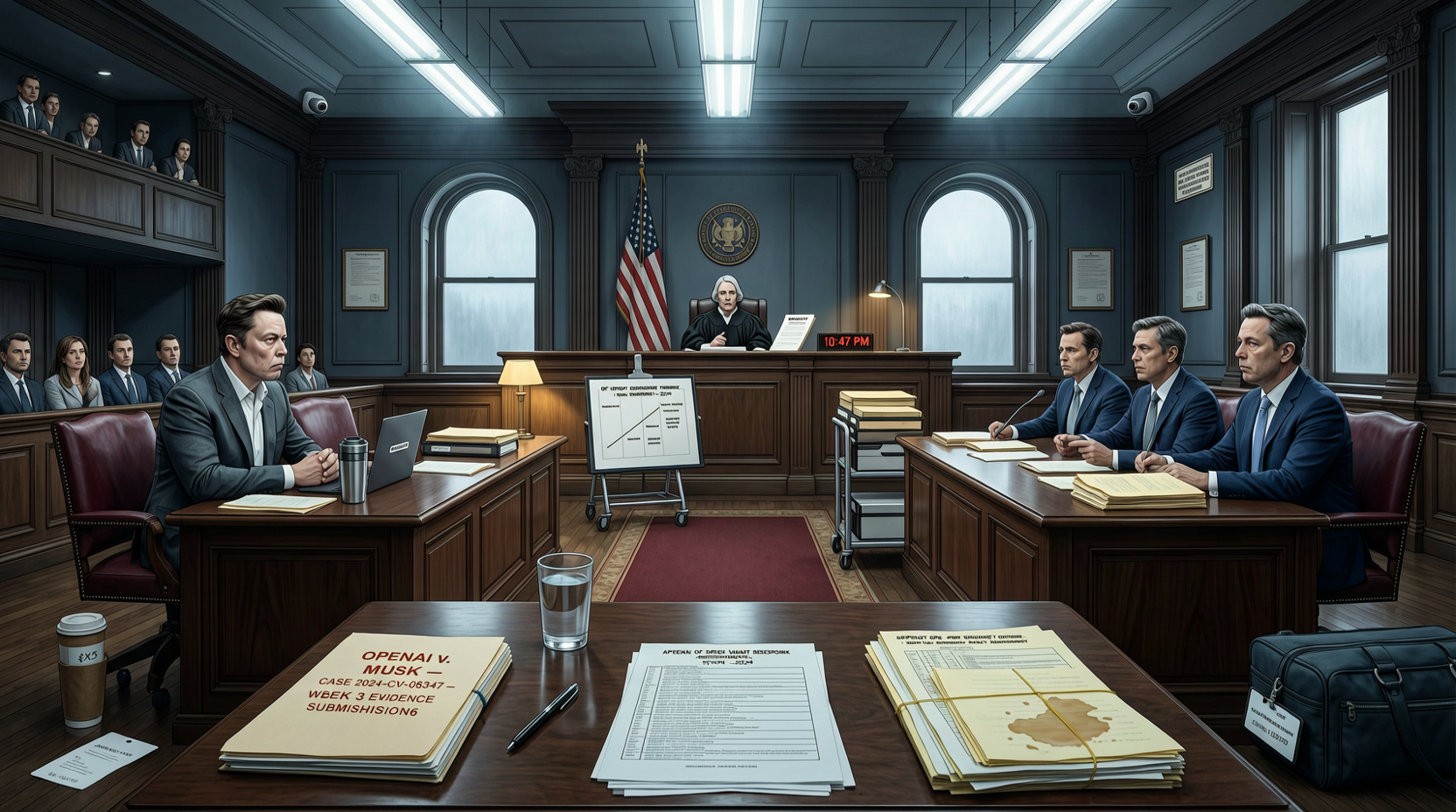
While Musk was traveling to China for business, Sam Altman took the witness stand in a California federal court.
This is a lawsuit that has dragged on far too long—Musk suing OpenAI for "betraying its founding principles," alleging it transformed from a nonprofit into a for-profit company deeply tied to Microsoft. But today's hearing was almost entirely Altman's one-way narrative.
He brought two core arguments, each attempting to overturn Musk's public narrative.
"He knew about it from the start"
One of the foundations of Musk's lawsuit is that OpenAI violated its original nonprofit commitment. But Altman testified that Musk not only knew OpenAI would move toward a for-profit structure, but supported it.
Altman described their second meeting at Tesla headquarters: they reviewed documents about OpenAI creating a for-profit entity together, with term sheets detailing what the nonprofit would contribute and receive in return. Musk, according to Altman, praised the move, saying "the lab really needed a lot of funding."
This detail matters. If Musk knew and supported this from the beginning, his moral high ground in accusing OpenAI of "betrayal" crumbles.
The more explosive part: hereditary succession
But what truly quieted the courtroom was something else.
Altman testified that OpenAI's early leadership discussed a governance question: what happens if the person controlling OpenAI dies?
According to him, Musk's answer was: pass control to his children.
Altman said he was "deeply opposed" to this idea at the time.
This statement's power lies in transforming an abstract "corporate governance dispute" into a concrete story anyone can understand. Musk has long positioned himself publicly as a guardian "preventing AI from being controlled by a few," but Altman's description flips this role—it wasn't OpenAI that wanted to monopolize, it was Musk, even for his descendants.
OpenAI's lawyers put it even more bluntly: Musk filed the lawsuit primarily out of jealousy over OpenAI's success after leaving, and his failure to gain control.
Why OpenAI wasn't merged into Tesla
Altman also explained an early key divergence: Musk wanted to merge OpenAI into Tesla.
Altman strongly opposed this. His reasoning was simple: Tesla is a car company with its own commercial goals, while OpenAI carried a different mission—long-term research and future infrastructure. Putting them together, OpenAI's direction would likely be distorted by commercial objectives.
Looking back, this judgment was hard to argue with.
The essence of this lawsuit
This case has gone on so long that both sides are really fighting over narrative control, not legal provisions.
Whoever convinces the public "this is how the OpenAI story began" takes the moral high ground. Musk's version: "nonprofit ideals corrupted by commercial interests." Altman's version today: "the one who wanted exclusive control from the start was the other guy."
Neither narrative is entirely accurate. The reality is probably more boring—a nonprofit organization, after receiving massive investment, inevitably needed a commercial structure to承载 it. But courts aren't academia; courts need stories that convince ordinary people.
"Hereditary succession of AGI control" is a story with a lot of杀伤力.
Primary sources: