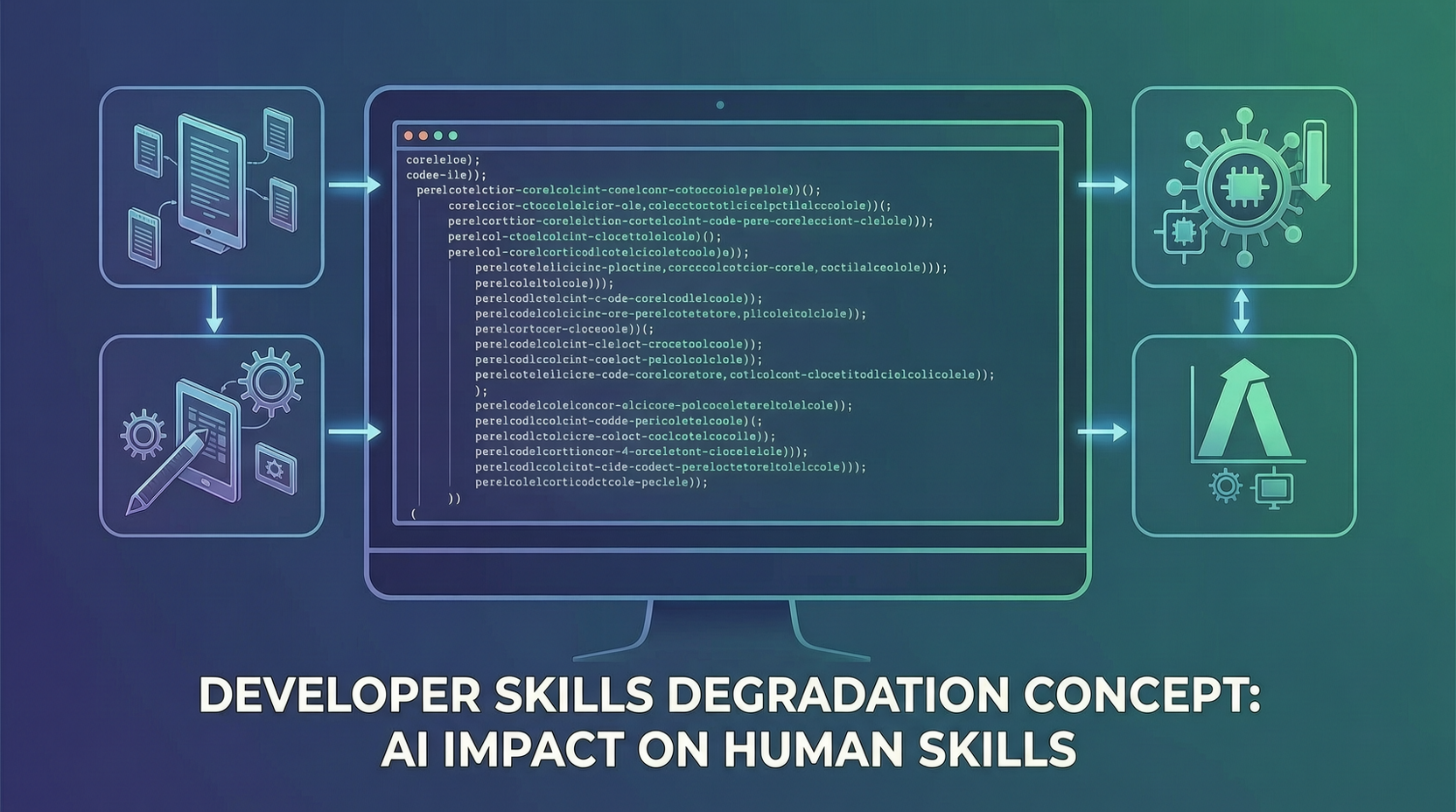
I've been coding with Claude Code for nearly a year. Over 90% of my daily coding tasks go through it.
But recently I noticed something off: I'm starting to lose my debugging skills.
Not completely. But the ability to walk into an unfamiliar codebase without AI and figure out what's wrong—it used to take me 20 minutes. Now it might take 40, or longer.
This isn't just me.
What the Agent-Skills Repo Tells Us
Agent-skills hit 40,969 stars this week. But look at the skills it lists—code review, migration scripts, changelogs. All supporting skills.
Not a single one called "independent debugging" or "architectural design from scratch" or "understanding unfamiliar code without AI."
Because those skills aren't needed for AI agents. But for humans, they're core competencies.
Degradation Doesn't Happen Overnight
Phase 1: You use AI for boilerplate. Saves time, reasonable.
Phase 2: You use AI for business logic. Still fine—you review the output.
Phase 3: You let AI handle an entire feature. You only read the diff.
Phase 4: You no longer debug manually. Paste the error into AI, wait for the fix.
I'm somewhere between phases 3 and 4.
The problem: developers at phases 3 and 4 will see a cliff drop in capability when AI is unavailable.
I Am Not Saying "Don't Use AI Coding"
Quite the opposite. AI coding tools are the biggest efficiency gain for developers—period.
But I think we need a new habit: after every AI-completed task, spend 5 minutes reading the code it wrote. Understand what it does and why.
Those 5 minutes aren't wasted. They're your insurance for "surviving without AI."
The Company-Level Risk
Individual skill degradation is a personal problem. But if a team has 80% AI-generated code and only 20% of people understand it—that's a systemic risk.
Turnover, AI service outage, model regression—any event could leave a team in "we don't know what our own code does" territory.
This is already happening in some AI-native startups. They hire based on "can you prompt AI well" rather than algorithm skills. Short-term efficiency is high, but technical debt has changed form—from "bad code" to "nobody truly understands the code."
My Advice
- Complete at least one task per week manually—no AI, pure hand-coding. Keep your touch.
- Read AI-generated code as seriously as a colleague's code—don't trust, verify.
- Maintain an "AI-free" coding environment—local, offline, for emergency testing.
- Code review standards must not drop because of AI—in fact, they need to be stricter, because generation speed means errors come faster too.
This isn't anti-AI. It's "use AI but stay清醒" pragmatism.
Sources:
- Personal practice records using Claude Code and Cursor
- GitHub Trending observations