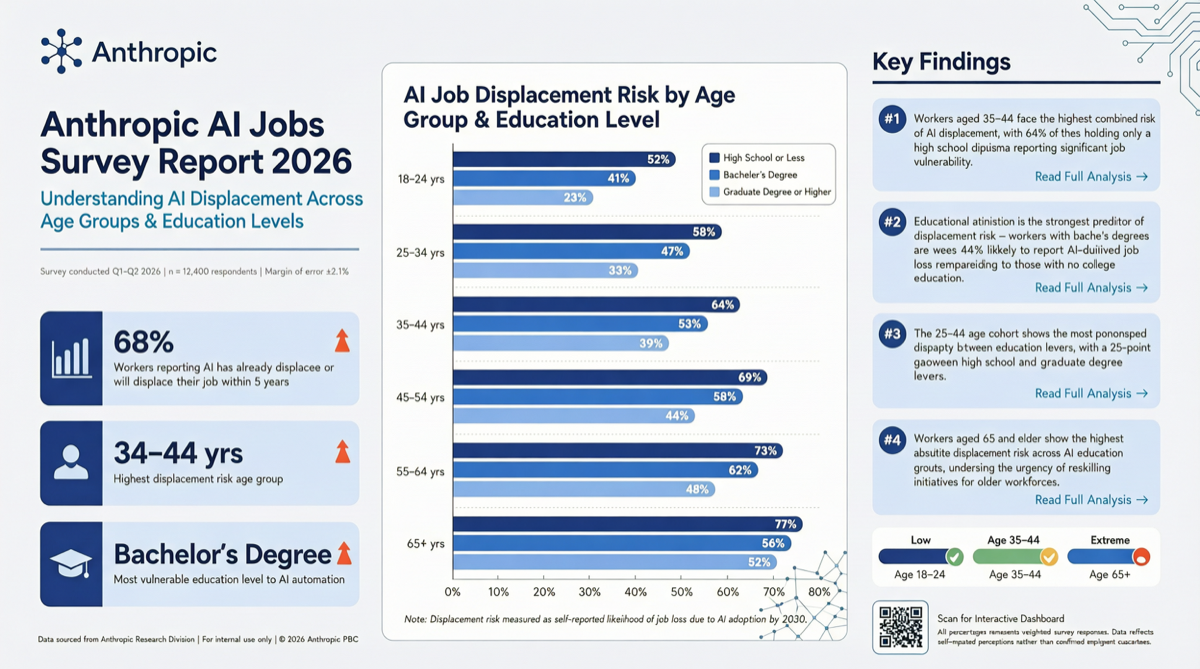
Anthropic has published a research report titled “What 81,000 people told us about the economics of AI,” revealing the real impact of AI on the job market based on a large-scale sample of 81,000 people. The report’s core findings deviate significantly from common public perception: AI is replacing not low-paying jobs, but high-paid white-collar workers.
Who Is Most Vulnerable
The most noteworthy finding is that the worker groups most at risk of AI displacement share these characteristics:
- Older: Older workers face higher displacement risk
- More educated: Those with bachelor’s degrees and above are more affected
- Higher paid: Affected groups earn approximately 47% more than the overall average
- Heavier AI users: Those who use AI tools most frequently are also the most fearful of job loss
This contrasts with the common narrative that “AI replaces low-end labor first.” In reality, AI is eroding traditional white-collar knowledge work—data analysis, document processing, basic programming, content generation, and similar roles.
How AI Is Actually Impacting Jobs
Another key finding is that AI’s impact on the job market currently manifests primarily as slowing hiring, rather than mass layoffs:
Companies are using AI to boost the productivity of existing employees, thereby reducing the need for new hires. This means:
- Current employees are relatively safe in the short term, as companies prefer to use AI to augment existing teams
- New entrants (especially fresh graduates) face a more competitive environment
- In the long term, as AI capabilities advance further, existing positions may also face structural adjustment
The Optimism-Pessimism Divide
The report also reveals a divide in attitudes toward AI:
- Most optimistic: Tech workers, younger workers, those who have deeply integrated AI into their workflows
- Most pessimistic: Older workers, traditional industry employees, those feeling direct competitive pressure from AI
This divergence shows that AI’s impact on the job market is not a uniform “flood,” but rather a “tide” affecting different roles and demographics differently—some places are seeing water rise, others are receding.
Actionable Takeaways
For AI practitioners and professionals:
- Don’t wait: AI capability iteration far outpaces labor market adaptation. Integrating AI into your workflow early is the best strategy to reduce displacement risk.
- Focus on irreplaceable skills: Creative thinking, complex decision-making, interpersonal collaboration, and deep domain knowledge—these remain difficult for AI to replicate.
- Transition to “AI operator” roles: The future core competency isn’t “knowing how to use AI,” but “designing how AI interacts with real workflows.”