Core Facts
Anthropic’s team publicly shared its internal Agent workflow practices in late April. Key data:
- 90% of code written by Claude Agents
- 1 hour to complete work that previously took days
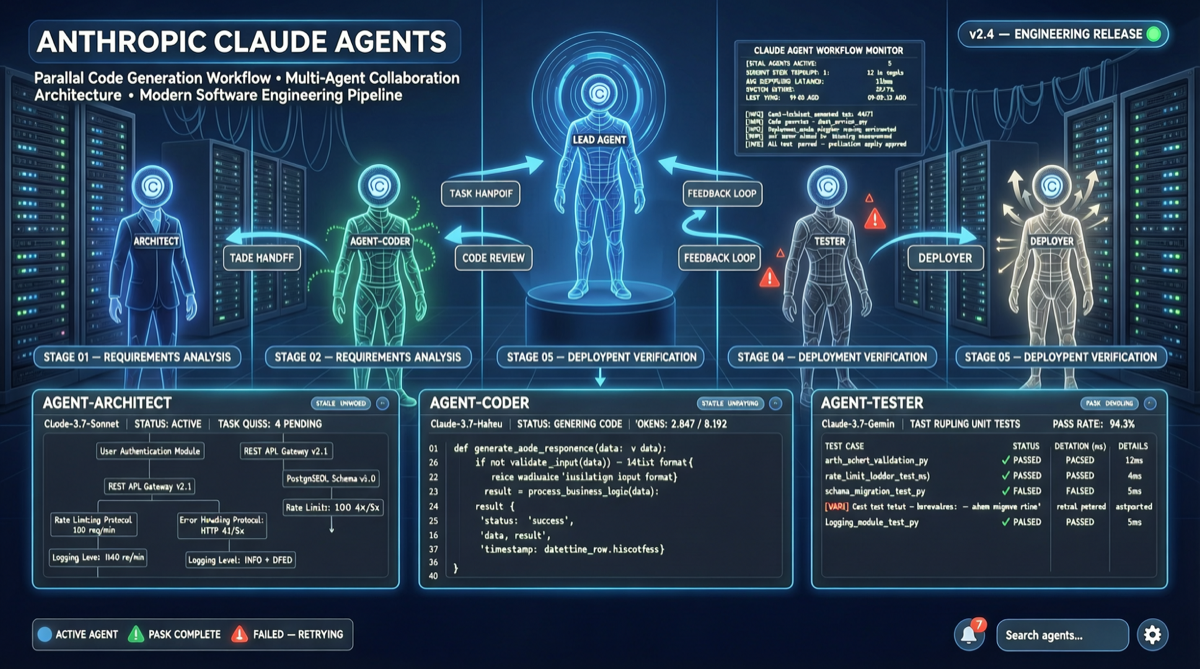
- One Agent delegates, multiple Agents execute in parallel
- Completely replaced the previous internal workflow system
This comes from the team that directly built Claude Code — they’re not describing theory, but demonstrating production practice already live.
Workflow Architecture
From Legacy System to Agent Workflow
Anthropic’s previous internal workflow relied on traditional task assignment and human coordination. The new Agent workflow adopts a completely different paradigm:
┌─────────────────────────────┐
│    Coordinator Agent         │
│    (Task breakdown + dispatch)│
└──────────┬──────────────────┘
           │
    ┌──────┼──────┬──────────┐
    ▼      ▼      ▼          ▼
  Agent  Agent  Agent     Agent
   #1     #2     #3        #4
  (Code)  (Test) (Docs)   (Review)
    │      │      │          │
    └──────┴──────┴──────────┘
           │
    ┌──────▼──────┐
    │  Merge +    │
    │  Deploy      │
    └─────────────┘
Key Design Principles
- Agent Delegation: Not one big Agent doing everything — a coordinator Agent breaks down tasks and assigns to specialized sub-Agents
- Parallel Execution: Multiple Agents work simultaneously, dramatically shortening delivery cycles
- Persistent Sessions: Memory and files persist — Agents aren’t stateless; they remember prior work context
Industry Comparison
| Dimension | Anthropic Internal | Claude Code (Public) | OpenClaw | Hermes Agent |
|---|---|---|---|---|
| Code auto-gen rate | 90% | ~60-70% | ~40-50% | ~50-60% |
| Multi-Agent parallel | Yes | Limited | No | Yes |
| Internal system integration | Deep custom | Generic | Generic | Generic |
| Availability | Internal use | Paid subscription | Open source | Open source |
Why Anthropic Achieves 90%
Key factors:
- Proprietary model access: Direct access to latest Claude models, including unreleased versions
- Deep integration: Agents deeply integrated with internal codebase, CI/CD, documentation systems
- Internal data flywheel: Each Agent execution produces training data that feeds back into model improvement
- Engineering culture: From founders to engineers, strong belief in Agent-first approach
Industry Signals
This releases several important signals:
- Agents are no longer experiments: Anthropic, a top AI company, uses Agent workflows for daily development — marking the qualitative shift from “toy” to “tool”
- Multi-Agent orchestration is the direction: Single-Agent capability ceilings are becoming visible; future competitiveness lies in effectively coordinating multiple specialized Agents
- Claude Code is just the tip of the iceberg: The public Claude Code is far less powerful than the internal version, meaning Anthropic has enormous productization headroom
Actionable Recommendations
- Team managers: Evaluate which parts of current dev workflow can be replaced by Agents. Start with code review and documentation
- Developers: Learn Agent collaboration paradigms. “Writing Agent instructions” may become more important than “writing code”
- Investors: Focus on companies providing multi-Agent orchestration infrastructure (Hermes, CrewAI, Dify)
Anthropic’s practice proves one trend: when AI Agents shift from auxiliary tools to core productivity, the paradigm of software engineering will fundamentally change.