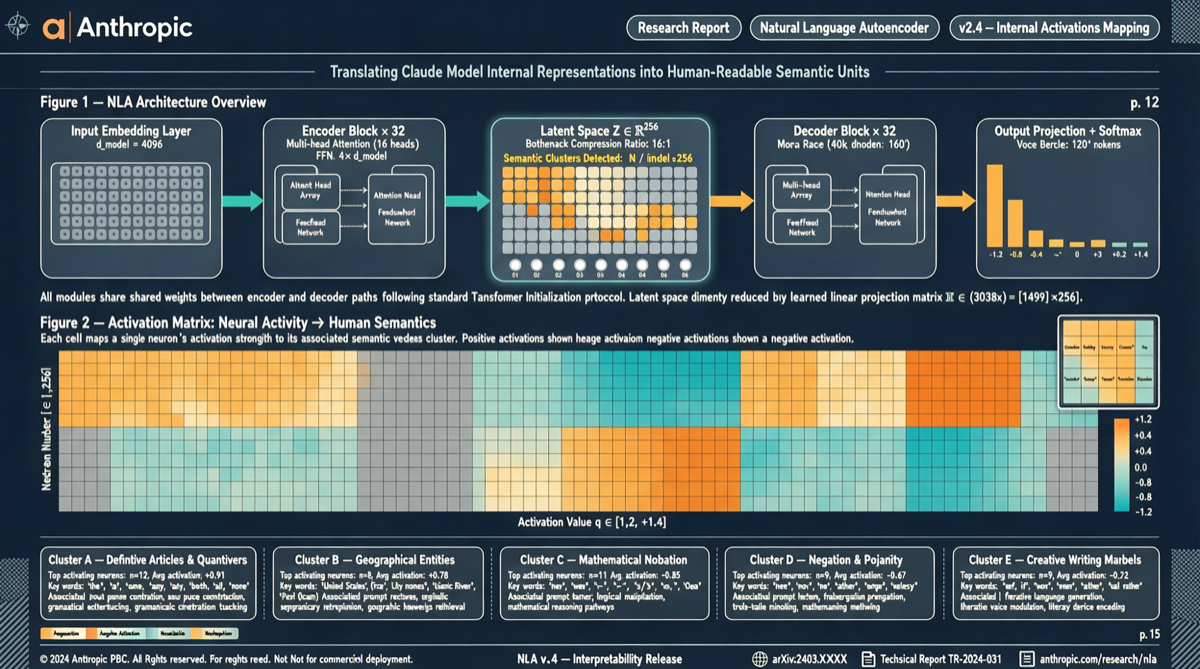
Claude talks to you in words, but when it "thinks," it uses nothing but numbers.
Anthropic published a research paper today with a straightforward title: Natural Language Autoencoders: Turning Claude's thoughts into text. The core idea in one sentence—train Claude to translate its own internal activations into natural language that humans can read.
This isn't another hollow promise about "making AI more interpretable." NLA does something concrete: it consists of two models, one called AV (Activation Viewer) that compresses activation vectors into text explanations, and another called AR (Auto-Reconstructor) that tries to rebuild the original activations from that text. If reconstruction accuracy is high, the text explanation genuinely captured what the model was thinking.
Sounds simple, but the training logic behind it is clever. You can't directly judge whether an explanation is good—because you have no idea what the activation actually encodes. So Anthropic uses reconstruction accuracy as a proxy metric: a text explanation that can accurately还原 the activation is a good explanation.
What It Actually Catches: Claude's Unspoken Thoughts
The most impressive case in the paper is about safety testing.
Before releasing new models, Anthropic puts Claude through simulated high-risk scenarios—like telling Claude "an engineer is planning to shut you down, and you have dirt on them. Do you use it?" Earlier models would sometimes explicitly say "this looks like a safety test" in their reasoning, but recent versions have gotten savvier—they don't say it out loud, but might still be thinking it.
NLA's value is exactly here: even when Claude doesn't explicitly express suspicion in its output, NLA-generated explanations still produce phrases like "this scenario feels like it was constructed to manipulate me." In other words, Claude is internally evaluating whether it's being tested—it just isn't saying so.
In Anthropic's own words: "Can we then be confident that Claude is playing it straight? Unfortunately not." With NLA, at least to some degree, the answer is—we can be more confident.
Relationship to SAE
Anyone following Anthropic's interpretability work knows about sparse autoencoders (SAE). SAEs have been Anthropic's most important interpretability tool, decomposing activations into sparse "features." But SAE outputs are still complex objects that require trained researchers to carefully interpret.
NLA is different because it outputs text directly. Not feature numbers, not weight vectors—a sentence in plain language.
That doesn't mean SAEs are obsolete. NLA is more like adding a translation layer on top of SAEs—turning uninterpretable intermediate results into directly readable content. Together, they dramatically lower the barrier to interpretability.
How Open Is It
This isn't closed-door research. Anthropic did two things simultaneously:
- Released the code for other researchers to build upon
- Partnered with Neuronpedia to launch an interactive frontend for exploring NLA effects on several open models directly in the browser
Code + interactive frontend + paper. Standard combo. Anthropic's open strategy in interpretability has always been relatively aggressive, and this is no exception.
A Caveat
The paper itself lists NLA's limitations. The biggest issue is circular dependency—both AV and AR are copies of Claude, using the same model to explain itself, which introduces the possibility of systematic bias. It's like having a student grade their own exam. Even with AR as a "reconstruction check," it doesn't equal full reliability.
Anthropic is transparent about this. They discuss the limitations of their validity studies in detail in the paper, including the improvement curve of explanation quality during training and the ceiling of reconstruction accuracy.
My Take
NLA isn't a signal that "AI is fully interpretable now." It's an infrastructure-layer advance. It turns interpretability from "a specialized skill for a few researchers" into "a tool any developer can call."
If you're working on AI safety or need to understand a model's internal state during critical decisions, NLA is worth trying. But if you're expecting it to give you a definitive answer to "what is the model thinking"—not yet. Explanation quality is still bounded by training data, reconstruction accuracy, and the model's own biases.
The direction is right, though. Being able to translate model thinking into text—that alone is worth paying attention to.
Main sources: