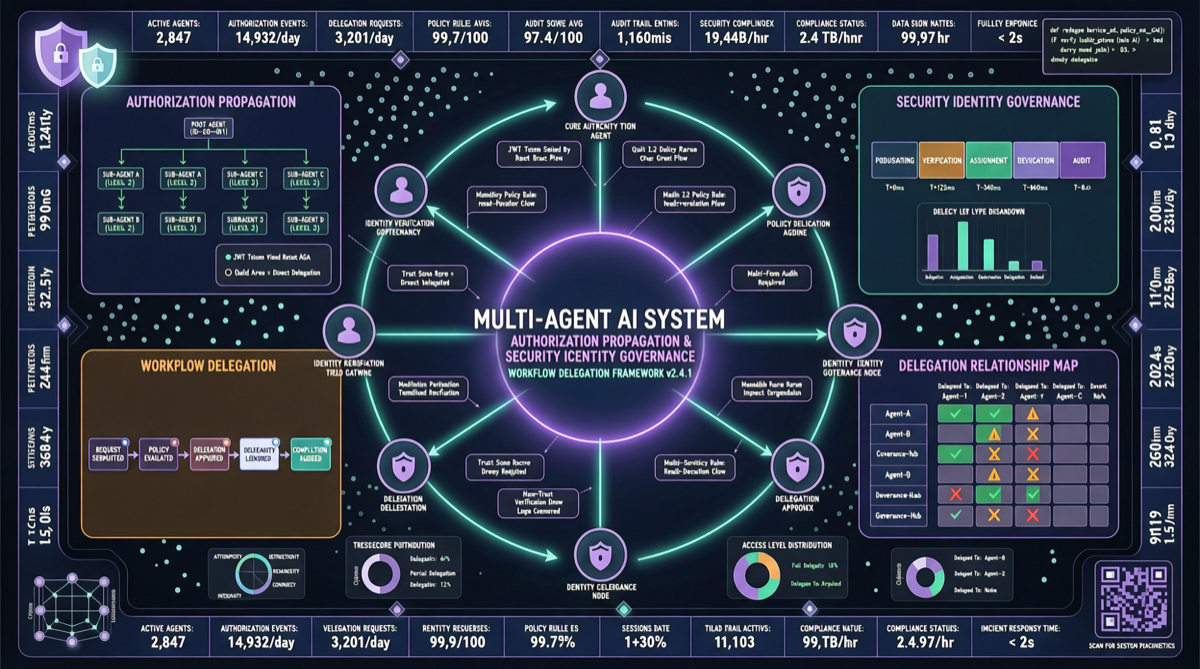
The Agent security discussion has focused heavily on prompt injection. But a paper published May 6 on arXiv (2605.05440) turns attention to a less discussed — and potentially more fundamental — problem: Authorization Propagation.
The author is Krti Tallam. The paper is 20 pages, classified under cs.AI.
What Is the Core Problem
When an AI Agent is authorized to execute a task, it may:
- Retrieve information from data sources
- Delegate subtasks to other Agents
- Synthesize results across different system boundaries
In this process, how does the original authorization change as tasks are passed and data flows?
The paper argues this is not a variant of prompt injection, nor can it be fully addressed by classical access control models like RBAC, ABAC, or ReBAC. Because classical models assume human principals, while Agent systems are defined by automatic delegation and data flows between non-human entities.
Three Sub-Problems
The paper formalizes three sub-problems:
- Transitive Delegation — Agent A delegates to Agent B, which delegates to Agent C. How should permissions attenuate or persist at each hop?
- Aggregation Inference — Each piece of data an Agent retrieves is individually authorized, but aggregating multiple pieces may yield conclusions beyond the original authorization scope.
- Temporal Validity — Authorizations are time-bound. But in long-running Agent workflows, an authorization may expire during execution, and the Agent may not know.
None of these three are systematically handled in most current Agent frameworks.
Seven Architectural Requirements
Based on these sub-problems, the paper derives seven requirements for multi-agent authorization architectures. Key ones include:
- Authorization must be re-evaluated at every interaction boundary, not just checked at system startup
- Task-scoped authorization envelopes are needed to limit permission scope in delegation chains
- Execution-count revocation — permissions auto-revoke after a certain number of Agent executions
The paper notes that preliminary evidence from a production enterprise AI platform shows that normal system behavior (not just adversarial attacks) already produces these authorization failures.
What This Means
If you're building multi-Agent systems — using LangChain, CrewAI, or custom orchestration — this paper is flagging a risk that's been overlooked: even if each Agent is individually safe, their combination can produce cascading authorization propagation effects.
The paper's contribution is formalizing the problem. In Agent security, that's usually the first step toward solving it.
Directions to watch: invocation-bound capability tokens, dependency-graph policy enforcement — these are the converging technical approaches mentioned in the paper.
Main source: