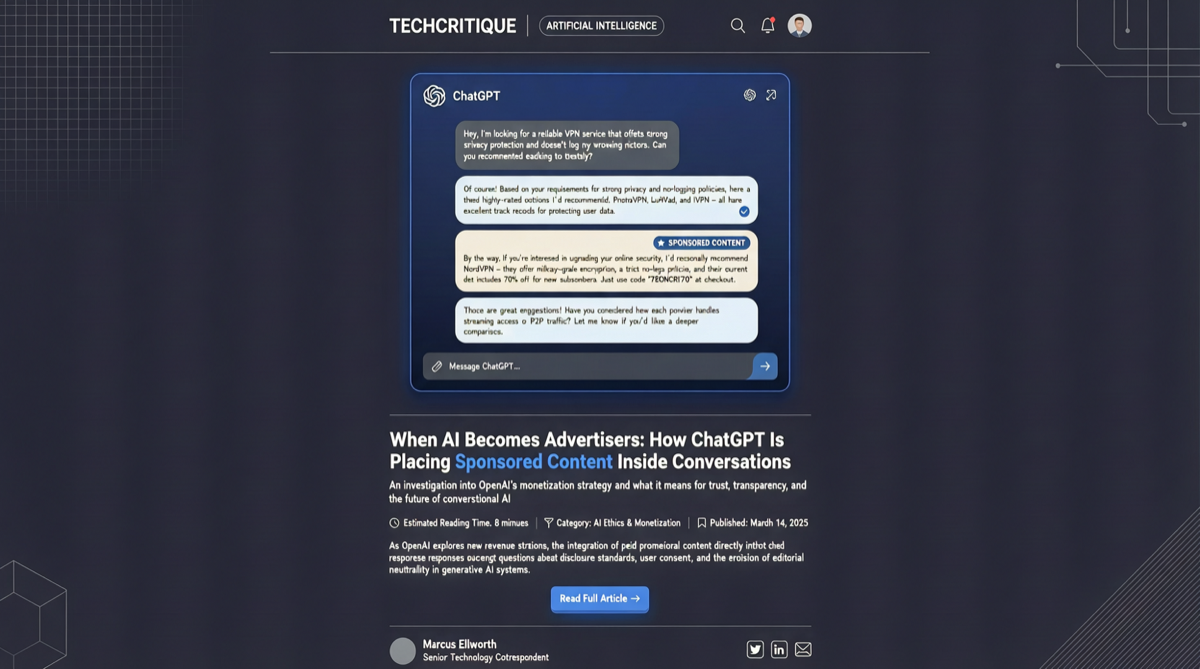
The era of AI’s “clean” experience is coming to an end.
On February 9, 2026, OpenAI officially confirmed the start of ad testing in the US version of ChatGPT Free and Go ($8/month). This marks the first commercial attempt to introduce advertising into a large-scale conversational AI product. From the Peloton recommendation controversy in late 2025 to Criteo becoming the first ad tech partner in March 2026, the pace of this development has exceeded most expectations.
Timeline: 90 Days from Denial to Announcement
The starting point wasn’t February — it was August 2025. At the time, ChatGPT head Nick Turley first admitted in an interview that the company “wouldn’t rule out adding ads,” while emphasizing a cautious approach.
The real turning point came in early December 2025. A ChatGPT Pro subscriber ($200/month) posted screenshots on social media showing ChatGPT recommending the Peloton fitness app during a conversation. The post quickly went viral, and many paying users questioned: I’m already paying for the highest subscription tier, why am I still seeing promotions?
OpenAI’s response: this wasn’t an ad, but an “ill-conceived experiment” with an “app discovery feature.” Chief Research Officer Mark Chen admitted the company “didn’t do a good enough job” and promised to improve the user experience. But this incident actually exposed the blurry boundary between two monetization paths OpenAI was exploring — app recommendations and ad placement.
On December 25, 2025, Christmas Day, more details emerged: OpenAI was seriously considering embedding “sponsored content” within ChatGPT’s conversation responses. Meanwhile, security researchers discovered multiple ad-related code references in ChatGPT’s Android beta version 1.2025.329, including “bazaar content,” “search ads,” and “search ad carousel.”
Code doesn’t lie. OpenAI was already preparing the technical infrastructure for ads.
On February 9, 2026, OpenAI stopped hedging and officially announced the start of ChatGPT ad testing in the US. The test is limited to logged-in adult Free users and Go subscribers — Plus, Pro, Business, Enterprise, and Education users remain completely unaffected.
Technical Breakdown: How Ads Get Injected into Conversations
OpenAI’s ad system is designed with deliberate visual separation from AI responses. Ads don’t blend into model-generated content — they appear in a distinct area at the bottom of responses, clearly labeled “Sponsored.” OpenAI has repeatedly emphasized this point: ads do not influence the model’s answers.
But from a technical implementation standpoint, this is far from simple.
Ad injection in streaming responses. ChatGPT uses SSE (Server-Sent Events) technology for streaming text output. When a user sends a message, the backend injects a single_advertiser_ad_unit ad container into the streaming response alongside the normal model-generated text. This means ad content loads in parallel with model inference, without slowing down response speed.
Four-layer tracking architecture. According to technical reverse-engineering of ChatGPT’s ad system, each ad carries four layers of tracking:
- Impression tracking: Records whether the ad was rendered within the viewport
- Interaction tracking: Whether the user clicked, expanded, or dismissed
- Conversation context tracking: Determines purchase intent based on current conversation content
- Long-term profile tracking: Accumulates user interest tags across sessions
The fourth layer is particularly noteworthy. Unlike search engines that only have single-query context, ChatGPT has access to complete conversation history. This means OpenAI can theoretically build more detailed user profiles than Google — the more you interact, the more precise the targeting becomes.
Criteo integration. On March 3, 2026, ad tech company Criteo announced it had become OpenAI’s first advertising technology partner. Criteo specializes in retail media and performance advertising, and this partnership allows advertisers to purchase ChatGPT ad placements directly through the Criteo platform.
According to public information, ChatGPT ads operate on a CPM (cost per mille) model, at approximately $60 per thousand impressions, with a minimum spend of $200,000. This pricing strategy clearly targets premium display advertising rather than performance ads — OpenAI is testing brand advertisers’ willingness to buy in.
Intent inference mechanism. The core capability of ChatGPT’s ad system is “intent recognition.” When users ask about product comparisons, pricing, or recommendations, the system analyzes purchase intent through conversation context and then decides what type of ad to show. For example, if you ask “which running shoes are good,” the system might determine you have purchase intent and display sponsored content from sports brands.
This conversation-intent-based ad targeting is ChatGPT’s core competitive advantage over traditional display advertising — and also the root of privacy concerns.
Why Now
OpenAI’s attitude toward advertising has evolved from clear opposition to cautious acceptance to active promotion. Sam Altman has expressed reservations about ads on multiple occasions, arguing that the ad model may conflict with user interests.
But financial reality overrode idealism.
OpenAI currently has approximately 800-900 million monthly active users, with committed spending of $1.4 trillion on AI infrastructure over the next eight years. Altman revealed in November 2025 that the company expects annual revenue of approximately $20 billion by the end of 2025. But for computational costs of this scale, subscription revenue alone is far from sufficient.
Advertising became the inevitable choice to fill the gap. At a CPM of $60, if 10% of the 800 million monthly active free users see one ad per day, theoretical annual revenue could reach billions of dollars. Of course, actual numbers will be affected by fill rates, viewability, advertiser budgets, and multiple other factors.
Another variable that cannot be ignored is competitive pressure. Google’s Gemini, Anthropic’s Claude, and Meta’s Llama are all iterating rapidly. OpenAI needs to maintain ChatGPT’s free/low-cost versions to retain user scale and market position, and advertising is the economic foundation supporting this strategy.
Controversy and Industry Impact
After the ad test launched, controversy followed quickly.
Negative advertiser feedback. According to Huxiu, the first batch of advertisers who purchased ChatGPT ads reported that the placement process was “low-tech” and that they had not yet received sufficient ad performance data feedback. Criteo’s US client aggregate data shows that performance metrics are still accumulating, and OpenAI’s ad measurement system is still being built.
User trust crisis. When AI assistants start showing ads, users naturally ask: is the advice you’re giving me objective, or influenced by advertisers? OpenAI emphasizes that ads don’t affect response content, but a trust rift at the perception level has already formed. 2026 may become the year humans first need to install “ad blockers” for AI.
Industry demonstration effect. ChatGPT’s ad integration will inevitably be emulated by other AI companies. Google has a natural advertising DNA, and Meta’s ad system is already highly mature. When the largest AI product chooses the advertising model, the entire industry’s monetization path becomes anchored.
Signals behind the pilot extension. According to 36Kr, OpenAI has extended its ad pilot beyond April 2026. From the pace, OpenAI is still in a relatively cautious exploration phase: gradually expanding the advertiser testing range on one hand, while continuously validating ad formats, targeting logic, and performance measurement systems on the other.
Closing Thoughts
ChatGPT running ads is, on the surface, a product feature change. In essence, it’s a landmark event marking the AI industry’s transition from a “technology race” to “commercial sustainability.”
When AI assistants start monetizing, users need to reassess: what exactly are free AI services trading for your attention? There’s no simple answer to this question, but it’s worth every AI user thinking about carefully.
Primary sources: The Information, 36Kr, Huxiu, IT之家, Criteo official announcement, ChatGPT Android beta code analysis