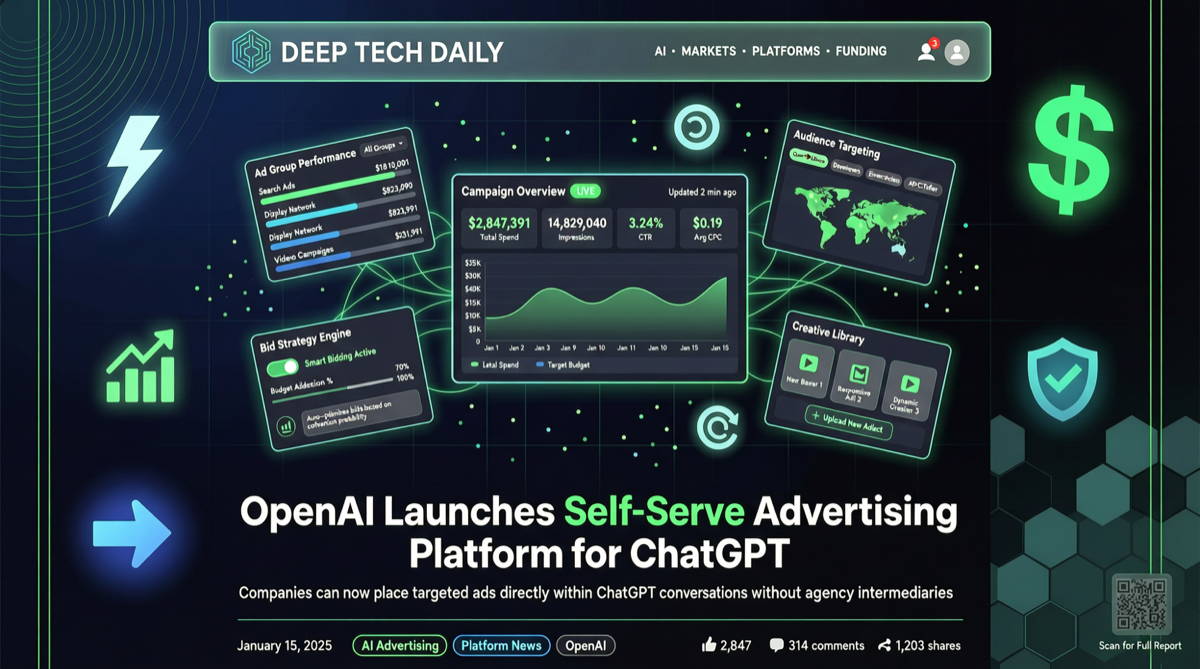
Starting today, advertising on ChatGPT is no longer an exclusive game for big-brand budgets.
On May 5, OpenAI officially launched its self-serve Ads Manager, opening a beta version to all US-based advertisers. Alongside it came CPC (cost-per-click) bidding, a Conversions API for performance tracking, and three ad-tech partnerships with Pacvue, Kargo, and StackAdapt.
This marks a critical inflection point: ChatGPT advertising is graduating from a closed pilot into a scaled commercial product.
From $250K to $50K: The Barrier Slashes
In January, OpenAI began testing ad placements within the free and Go ($8/month) tiers of ChatGPT. But it was a tightly controlled pilot: advertisers had to go through OpenAI directly or via an agency, with a minimum spend of $250,000. Most small and mid-size businesses couldn’t even get in the door.
Now, the floor has dropped to $50,000—still not cheap, but an 80% reduction.
The more significant change: agencies are no longer mandatory. Any US business can register at ads.openai.com, submit for review, fund a budget, upload creative, build campaigns, set bidding strategies, and launch with one click. The entire workflow mirrors the logic of Google Ads and Meta Ads Manager.
CPC Bidding: No Longer Just Buying Eyeballs
Until now, ChatGPT ads offered only one pricing model: CPM (cost per thousand impressions), with a default maximum bid of $60 CPM.
For comparison: Meta’s CPM typically sits below $20, and Google Search CPM ranges from $5 to $30 depending on the keyword. ChatGPT’s pricing is roughly three times Meta’s.
The newly added CPC model gives advertisers a second path:
- Suggested CPC bid: $3-$5 per click
- CPM remains available, with the same $60 default ceiling
OpenAI’s logic is clear: the value of search advertising lies in clicks, not impressions. When users ask ChatGPT “which laptop should I buy,” “which insurance plan is best,” or “how do I fix my insomnia,” they are in a high-intent purchasing context, not passively scrolling a feed. Every click carries significantly more weight than a traditional display ad impression.
Tech Infrastructure Fills In: Conversion Tracking Is Here
What’s been the biggest complaint from ChatGPT advertisers? No visibility into performance data.
Earlier reports indicated that early adopters found the platform technically immature, lacking a proper conversion attribution system. OpenAI knows this—and has now addressed it:
- Conversions API: Advertisers can send backend conversion events (purchases, sign-ups, downloads, etc.) directly back to OpenAI to optimize campaign delivery.
- Pixel-based measurement: Deploy tracking code on advertiser websites to monitor user behavior after they click through from a ChatGPT ad.
This is the foundational infrastructure for performance advertising. Without it, ChatGPT ads can only function as brand-awareness buys. With it, the platform enters the performance-ad arena.
The Ad-Tech Partner Ecosystem
OpenAI has onboarded three ad-tech partners:
| Partner | Background |
|---|---|
| Pacvue | E-commerce ad automation platform; its president and co-founder previously held an executive role at Amazon Advertising |
| Kargo | Mobile ad-tech company known for advanced targeting and privacy compliance |
| StackAdapt | Omnichannel programmatic advertising platform |
This means advertisers can now buy ChatGPT inventory through these third-party platforms, no longer confined to OpenAI’s own dashboard. It’s a hallmark of platform maturity—the same path Google Ads and Meta Ads took.
On the User Side: What Do Ads Look Like?
Ads appear at the bottom of AI responses with a “Sponsored” label, visually separated from the response content. OpenAI has repeatedly emphasized: ads do not influence model outputs. Advertisers cannot alter, reorder, or interfere with AI answers, nor can they access individual user conversations or personal data. They only receive aggregated, anonymized metrics (impressions, clicks).
Paid subscribers (Plus/Pro/Business/Enterprise) and users under 18 will not see ads. Free users who wish to opt out of ads can do so in settings, but the trade-off is reduced message limits and loss of access to image generation and Deep Research features.
In short: trade your attention for a free service.
Why OpenAI Has to Do Ads
ChatGPT now has 900 million weekly active users, but paid subscribers sit at roughly 50 million—a paid conversion rate of just 5-6%.
The harsher numbers:
- 12-month retention for Plus subscribers: 59% (nearly half of users subscribe for a while, then leave)
- Monthly churn for free users: 19% (one in five drops off every month)
Of those 900 million users, the vast majority are “search-type users”—looking things up, asking questions, doing homework, translating, chatting. They don’t need GPT-5.5’s advanced reasoning or Claude Code-level programming assistance. They just want a tool that’s useful, free, and always available.
For this cohort, a subscription model simply doesn’t work. Advertising is the only economic model that can sustain free-tier service operations.
Last September, a research paper co-published by OpenAI, Harvard, and Duke analyzed 1.1 million randomly sampled ChatGPT conversations and confirmed this split: the user base has bifurcated into “productivity users” (willing to pay) and “convenience users” (free-only), with a wide gulf between the two.
Competitive Impact: Google and Meta’s New Rival
As ChatGPT ads transition from a closed beta to an open self-serve platform, the digital advertising landscape is beginning to shift.
Benchmarked against Google Search: ChatGPT’s high-intent search scenarios—users actively asking questions and seeking recommendations—overlap significantly with the intent logic of Google search ads. The difference: ChatGPT’s conversational context provides richer intent signals than keywords alone, including full conversation history and user memory (if enabled).
Benchmarked against Meta feeds: The CPM is three times Meta’s, but if click-through conversion rates are strong enough, the actual cost-per-acquisition under CPC could prove more competitive. That depends on the performance data still to come.
Anthropic blogged in February that “Claude will never have ads,” even spending millions on a Super Bowl spot declaring “Ads are coming to AI. But not to Claude.” It’s both a values statement and a pointed counter-positioning against ChatGPT’s monetization play.
What’s Next
- US-only for now, with no public timeline for international rollout.
- Manual review required for registration; approval can take several days.
- The initial landing page features only soft testimonials from three clients—Best Buy, Lowe’s, and VistaPrint—with no concrete ROI or conversion figures. Evidence of performance is still accumulating.
OpenAI went from a February ad pilot to a self-serve platform launch in under three months. The pace is fast, but the lack of performance data remains an open question. Small and mid-size businesses will only spend $50,000 to enter if they can see a clear return on that investment—and that’s something OpenAI still needs to prove with numbers.
Primary Sources:
Related Reading: