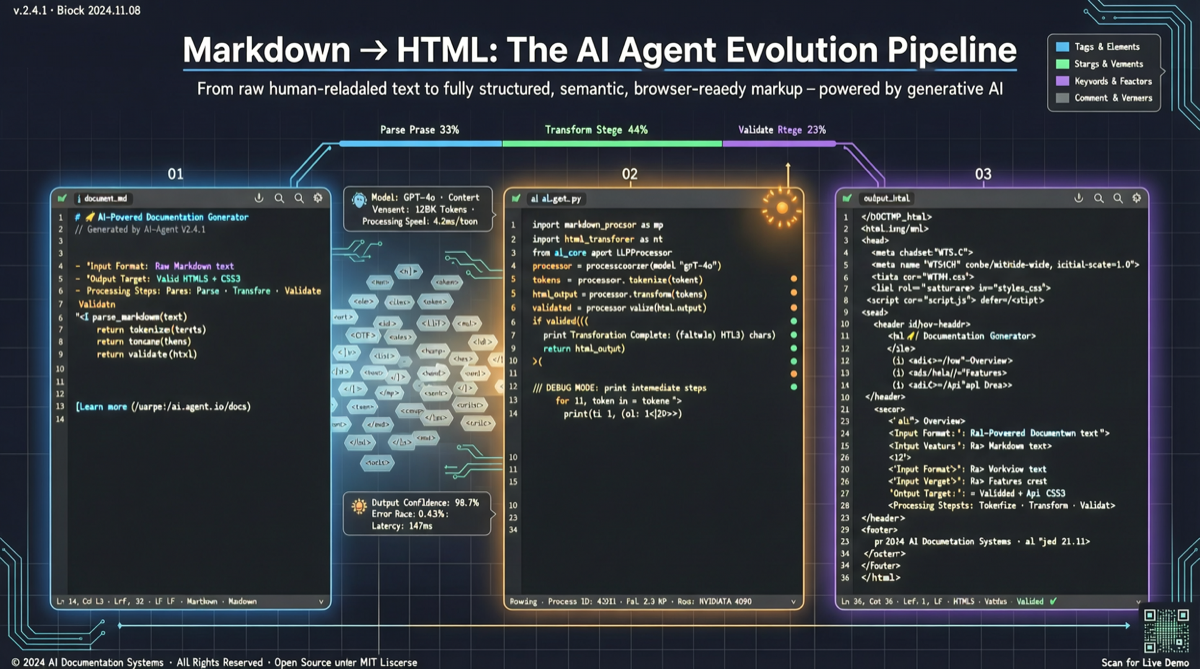
Markdown ruled AI output for the first two years. Until agents started writing reports, building dashboards, and generating documents.
Thariq, a core member of the Claude Code team, recently published an article titled The Unreasonable Effectiveness of HTML. The core argument is just one sentence: in the AI agent era, HTML might be becoming the new Markdown.
Your first reaction might be: HTML? That old thing tortured by Tailwind and React for over a decade? But the logic holds up.
Where Markdown Hits Its Limits
Markdown was designed to be "comfortable for humans to write." It solves the middle ground between plain text and rich text. But agents are not humans — they do not need "comfortable writing," they need "sufficient expression."
When an agent's output exceeds 100 lines, Markdown starts breaking. No folding, no hierarchical navigation, no interactive elements. Ask an agent to generate a competitive analysis report, and a 5000-word Markdown document reads like a log file.
More critically, agents can generate structured data. Tables, charts, collapsible sections, embedded mermaid flowcharts — Markdown's support for these is either nonexistent or relies on platform-specific extensions with terrible compatibility.
HTML has no such problem. It was designed for structured content.
HTML's Natural Advantages as Agent Output
Expressiveness. Agents can generate HTML of arbitrary complexity — from simple documents to full dashboards. Sortable tables, syntax-highlighted code, interactive charts. Whatever Markdown can do, HTML can do. Whatever HTML can do, Markdown cannot.
Rendering consistency. The browser is the ultimate rendering engine. HTML renders correctly regardless of platform or device. Markdown's rendering varies across platforms — GitHub, Notion, Obsidian each have their own flavor — and this problem amplifies with agent output.
Agents understand HTML. LLM training data is full of HTML. An agent's understanding of HTML structure is more stable than its understanding of Markdown variants. Getting an agent to generate properly nested <details> and <summary> tags is more reliable than using platform-specific extension syntax.
Not a Silver Bullet
HTML has its own problems.
First, security. If agent-generated HTML is rendered directly on a page, XSS risks cannot be ignored. You need CSP policies, sandboxed iframes, or server-side sanitization. This is not a small concern, especially when agent output gets forwarded to other users.
Second, "overkill." If you just want an agent to write a code comment or a short summary, HTML is indeed using a sledgehammer to crack a nut. Markdown remains the best choice for these simple scenarios.
Thariq's article makes this point too — he is not saying "abandon Markdown entirely," but rather "when agent output becomes complex, HTML is the better choice."
Signals of This Trend
If you follow the AI agent ecosystem, similar voices are multiplying:
- Some AI coding agents now default to HTML-formatted diff reports
- Notion's AI features already use HTML heavily under the hood instead of Markdown
- Some agent frameworks are adopting HTML as an intermediate output format, converting to target platforms afterward
This does not mean Markdown is dying. But it means the output format standard for the agent era is being reshuffled. Markdown is a format "written for humans to read," while HTML is "generated by machines, consumed by humans" — the latter is exactly what agent output is.