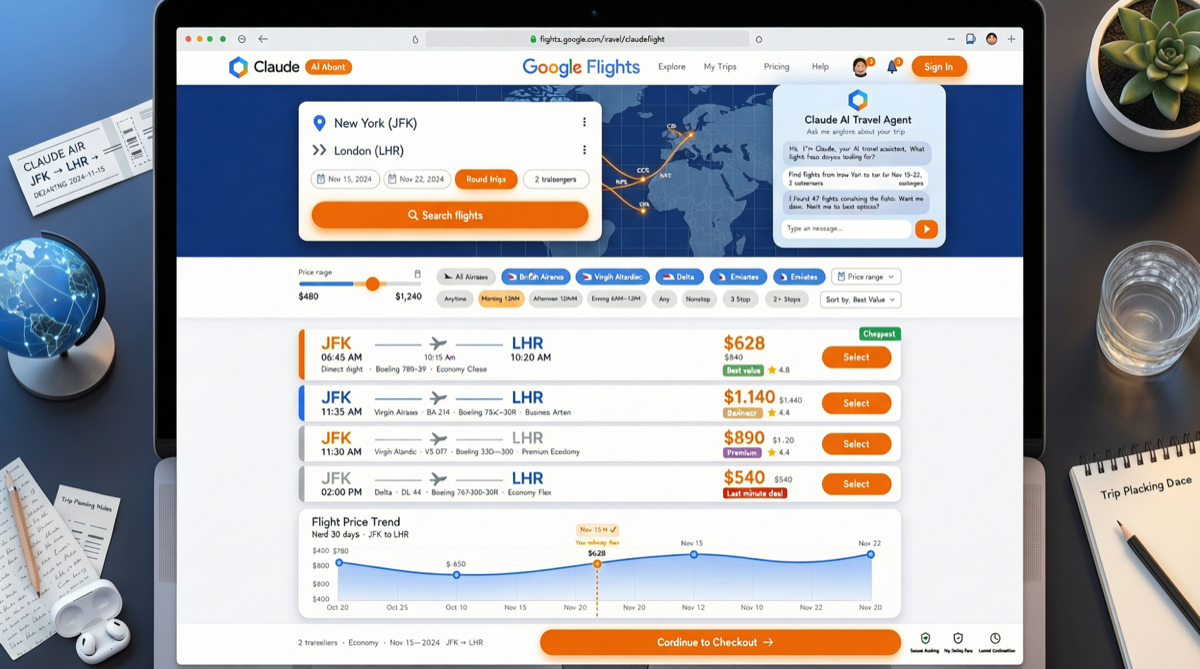
An open-source project connected Claude Opus to the Google Flights API. Not big news, but interesting.
Give it a date range, it queries Google Flights directly, returns the cheapest options. Filter by airline, compare dates. Code is open source, runs in your own environment.
Why It Matters
This is not a shell product called "AI Travel Assistant" - no web interface, no user registration, no subscription fee. It is just an MCP tool: Claude calls Google Flights through the API and brings results back to you.
Brutally simple, but effective.
The key point: Agents are starting to connect directly to real-world APIs. Not simulations, not old information from training data, but live calls. Flight prices change every minute, and the Agent gets real-time data right now.
This follows the same logic as Anthropic recently opening financial services agents - let Agents connect directly to specialized data sources, rather than having them "guess based on training knowledge."
How It Works
The core is MCP (Model Context Protocol). Google Flights data is exposed through an API, Claude as an Agent calls this tool, parses the structured data returned, and presents it to you.
No complex middle layer. No "AI analysis." Just Agent -> API -> data.
This pattern can be replicated for any service with an API: hotel price comparison, stock queries, weather forecasts, package tracking... as long as the data source has an API, the Agent can call it directly.
My Take
The value of tools like this is not in technical difficulty - connecting an API into MCP is not hard. The value is in "being the first person to do this well."
Flight search is a good entry point: high-frequency demand, price-sensitive, highly structured data. But the really interesting thing is the pattern itself. If every vertical has a corresponding MCP tool, the Agent is no longer just a chatbot - it becomes an interface that can operate in the real world.
What is next? Hotel bookings? Restaurant reservations? Medical appointment scheduling?
Main sources: X thread (related to @anthropic discussions)