If you have been building AI agents long enough, you start to notice a pattern: every platform is reinventing the wheel. Claude has its own skill format, OpenAI has its function calling spec, and every agent framework has its own communication protocol. Developers end up writing a compatibility layer for each platform.
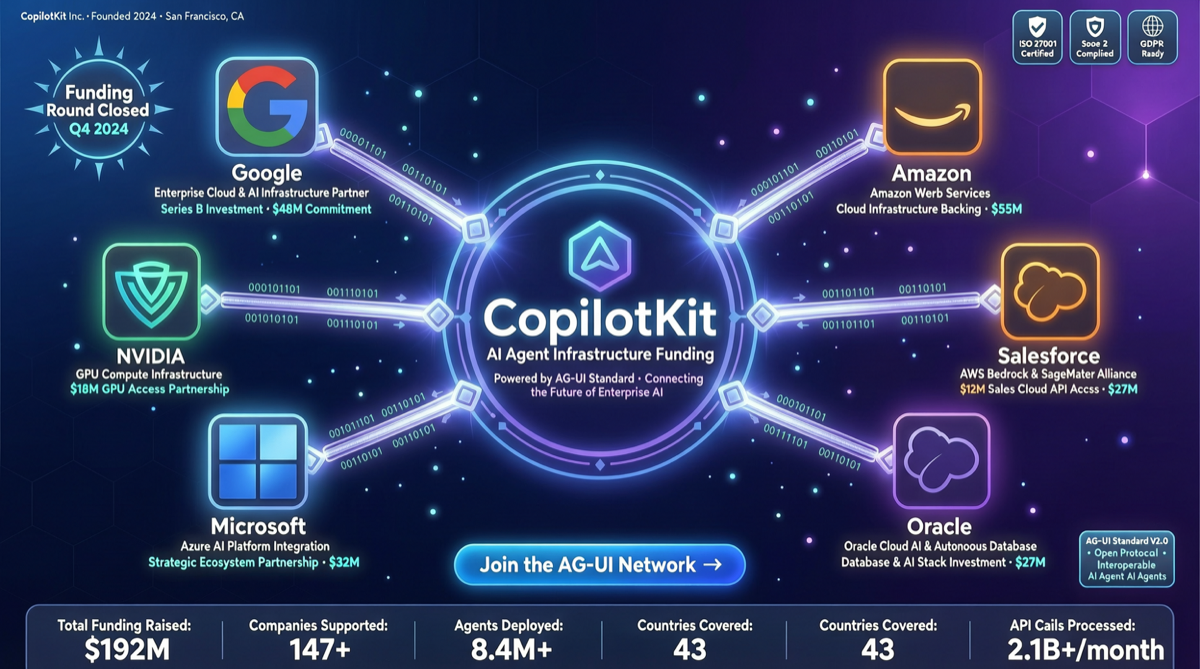
CopilotKit just raised $27 million, and its pitch is not "yet another agent framework." It is the AG-UI open standard—already adopted by Google, Microsoft, Amazon, and Oracle.
What AG-UI Solves
AG-UI (Agent-Graphical User Interface) is essentially a standardized protocol between agents and UIs.
Picture this: you built a flight-booking agent on Claude, a weather-checking agent on OpenAI, and you want to plug in your company's internal CRM agent. Each one outputs in a different format, interacts differently, and has its own permission model. How does the frontend handle all of them?
AG-UI's answer: define a standard communication protocol for what agents output to the UI. Regardless of what model the agent runs on or what platform it lives on, if it follows the AG-UI spec, the frontend can render interactions uniformly.
It is like HTTP for the web—web pages vary wildly, but browsers only need to understand HTTP to render them correctly.
Why Would Four Giants Accept a Standard from an Israeli Startup
That is the part worth digging into.
Google, Microsoft, Amazon, and Oracle each have the resources to define their own standards. Their acceptance of AG-UI signals two things:
First, agent interaction fragmentation has become a real industry pain point. Even these giants are realizing that going it alone makes the developer ecosystem more fractured, not less.
Second, CopilotKit is moving fast enough. Founded in 2024, they have not only defined the standard but built something the big four can actually integrate. The $27 million raise is not huge, but combined with existing adoption, the signal is clear.
Comparison: MCP Is the Tool Layer Standard, AG-UI Is the Interaction Layer
People will compare AG-UI to Anthropic's MCP (Model Context Protocol). They solve different problems:
- MCP solves "how does an agent call tools"—database access, file systems, APIs
- AG-UI solves "how does an agent interact with humans"—how agent output gets rendered on the frontend, how users converse with agents
They are complementary, not competing. A complete agent architecture might need both MCP (tool layer) and AG-UI (interaction layer).
What This Means for Developers
If you are building agent-facing products, AG-UI is worth watching. Three reasons:
- Four major companies have already backed it, so it is unlikely to die
- If your agent faces end users (not just running batch jobs in the backend), AG-UI saves you a ton of frontend adaptation work
- Early adoption costs are almost always lower than later migration
Of course, standards only win if the ecosystem adopts them. Four companies is a strong start, but it is not "industry standard" yet. The direction is right, though—the agent space is moving from "everyone does their own thing" toward "interoperable infrastructure."
GitHub Trending Agent Frameworks
Agent Infrastructure Convergence
MCP Protocol Industry Standard
Primary sources: CopilotKit official announcement, X/Twitter community discussion