Bottom Line First
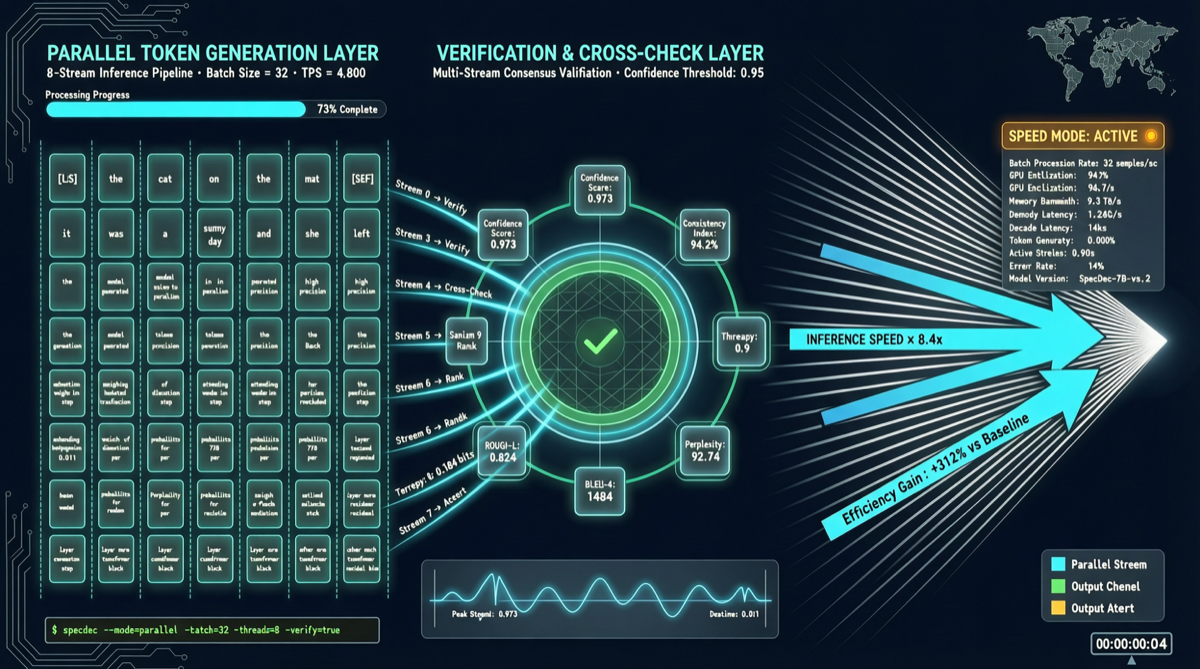
DFlash is currently the most noteworthy speculative decoding solution in the field: Block Diffusion-based multi-token parallel prediction achieves up to 6x inference speedup on mainstream models like Qwen3.5, Gemma-4, and Kimi-K2, with zero accuracy loss. For teams deploying LLMs on-premises, this is a direct solution to reduce GPU costs and improve response speed.
Technical Principles
Traditional LLM inference is autoregressive token-by-token generation—each step outputs only one token, then generates the next based on full context. This is the root cause of slow LLM inference.
DFlash's core innovation is the Block Diffusion draft model:
| Step | Traditional Method | DFlash Method |
|---|---|---|
| Draft Generation | Small draft model generates N tokens one by one | Block Diffusion generates 16 tokens in parallel in one pass |
| Target Verification | Large model verifies draft tokens one by one | Large model verifies entire block in one pass |
| Acceptance Mechanism | Stops at first mismatch | Verifies all tokens before commit |
The key difference: both draft and verification require only one forward pass instead of N sequential passes.
Benchmark Data
Qwen3.5 Performance
| GPU | Original Speed | With DFlash | Speedup |
|---|---|---|---|
| RTX 4000 Ada 20GB | ~37 tok/s | 161.85 tok/s | 4.31× |
| Consumer RTX 3090 | Not published | 400+ tok/s | Up to 6× |
Cross-Model Support
DFlash is not limited to a single model. Verified compatibility includes:
- Qwen3.5: Main model for Chinese language scenarios
- Gemma-4-26B-A4B: Google's open-source MoE model
- Kimi-K2: Moonshot AI's open-source model
- GPT OSS: OpenAI's open-source model
Comparison with Existing Solutions
| Solution | Speedup | Accuracy Loss | Use Case |
|---|---|---|---|
| EAGLE-3 | Baseline | None | General |
| DFlash | Up to 2.5× vs EAGLE-3 | None | General |
| Speculative Decoding (Traditional) | 1.5-2× | Small | Specific models |
MLX Version: Native Apple Silicon Support
DFlash-MLX is specifically optimized for Apple Silicon, achieving through MLX framework + custom Metal kernels:
- Block Diffusion draft generates 16 tokens in one pass
- Target model verifies in one pass
- Every token verified before commit, guaranteeing zero accuracy loss
- 645+ stars, active community
Why It Matters Now
Q2 2026 is the competitive focus for open-source model inference efficiency:
- Models getting larger: Qwen3.6-35B, MiniMax M2.7 (230B) and others continue to grow in parameters
- GPU cost pressure: RTX 5090 single card costs ~$2000, cluster costs even higher
- User experience demands: 400 tok/s vs 67 tok/s means interaction latency drops from 15s to 2.5s
Inference acceleration technologies like DFlash are transitioning from "optional optimization" to "essential infrastructure."
Action Items
- Teams with GPU servers: Integrate DFlash into existing deployments for 3-6× throughput improvement without additional hardware
- Apple Silicon developers: Try DFlash-MLX—running large models on MacBook will see a qualitative speed improvement
- Model selection phase: Prioritize DFlash-verified models (Qwen3.5, Gemma-4, Kimi-K2) to avoid pitfalls
- Cost-sensitive scenarios: Combine quantization (AWQ 4-bit) + DFlash—consumer GPUs can achieve near high-end card experience