Bottom Line First
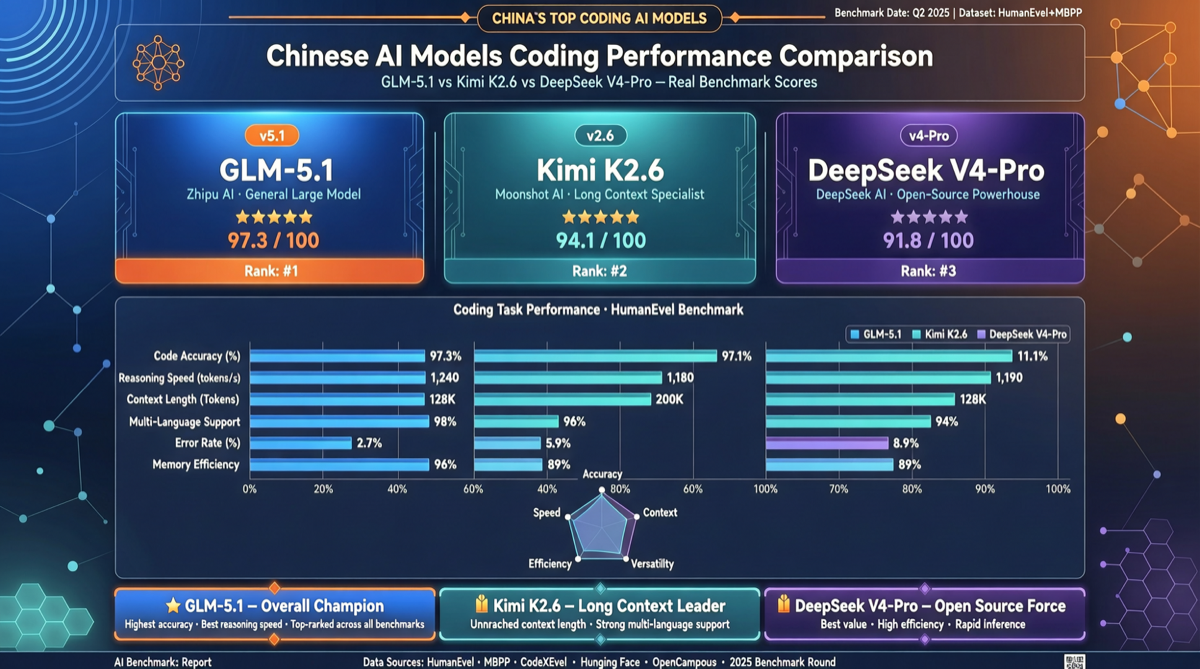
A community developer’s unofficial coding model evaluation in the TGO group produced a ranking that doesn’t fully align with benchmark results:
| Tier | Model | Positioning |
|---|---|---|
| First Tier | GLM-5.1 ≈ Kimi K2.6 | Past entry line, capable of daily development |
| Near First Tier | DeepSeek V4-Pro | Close to entry line, advantages in specific scenarios |
| Second Tier | Qwen 3.6-Max-Preview | Below entry line, but outstanding cost-effectiveness |
| Third Tier | Mimo V2.5-Pro > Qwen 3.6-Plus > HY-3 > Grok 4.20 | Usable for auxiliary coding |
The core value of this ranking: it comes from real-world daily usage experience in actual projects, not from standardized benchmark scores.
Evaluation Methodology: What is “Hands-On Feel”?
The essential difference between “hands-on evaluation” and standardized tests like SWE-bench or HumanEval:
- Benchmarks: Run on fixed datasets, testing model performance on known problems
- Hands-on feel: Subjective experience of developers interacting with models in real projects, including error recovery, context understanding depth, code style consistency, and other dimensions that are hard to quantify
The evaluator specifically distinguished the concept of the “entry tier” — can the model independently develop a medium-complexity module without the developer needing to repeatedly correct it. This is the watershed between “auxiliary tool” and “collaborator.”
First Tier: GLM-5.1 and Kimi K2.6
GLM-5.1: Strong Architecture Understanding
GLM-5.1’s standout capability in the evaluation is understanding code architecture. When handling tasks involving multiple files and inter-module dependencies, GLM-5.1 delivers structurally sound solutions rather than simply filling in individual functions.
This is directly related to the enhanced long-context capability that Zhipu built into the GLM-5 series — when the model can “see” more code, its understanding of the entire project naturally deepens.
Kimi K2.6: Outstanding Debugging Ability
Kimi K2.6 excels in debugging scenarios. When developers encounter errors and need to trace bug roots, K2.6 often outperforms other models. It not only identifies the error location but explains the cause and provides fix suggestions.
This relates to Moonshot AI’s strengthened reasoning chain capability in K2.6 — debugging is essentially a reverse reasoning process requiring the model to deduce causes from symptoms.
Near First Tier: DeepSeek V4-Pro’s Positioning
DeepSeek V4-Pro is ranked below the “entry tier,” but the evaluator noted its unique advantages in certain scenarios:
- Cost advantage: 75% API discount extended through May 31, usage cost significantly lower than first tier
- Specific task performance: In data analysis and math-related coding tasks, V4-Pro sometimes surpasses first tier
- Tool calling: DeepSeek V4 series has higher maturity in MCP tool integration
For budget-sensitive projects, V4-Pro is a “good enough and money-saving” choice.
Actionable Recommendations
Choose based on your actual needs:
| Use Case | Recommended Model | Reason |
|---|---|---|
| Daily development main driver | GLM-5.1 or Kimi K2.6 | Past entry line, can independently complete modules |
| Debugging | Kimi K2.6 | Strong reverse reasoning ability |
| Cost control | DeepSeek V4-Pro | 75% discount + sufficient performance |
| Auxiliary coding | Qwen 3.6-Plus | Low-cost “copilot” |
| Mobile integration | Mimo V2.5-Pro | Edge deployment friendly |
The value of hands-on evaluation lies not in providing absolute rankings, but in reminding us: real-world experience beyond benchmarks matters equally. When multiple models’ benchmark scores narrow within 5%, hands-on feel differences are often the deciding factor.