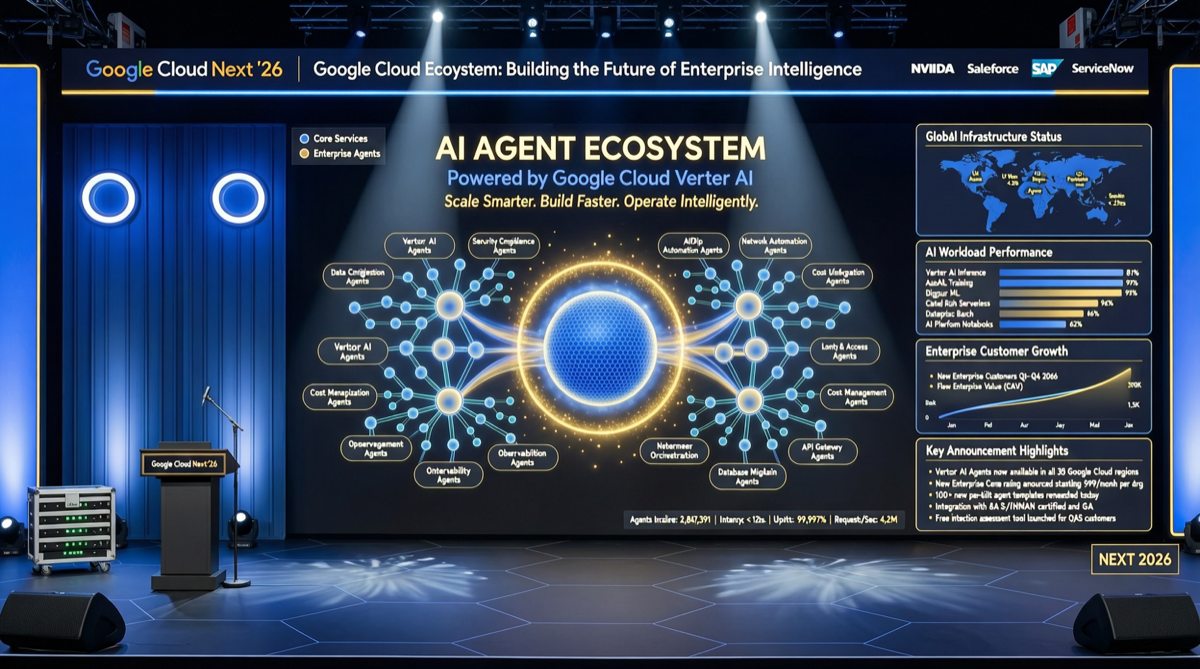
On April 22, 2026, Google Cloud Next sent a clear signal: the enterprise AI battlefield has shifted from “how to experiment” to “how to govern and scale deployments.” Google’s answer is a complete technology stack from chip to Agent platform, codenamed “Agentic Enterprise.”
Three Core Releases
8th Generation TPU: Computing Foundation Upgraded
The conference revealed progress on the 8th generation TPU chip. While full specifications remain undisclosed, financial analyst reports indicate accelerated规模化 deployment, directly supporting Gemini series model training and inference needs.
Agentic Enterprise Technology Stack
The keynote release: a platform designed to push enterprise workflows toward comprehensive agent adoption:
- Agent Software Platform: Supports rapid building, deployment, and management of hundreds to thousands of AI Agents
- Unified Supervision Framework: Humans can monitor and intervene when multiple agents collaborate
- Gemini Enterprise Agent Platform: Agent platform for enterprise scenarios
Following the $32 billion acquisition of cloud security platform Wiz in March 2026, Google launched a series of threat detection and security management agents built on Wiz capabilities.
BYO MCP Strategy
Google Cloud Next announced BYO MCP (Bring Your Own MCP). Enterprises can connect their own MCP (Model Context Protocol) servers to Google’s AI Agent platform — choosing an open route compatible with community standards rather than forcing proprietary protocols.
Strategic Intent
Google’s AI approach differs significantly from OpenAI and Anthropic. Rather than competing on “single strongest model,” Google aims to own the entire AI Agent ecosystem:
- Model layer: Gemini Pro, Flash, Deep Think, Gemma
- Tool layer: Stitch, Whisk, Imagen series
- Research layer: NotebookLM, AI Mode, Deep Research
- Video layer: Veo series
- Infrastructure: 8th Gen TPU, Cloud platform, Wiz security
When competitors debate “ChatGPT vs Claude,” Google is laying a longer value chain.