Event Overview
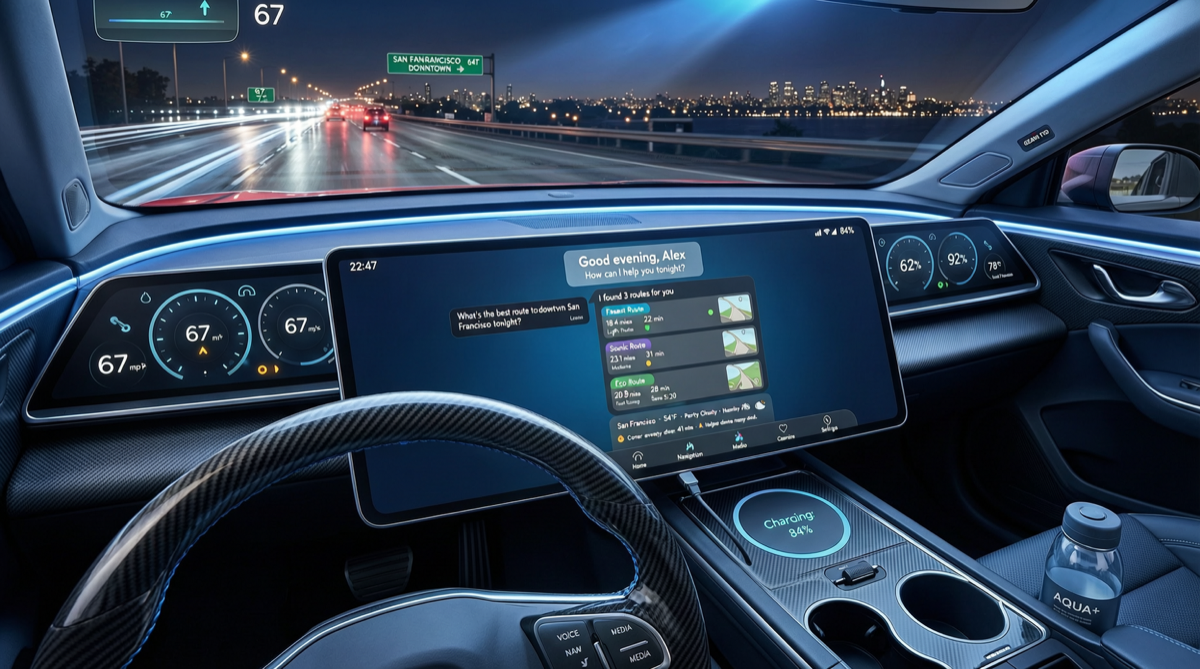
Google announced in late April that it will extend Gemini AI assistant to vehicle systems, covering millions of cars. This marks Google AI assistant’s first large-scale entry into physical driving scenarios, no longer confined to phone and web-based digital interaction.
Technical Implementation Path
From Android Auto to Gemini Native
Gemini’s vehicle deployment builds on Google’s existing automotive ecosystem foundation:
| Phase | Product | Capability |
|---|---|---|
| 1.0 | Android Auto | Basic navigation, music, calls |
| 2.0 | Google Assistant in Car | Voice commands, simple Q&A |
| 3.0 | Gemini in Car | Natural dialogue, contextual understanding, multimodal interaction |
Gemini’s Unique Capabilities In-Vehicle
- Context Awareness: Combines GPS, vehicle state, user habits to provide proactive services
- Natural Language Navigation: No more precise address input needed — use fuzzy descriptions (“find a highly-rated Sichuan restaurant, not too far”)
- Multimodal Interaction: Voice + screen + potential AR-HUD for more natural driving interaction
- Offline Capability: Some Gemini features support on-device execution, providing basic services without network
Industry Landscape
Competitor Comparison
| Company | In-Car AI Solution | Coverage | Core Advantage |
|---|---|---|---|
| Google (Gemini) | Android Auto + Gemini | Millions (Android ecosystem) | Ecosystem integration, model capability |
| Apple (CarPlay AI) | CarPlay + Siri | Hundreds of millions (iOS ecosystem) | User base, privacy protection |
| Tesla | Self-developed FSD + voice assistant | Tesla fleet | Deep integration, autonomous driving linkage |
| Baidu (Xiaodu) | Apollo + Xiaodu in-car | China market | Localization, map data |
| Huawei (HarmonyOS Cockpit) | HarmonyOS + Pangu model | China market | Car ecosystem, domestic substitution |
Google’s Strategic Intent
From Google Q1 2026 earnings:
- Google Cloud revenue grew 63%
- Gemini models drive search queries to all-time highs
- AI investments are monetizing
The strategic logic for bringing Gemini to vehicles is clear:
- New interaction entry point: Driving is a high-frequency, high-duration daily scenario — a new entry for AI assistants
- Data flywheel: Real-world interaction data from vehicle scenarios feeds back into Gemini model training
- Ecosystem lock-in extension: From phone to car, Google aims to extend Android’s moat into smart cockpits
Impact on Consumers
- Existing Android Auto users: Expected to receive Gemini features via OTA updates, no hardware replacement needed
- Car purchasing decisions: In-car AI capability may become a new consideration factor in the next 2-3 years
- Privacy concerns: In-car AI involves location, driving habits and other sensitive data
Industry Trend Judgment
Gemini entering vehicles is not an isolated event but part of the AI assistant “physicalization” trend — AI is moving from the digital world behind screens to physical world perception and interaction. In the next 12 months, we may see more AI assistants deeply integrated with physical devices (cars, appliances, wearables).
For developers, the development paradigm for in-car AI differs fundamentally from traditional mobile apps — fragmented interaction time, extreme safety requirements, frequent offline scenarios. Understanding these differences and positioning early will secure a foothold in the in-car AI ecosystem.