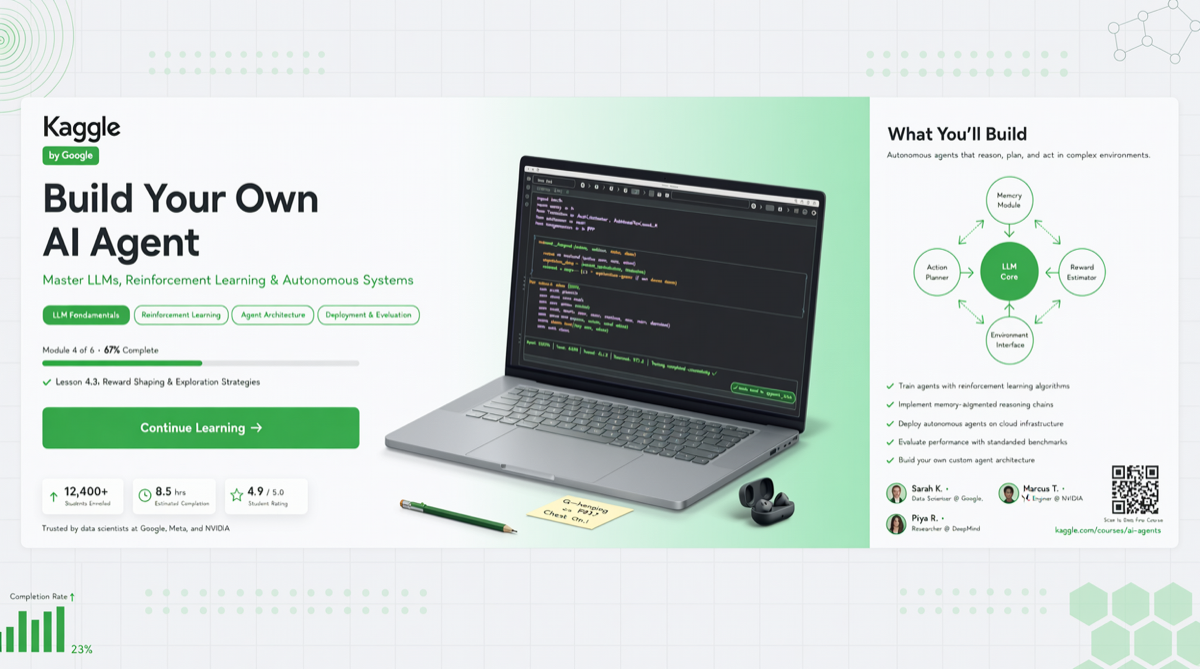
Google and Kaggle have jointly announced a free 5-day AI Agent course, scheduled for June 15-19, 2026. Built around the concept of “Vibe Coding” (using natural language as the primary programming interface), the course targets developers with some programming background who want to quickly enter agent development.
What You’ll Learn
Based on the published syllabus, the course covers:
- Building production-grade agents from scratch: Not toy demos, but agent architectures deployable to real environments
- Natural language programming: Describe requirements in natural language, let AI generate runnable code, learn how to effectively guide and constrain outputs
- Tool and API integration: How agents call external services (databases, web APIs, third-party platforms), and MCP’s role in it
- Agent debugging and evaluation: When agent behavior doesn’t meet expectations, how to pinpoint issues and establish evaluation criteria
- Deployment and operations: Moving agents from notebooks to production, handling concurrency, logging, monitoring, and costs
Who It’s For
| Background | Suitability | Recommendation |
|---|---|---|
| Python basics, no agent experience | ✅ Best fit | Join directly |
| Built LLM apps, no agent experience | ✅ Good fit | Skip basics, focus on tool integration and deployment |
| Complete beginner | ⚠️ Marginal | Supplement Python and API basics first |
| Existing agent project experience | ⚠️ Partially useful | Basics may be shallow, but deployment and evaluation sections worth attending |
Quick Preparation
To prepare for this course:
# 1. Register a Kaggle account
# https://www.kaggle.com/account/login

# 2. Install basic tools
pip install google-generativeai langchain mcp

# 3. Apply for Google AI Studio API key
# https://aistudio.google.com/apikey

# 4. Prepare a local dev environment (optional, course may use Kaggle Notebooks)
# VS Code + Python extension is sufficient

# 5. Preview MCP basics
# https://modelcontextprotocol.io/introduction
Cost and Limitations
Cost:
- Course itself is free
- Requires Google AI Studio API key (has free tier)
- Continued practice after the course may incur API charges
Limitations:
- Time window: June 15-19, intensive 5-day learning requiring 2-4 hours daily
- Technical depth: As an introductory course, it may not dive into agent framework internals or complex architecture patterns
- Platform lock-in: Course uses Google ecosystem tools (Gemini, Google Cloud); migrating to other platforms afterward requires additional learning
- Practice environment: If relying on Kaggle Notebooks, local reproduction may need adjustments
Why It Matters
Several signals worth noting:
-
Google is pushing “low-barrier” agent development. Vibe Coding’s core idea is replacing traditional coding with natural language, lowering the development threshold. Google promoting this through Kaggle’s education channel signals they see this as a key path to agent adoption.
-
Kaggle’s educational positioning is upgrading. From Kaggle competitions (data science) to agent courses (AI application development), the platform is expanding its audience.
-
Free courses from major tech companies often exceed paid alternatives. Big tech free courses typically have dedicated teaching teams and real-world case support, unlike some paid courses that are merely documentation translations.
Next Steps After the Course
Recommended follow-ups:
- Complete a personal project using methods learned in the course
- Follow MCP ecosystem developments, learn more tool integration approaches
- Compare agent development tools like Claude Code and Cursor to find your ideal workflow
Primary sources:
- Kaggle official course page: https://www.kaggle.com
- Google AI Studio: https://aistudio.google.com