Bottom Line
Hermes Agent v0.12.0 simultaneously releases two major features: Kanban multi-agent collaboration and a desktop application. These updates mark Hermes’s transition from a “solo AI assistant” to a “team collaboration AI workspace.”
Community response has been intense — the announcement tweet achieved 783,253 views, 4,405 likes, and 3,197 bookmarks within 24 hours, making it one of the most widely shared product updates in the AI Agent space recently.
Kanban: A New Paradigm for Multi-Agent Collaboration
How It Works
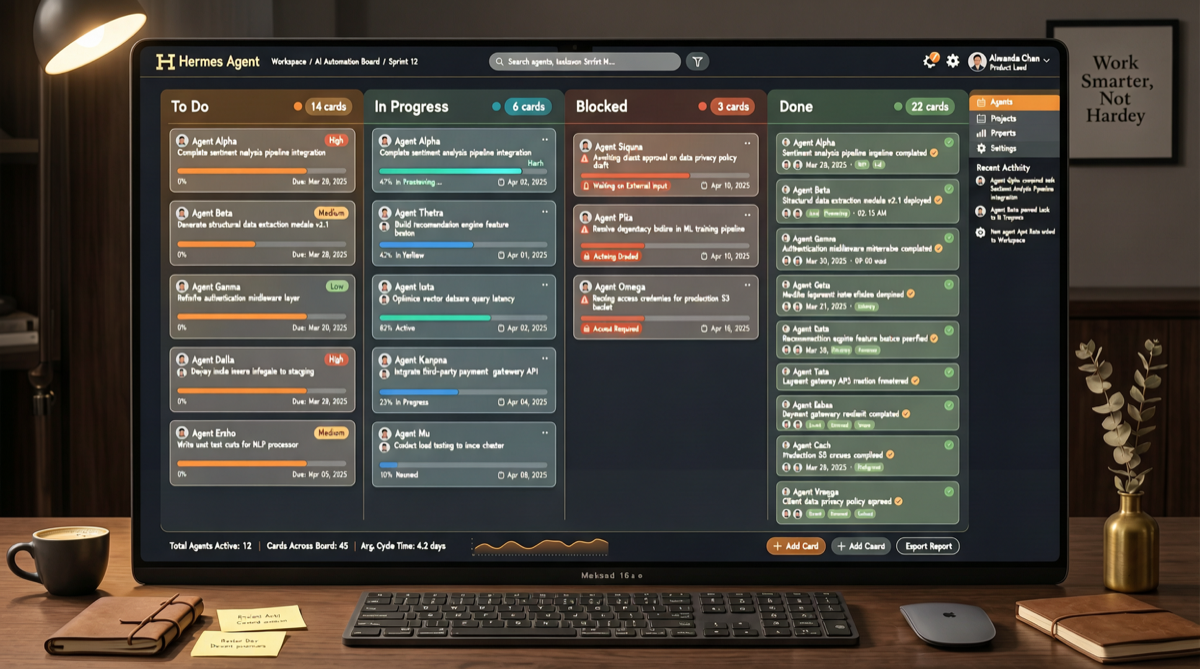
The Kanban task board changes how Agents execute work:
| Traditional Mode | Kanban Mode |
|---|---|
| Single Agent executes tasks sequentially | Multiple Agents “claim” tasks from the board |
| Requires manual splitting and scheduling by user | Agents self-claim and execute in parallel |
| User intervention needed when blocked | Agents mark themselves as blocked, wait for unlock |
| Progress scattered across terminal outputs | Unified board view, at a glance |
Real-World Scenario
Take a video production project as an example:
- Research Agent claims the “gather materials” task, searching and organizing in parallel
- Script Agent claims the “write copy” task, taking over after research completes
- Editing Agent claims the “video editing” task, automatically calling tools to finish
You no longer need to open multiple terminal windows watching individual progress — a single board view shows all Agent statuses: To Do, In Progress, Blocked, Done.
Comparison with Other Multi-Agent Solutions
| Solution | Collaboration Method | Visualization | Learning Curve |
|---|---|---|---|
| Hermes Kanban | Task claiming + board view | ✅ Built-in | Low |
| LangGraph | Graph structure definition | ❌ Self-built | High |
| CrewAI | Role assignment + sequential execution | ❌ Terminal logs | Medium |
| AutoGen | Conversational coordination | ❌ Dialogue flow | High |
Hermes Kanban’s core advantage is zero configuration — no need to define complex graph structures or role relationships. Just put tasks on the board, and the Agents will claim and execute them on their own.
Desktop App: From Terminal to Workspace
The desktop app addresses another pain point: the complexity of managing multiple Agents, models, and platforms.
Core features:
- Multi-Agent Management: Create, switch, and monitor multiple Agent instances in one interface
- Model Provider Switching: One-click switching between OpenRouter, OpenAI, Anthropic, and others
- Cross-Platform Session Sync: Session state interoperability between Telegram, Discord, and web interfaces
- Tool Integration: Directly connect Telegram Bots, Discord Bots, and other communication channels from the desktop app
For users running multiple Agents for different tasks simultaneously (one doing research, one writing code, one managing social media), the desktop app is equivalent to consolidating Agents scattered across terminals, browsers, and chat tools into a unified workspace.
Community Ecosystem Accelerating
Alongside v0.12.0, a batch of new projects centered around Hermes has emerged in the community:
- Local Voice UI: Integrates Hermes Gateway + OpenRouter TTS, enabling browser voice input and a sci-fi style assistant interface
- Open Web UI Integration: Gives Hermes persistent memory through Open Web UI — conversations no longer start from scratch
- Marketing Engineer Workflows: Community members have shared playbooks for using Hermes for marketing and growth work
Should You Try It Now?
Scenarios suited for Hermes Kanban:
- Team projects requiring simultaneous execution of multiple independent tasks
- Wanting to visualize Agent progress rather than staring at terminal output
- Tasks with dependencies (B can only start after A completes)
Scenarios suited for the Desktop App:
- Managing multiple Agent instances simultaneously
- Needing seamless switching between different platforms (Telegram, Discord, Web)
- Frequently switching between different model providers
Not suitable for:
- Only needing a single Agent for simple Q&A
- Preferring local deployment and terminal operations
- Teams already have mature multi-agent orchestration frameworks (e.g., LangGraph)
The release pace of Hermes v0.12.0 is worth noting — this major update came just weeks after Hermes Agent topped the GitHub trending list. Combined with Nous Research’s dual-track advancement in model training (Hermes open-source model series) and Agent frameworks, the development speed of this ecosystem deserves continued attention.