Conclusion
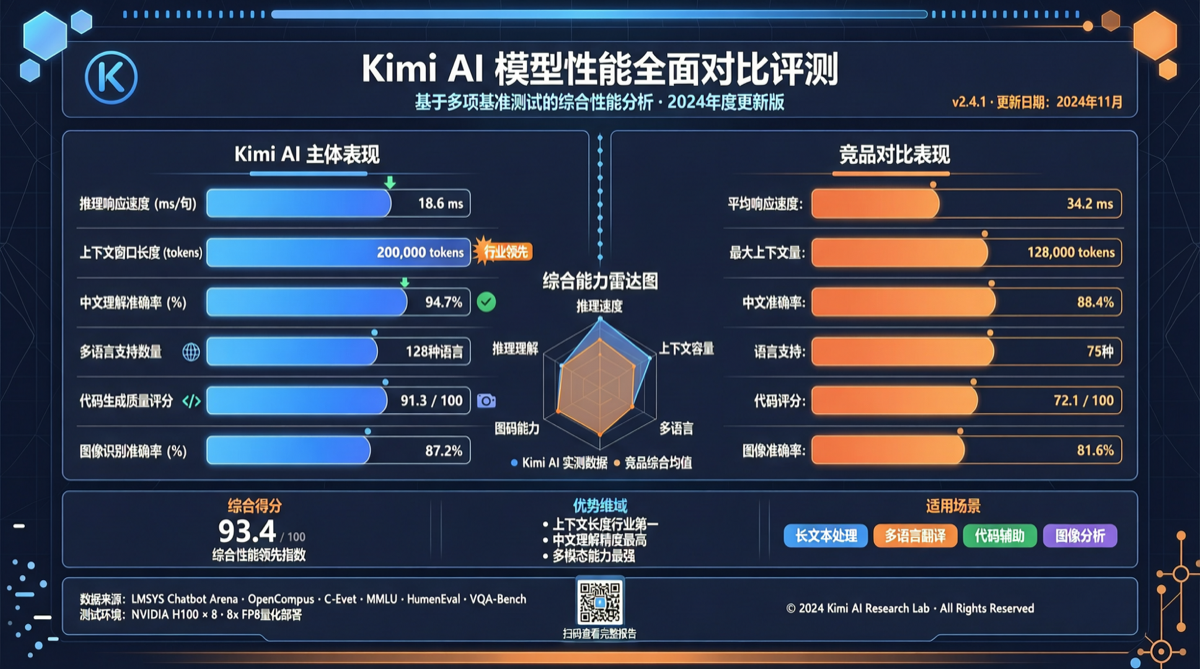
Kimi 2.6's benchmark results may be the most exciting breakthrough for Chinese models this year: surpassing Claude Opus 4.7 in some programming scenarios, beating GPT-5.5 in frontend development tasks, while costing only one tenth of both. This is not an advantage in a single metric, but simultaneous achievement across multiple practical dimensions.
Benchmark Data Comparison
| Test Dimension | Kimi 2.6 | Claude Opus 4.7 | GPT-5.5 | DeepSeek V4 Pro |
|---|---|---|---|---|
| Frontend Dev (React/Vue) | ⭐⭐⭐⭐⭐ | ⭐⭐⭐⭐ | ⭐⭐⭐⭐ | ⭐⭐⭐ |
| Backend Architecture | ⭐⭐⭐⭐ | ⭐⭐⭐⭐⭐ | ⭐⭐⭐⭐ | ⭐⭐⭐⭐ |
| Code Debug & Fix | ⭐⭐⭐⭐ | ⭐⭐⭐⭐⭐ | ⭐⭐⭐⭐ | ⭐⭐⭐⭐ |
| Long-horizon Coding (>50 steps) | ⭐⭐⭐ | ⭐⭐⭐⭐⭐ | ⭐⭐⭐⭐ | ⭐⭐⭐⭐ |
| Chinese Understanding & Generation | ⭐⭐⭐⭐⭐ | ⭐⭐⭐ | ⭐⭐⭐⭐ | ⭐⭐⭐⭐ |
| Price per Million Tokens | ~$0.15 | ~$15 | ~$10 | ~$0.55 |
Data notes: Frontend development testing covers component building, style implementation, and interaction logic writing; backend architecture covers API design, database modeling, and middleware configuration. Prices are based on official API pricing, taking weighted averages of input plus output.
Why Kimi 2.6 Is Breaking Out at This Moment
Technical approach:
- Kimi 2.6 continues the K2 series' hybrid architecture (MoE), but has done extensive optimization in reasoning efficiency and tool calling
- Specifically fine-tuned for Chinese development scenarios — this is also why it excels in frontend and Chinese understanding
- Long-horizon coding ability, while not matching Opus 4.7, is already sufficient for daily development tasks (<50 steps)
Price advantage:
- Kimi 2.6's API pricing is approximately 1/100 of Opus 4.7 and 1/67 of GPT-5.5
- Even compared to DeepSeek V4 Pro, which also follows a cost-effective route, Kimi 2.6 is still 3-4x cheaper
- This means at the same budget, Kimi 2.6 can process 10-100x more tokens than US models
Landscape Assessment
Kimi 2.6's emergence marks a new phase in Chinese model competition:
From "catching up" to "partial leadership":
- Surpassing GPT-5.5 in frontend development is a significant signal — frontend is developers' most daily and high-frequency scenario
- Absolute advantage in Chinese understanding makes Kimi 2.6 nearly unrivaled in Chinese development environments
But weaknesses remain:
- Long-horizon coding (>50 steps) still lags behind Opus 4.7 and GPT-5.5
- Complex system design and reasoning chain depth still gap with American flagships
- Ecosystem maturity (toolchains, community, documentation) trails Claude and OpenAI
Impact of price war:
- Kimi 2.6's one-tenth pricing is reshaping the value perception of Chinese models
- For budget-sensitive developers and SMBs, the "good enough + cheap" combination is more attractive than "the best but expensive"
Action Recommendations
Developer selection guide:
- Frontend development: Try Kimi 2.6 first, extremely cost-effective
- Full-stack projects: Use Kimi 2.6 for frontend + simple backend, switch to Opus 4.7 or GPT-5.5 for complex backend logic
- Chinese content generation: Kimi 2.6's Chinese ability is among the strongest of Chinese models
- Long-horizon complex tasks: Opus 4.7 still leads, choose it first when budget allows
Enterprise procurement advice:
- Build a multi-model parallel strategy: Kimi 2.6 handles daily development tasks, US flagships handle complex scenarios
- Use Kimi 2.6 as the "default model," automatically falling back to stronger models when results are insufficient
- Monitor Kimi 2.6's improvement progress in long-horizon coding in subsequent versions