Today's hottest AI post on Hacker News isn't about a model release — it's an opinion piece: "Local AI needs to be the norm." 727 points, 342 comments.
This level of engagement signals a trend: developers are getting fatigued with the "everything in the cloud" narrative.
Five signals that local AI isn't empty talk
Signal one: consumer hardware inference capability is growing exponentially.
Qwen3.6-27B on RTX 3090, 95% SimpleQA. M4 Mac mini with 128GB RAM, running 200B parameter models locally. AMD's new Halo Box, 128GB shared memory, $2K price point for large model inference.
Two years ago these scenarios required cloud A100s. Now your desktop does it.
Signal two: local toolchains are maturing.
Ollama has become the de facto standard. llama.cpp supports almost all major models. local-deep-research brings deep research to local. And rapid-mlx is 4.2x faster than Ollama on Mac.
Tools are no longer demo-level hacks — they're production-ready.
Signal three: privacy compliance pressure is increasing.
EU AI Act, China's data security law, Five Eyes' AI Agent security guidelines — more and more regulations require data localization. For healthcare, finance, and legal industries, "sending data to the cloud for AI processing" has increasing compliance costs.
Local AI is shifting from "optional" to "mandatory."
Signal four: the cost equation is starting to make sense.
Cloud API calls look cheap — a few cents each. But if you call thousands of times daily, that's hundreds of dollars monthly. A one-time local hardware investment typically pays back in 2-6 months.
For small and medium teams, this math is becoming obvious.
Signal five: offline work is becoming a real need.
A developer on HN shared completing a client project during an 11-hour transnational flight with no network. Powered by local models + local toolchain. This isn't showing off — for remote workers and frequently-traveling developers, this is a real need.
A practical local AI workflow
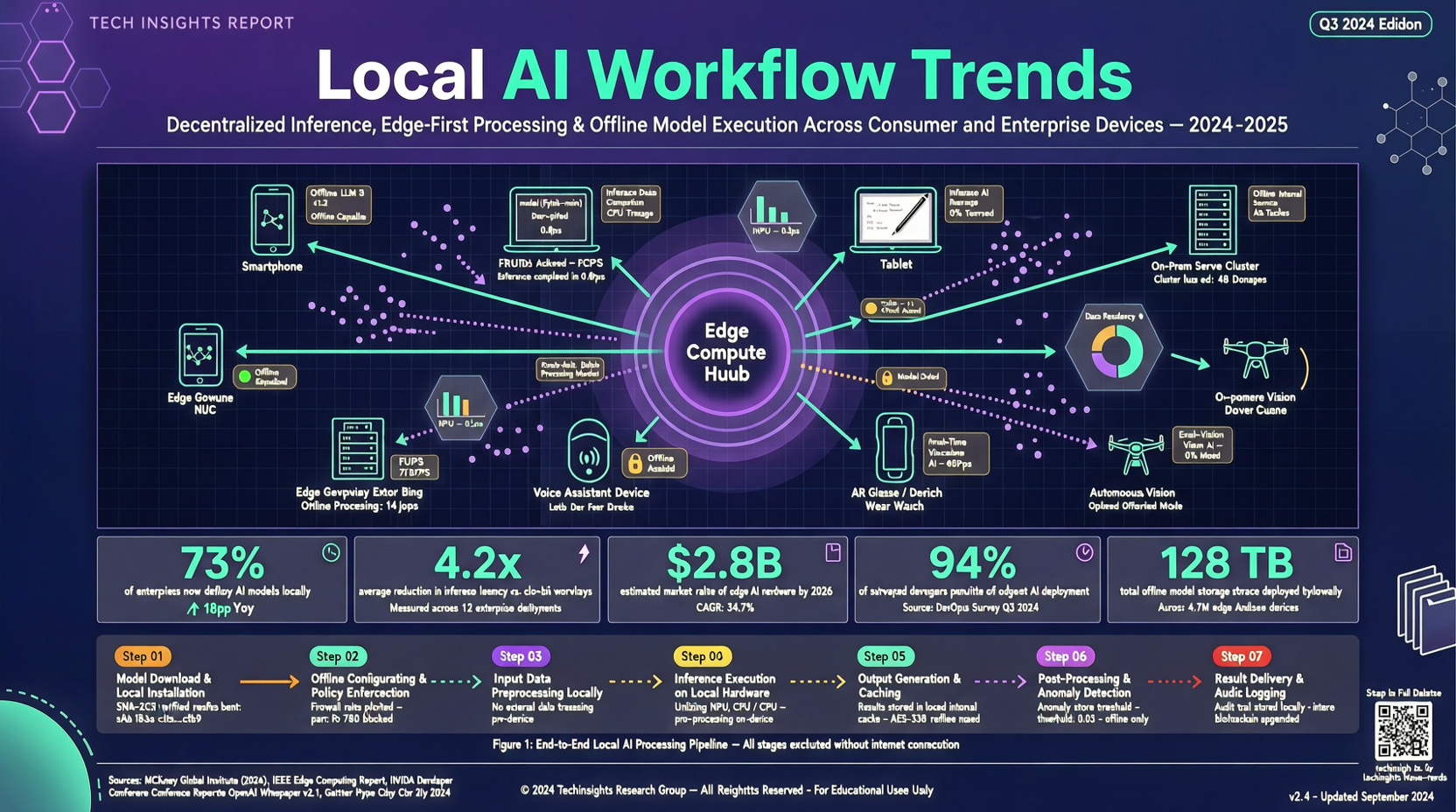
Based on the current tool ecosystem, an actionable local AI workflow looks roughly like this:
Foundation layer: Ollama or llama.cpp as model runtime. Pick a 7B-27B open-source model based on your hardware.
Coding layer: Local coding agents (like DeepSeek-TUI), or VS Code + Continue plugin. No cloud API needed.
Research layer: local-deep-research for deep research, with arXiv and PubMed search support.
Daily layer: Local LLMs for document summarization, email drafts, meeting notes. Privacy stays on-device.
Local AI's shortcomings
But don't get carried away by enthusiasm. Local AI has several hard limitations right now:
- Training capability is limited. Inference can be localized, but training large models remains cloud territory
- Access to latest knowledge. Local models have training data cutoff dates; while search augmentation helps, real-time capability lags behind cloud
- Multimodal capability. Video generation, image understanding — these heavy tasks still exceed consumer hardware
- Collaboration issues. How do you share locally-running models with your team? Everyone might run different versions
My take
Local AI won't replace cloud AI. It will become cloud AI's complement — the first choice in some scenarios, the backup in others.
For individual developers and small teams, local AI's ROI is exceeding cloud. For scenarios needing the latest model capabilities and large-scale compute, cloud remains the only option.
But the trend is clear: local AI is transitioning from "geek's toy" to "engineer's tool."
Sources:
- Hacker News - "Local AI needs to be the norm" — 727-point hot post
- Hacker News - "Running local models on an M4 with 24GB memory" — 165 points
- GitHub Trending weekly — Multiple local AI projects trending