The Signal
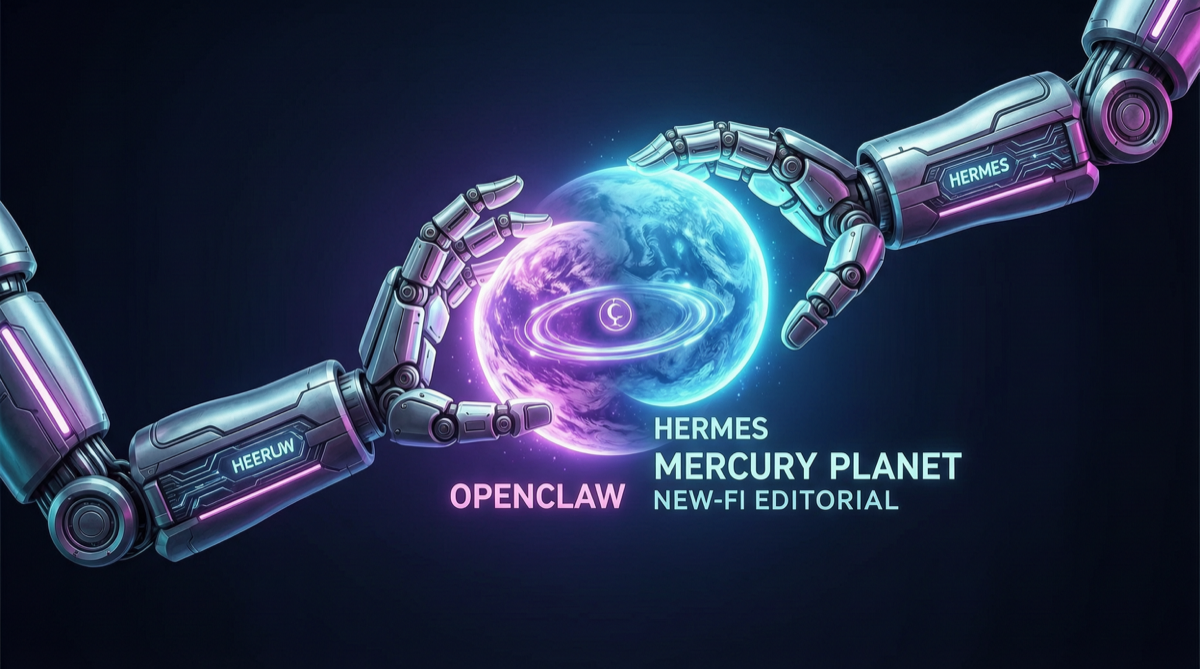
A new Agent project named Mercury has quietly appeared. Its official tagline is direct and ambitious:
“OpenClaw sparked the Idea. Hermes brought the Energy. Mercury now delivers true CONTROL. This is OpenClaw + Hermes, perfected.”
OpenClaw, one of the hottest open-source Agent frameworks recently, has already accumulated a large community. Hermes Agent stands out in multi-agent orchestration and skill management. Mercury’s positioning is not a third alternative, but a “perfect union” of the two.
Why It Matters
1. A Signal of Ecosystem Integration
In the AI Agent space, framework fragmentation has always been a pain point. LangChain, CrewAI, AutoGen, OpenClaw, Hermes — each framework has its niche, but users often need to switch between multiple frameworks.
Mercury represents a new approach: integration over competition. It attempts to fuse OpenClaw’s creative workflows with Hermes’s multi-agent orchestration capabilities, providing a unified upper-layer interface.
If done well, this integration will significantly reduce the complexity of agent development.
2. “True Control”: Filling the Agent Deployment Gap
Mercury emphasizes “true CONTROL.” This word has specific meaning in the Agent context:
- Task controllability: Humans can intervene in real-time during Agent execution, adjusting direction rather than running as a black box.
- Resource controllability: Precise management of token consumption, API calls, and tool usage.
- Output controllability: Ensuring Agent outputs meet expected format and quality standards.
OpenClaw excels at “ideas” — rapid prototyping, flexible skill combinations. Hermes excels at “energy” — multi-agent coordination, complex workflow orchestration. But both have room for improvement in fine-grained control. If Mercury can fill this gap, it will be a critical step for Agent frameworks moving from “usable” to “production-ready.”
3. The Competitive Landscape of Open-Source Agent Frameworks
Here is the current positioning of mainstream Agent frameworks:
| Framework | Core Strength | Use Case |
|---|---|---|
| OpenClaw | Rapid prototyping, active community | Individual developers, MVPs |
| Hermes | Multi-agent orchestration, skill management | Enterprise workflows |
| LangChain | Widest ecosystem, rich toolchain | All-purpose |
| CrewAI | Role-driven, usability | Team collaboration |
| Mercury | Integration + fine control | Production environment |
Mercury targets the highest barrier: the “production environment.” If it truly delivers on its control promises, it will directly challenge the existing framework landscape.
Potential Risks
The biggest challenge for integration projects is: complexity management. Fusing the core capabilities of two mature frameworks means code complexity multiplies. Maintenance cost, performance overhead, and compatibility are all hanging issues.
Additionally, both OpenClaw and Hermes have their own communities and roadmaps. Whether Mercury gains support from the core contributors of the original projects, or is merely “name-borrowing marketing,” remains to be seen.
Actionable Advice
- OpenClaw users: If you’re hitting bottlenecks in multi-agent orchestration, watch whether Mercury offers a cleaner solution.
- Hermes users: If you need more flexibility in creative workflows and rapid prototyping, Mercury’s OpenClaw DNA might help.
- Framework-choosing undecided: Don’t rush to switch to Mercury. Wait for stable releases and benchmarks before evaluating.
- Framework developers: Mercury’s integration approach is worth studying — future Agent framework competition may no longer be about who has more features, but about who integrates other tools better.