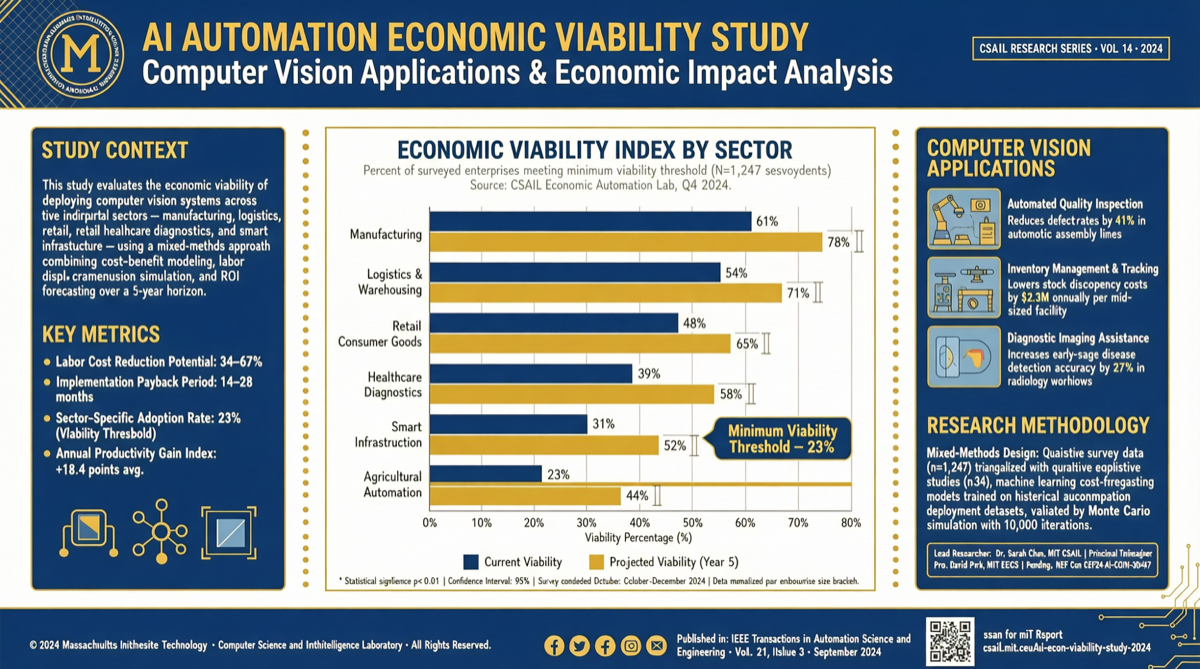
MIT’s Computer Science and Artificial Intelligence Laboratory (CSAIL) has published a study on the economic viability of AI automation, revealing a conclusion that contrasts sharply with industry narratives: currently, only about 23% of wage costs in vision-related work tasks can be economically replaced by AI automation.
Core Findings
The research team conducted a systematic analysis of AI automation in the workplace, with a specific focus on computer vision-related tasks. They found:
- 23% wage viability: At current technology levels and cost structures, only about 23% of wage costs for vision-related work tasks can be economically replaced by AI automation
- Compute costs are the primary barrier: For tasks requiring high-quality visual processing, compute costs often exceed the labor costs of the workers being replaced
- Non-vision tasks are more viable: In contrast, pure text and data processing tasks have significantly higher economic viability for automation
This means that despite significant advances in computer vision technology over the past few years, the economic case for replacing human visual workers with AI still doesn’t add up in most real-world business scenarios.
Nvidia VP’s Complementary Perspective
In the same discussion context, Nvidia’s VP of Applied Deep Learning revealed to Axios a noteworthy data point: for his team, compute costs far exceed employee costs.
These two data points create an interesting tension:
- On one hand, the AI industry invested approximately $740 billion in capital expenditure in 2026, massively deploying compute infrastructure
- On the other hand, MIT research shows that most vision-centric roles are not economically viable to automate with AI
- Meanwhile, the industry has already seen approximately 92,000 layoffs
These data points suggest there may be a structural mismatch in the current AI investment boom—capital is pouring into compute, but the actual commercial deployment scenarios are more limited than expected.
Implications for the Industry
This study has several layers of implications for the AI industry:
For investors: ROI models for AI automation projects need to be re-examined. Not everything that “can be done with AI” “should be done with AI.”
For business leaders: When planning AI transformation, prioritize economically viable scenarios—such as text processing, data analysis, and workflow automation—rather than blindly pursuing visually “impressive” applications.
For practitioners: Vision-related roles (such as quality inspection, image analysis, design review) may face lower-than-expected displacement risk, but this doesn’t mean safety—as compute costs decline, the boundary of economic viability will continue to expand.
MIT’s Broader Picture
This is not MIT’s only research on AI’s employment impact. As early as December 2025, another MIT study found:
- Current AI systems can automate nearly 12% of the existing US workforce
- Affected roles are not just technology-specific positions, but also finance, HR, office management, and more
- Entry-level developer positions are already declining
But MIT emphasized a crucial distinction: what AI can do and where companies will actually deploy AI are two entirely different questions. Economic viability is the bridge connecting these two questions.