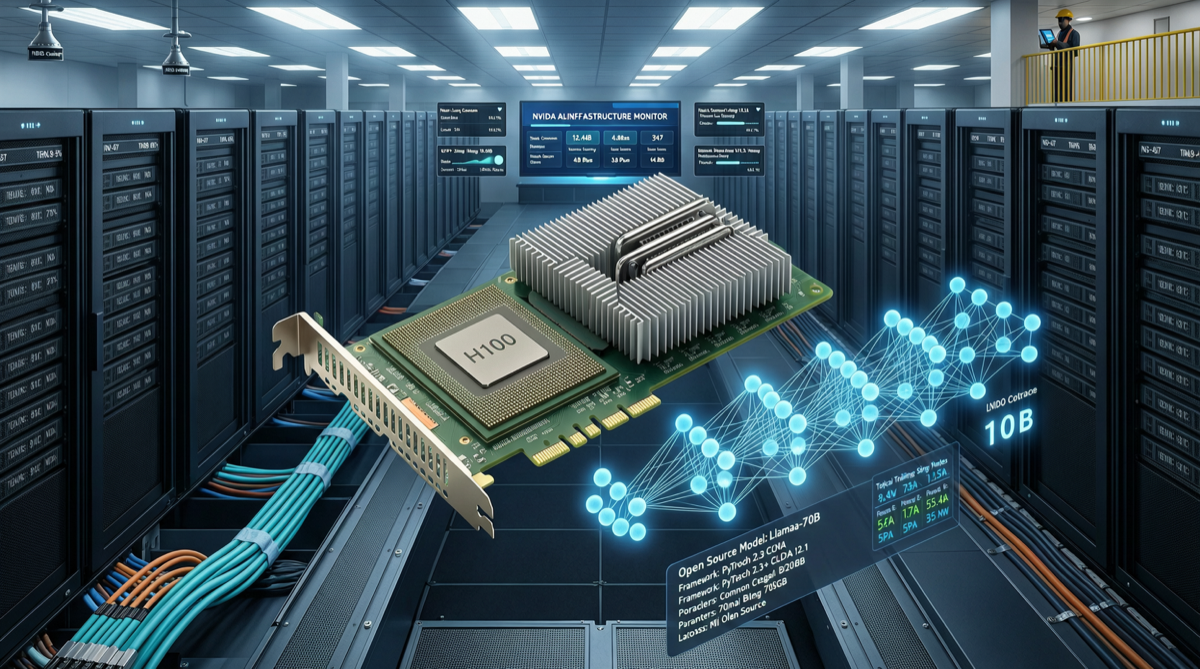
NVIDIA is no longer just a shovel seller.
According to 36Kr, NVIDIA announced a $26 billion investment in open-source large model R&D over the next five years, formally transitioning from a hardware giant to a full-stack AI enterprise. Alongside the already-released Nemotron 3 series (Nano, Super, and Ultra in three scales), NVIDIA is building a closed-loop ecosystem from chips to models.
The most notable is Nemotron 3 Super—128 billion parameters, scoring 37 in composite evaluation, surpassing OpenAI GPT-OSS's 33.
Why NVIDIA Is Building Models
This question was asked two years ago. NVIDIA's answer then was "we build models to sell more chips."
Now the answer has changed. A $26 billion investment scale means NVIDIA is no longer satisfied with reference implementations. They're seriously competing with OpenAI, Anthropic, and Google on model capabilities.
But the competition strategy is different. NVIDIA takes a fully open-source route:
- Nemotron 3 Nano Omni: Full-modal Agent model, runs on consumer-grade GPUs (RTX 5090 capable)
- Nemotron 3 Super: 128B parameters, enterprise-grade applications
- All open source, no closed-source "flagship version"
This is similar to Meta's Llama strategy—trading openness for ecosystem binding. But NVIDIA has an extra card: chips. Model open source + chip optimization = stronger ecosystem lock-in.
Impact on China's AI Ecosystem
This is the most noteworthy part.
Chinese model companies (Qwen, Kimi, DeepSeek, Zhipu, etc.) currently rely on open-source for ecosystem building. NVIDIA's entry means:
- Open-source model quality baseline is raised: Nemotron 3 Super at 128B parameters surpasses GPT-OSS in composite scoring. Chinese models need to deliver competitive performance at equivalent parameter scales
- Chip binding effect: Nemotron series is deeply optimized for Hopper and Blackwell architecture FP8 inference. If model capability is good enough, developers will naturally prefer NVIDIA chips
- Window for Chinese chips is narrowing: Part of the competitiveness of Huawei Ascend, Cambricon, and other Chinese chips comes from "no good NVIDIA models available." If NVIDIA's open-source models can run on Chinese chips (or adaptation costs decrease), the differentiation advantage of Chinese chips weakens
But this also brings opportunities for the Chinese ecosystem:
- Open-source model competition benefits developers: More high-quality open-source options mean lower costs and stronger bargaining power
- If Chinese chips can run Nemotron's inference optimization, they indirectly benefit from NVIDIA's $26 billion R&D investment
Key Variable: Nemotron Adaptation on Chinese Chips
This is the key that determines the future landscape.
Nemotron series currently optimizes primarily for NVIDIA's own hardware. If:
- Adaptation is smooth: Chinese chips can quickly run Nemotron inference, the Chinese ecosystem benefits
- Adaptation is difficult: Developers only get best performance on NVIDIA chips, ecosystem lock-in strengthens
Discussion of Nemotron adaptation in Chinese developer communities is still limited. This is an indicator worth continuous observation.
Assessment
NVIDIA's $26 billion open-source model investment won't change the model landscape in the short term—Qwen 3.6, Kimi K2.6, DeepSeek V4 Pro remain competitive in their respective domains. But in the medium to long term, NVIDIA's chip+model closed loop is a variable that needs serious attention.
Advice for Chinese model companies: keep open-sourcing, keep optimizing Chinese language capability, keep reducing inference costs. NVIDIA's models, no matter how good, can't catch up on Chinese language and localization services in the short term.
Advice for developers using open-source models: add the Nemotron series to your model selection list, especially if you have NVIDIA hardware. Run comparison tests to see how it performs against Qwen and Kimi in your scenarios.
Sources: