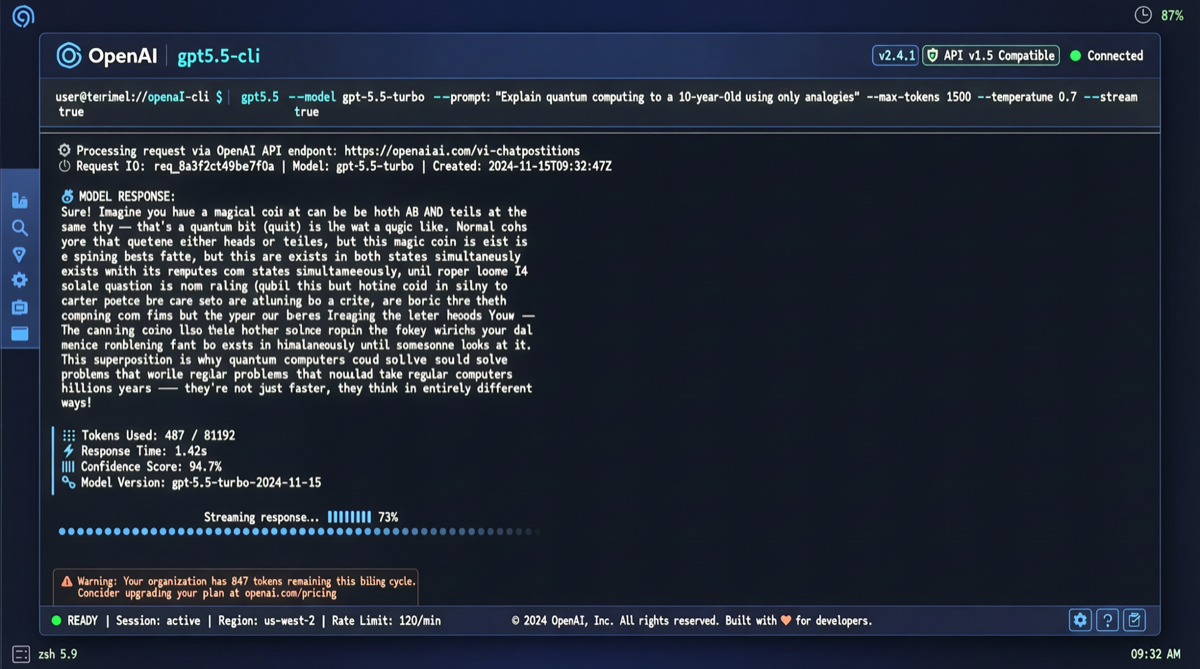
OpenAI did something small-looking but signal-rich: it open-sourced its official CLI.
The repo is openai/openai-cli. Go-based, created last Friday, already at v1.1.2 as of yesterday with 42 commits. 441 stars isn't huge, but for a repo that's been alive for a week, the velocity alone says something.
The core usage is one line:
openai responses create --input "your prompt" --model gpt-5.5
No Python SDK to install, no requests to configure, no boilerplate. Install it and go.
What it actually does
The feature set isn't fancy yet, but it's enough:
- Responses API: Direct calls to GPT-5.5, GPT-5.5 Instant, and other models
- Realtime API: Real-time voice interaction (commit log shows
feat(api): realtime 2) - Bash completion: They even did tab completion properly —
Fix bash completion filename quotingcommits suggest someone cares about experience details - GoReleaser distribution: Cross-platform binaries, macOS/Linux/Windows all downloadable directly
Honestly, you could do all of this with the SDK. The CLI's value isn't in "can it do it" — it's in putting the OpenAI API into your shell workflow.
Think about it: running openai responses create in CI for automated evals, piping logs to GPT-5.5 for analysis inside tmux, one-liner prompt testing in a Makefile. That's why a CLI exists.
Relationship with Codex CLI
OpenAI now has two CLI tracks:
- openai-cli: General-purpose API command-line tool, call any model
- Codex CLI (openai/codex-cli): Code-focused agent tool
Different positioning. openai-cli is infrastructure — call whatever you want. Codex CLI is application — it writes, edits, and runs code for you.
Add in the already open-sourced Skills Catalog (18k+ stars), and OpenAI's developer toolkit is filling out fast.
The signal
OpenAI used to be an "API company," then became a "product company" (ChatGPT). Now it looks like it's heading toward "full-stack SDK company."
CLI, SDK, Skills Catalog, Codex — each piece is independently open-source, each can stand alone. The upside: whether you want API-level integration or ready-made tools, OpenAI covers it.
The downside for competitors: developer experience pressure is mounting. Google has Gemini CLI, Anthropic has Claude Code, and now OpenAI's CLI is in the mix. The terminal is the new battleground.
Worth installing?
If you're already using the OpenAI API, installing a CLI costs nothing. brew install openai-cli or download the binary, set a key, and you're running.
If you haven't used the OpenAI API yet, the CLI is the lowest-friction entry point — simpler than the SDK, more scriptable than the web interface.
My take: this isn't a "major launch," but it's OpenAI pushing the developer tool standard forward one small step. Those small steps accumulate into a moat.
Primary sources: