Core Conclusion
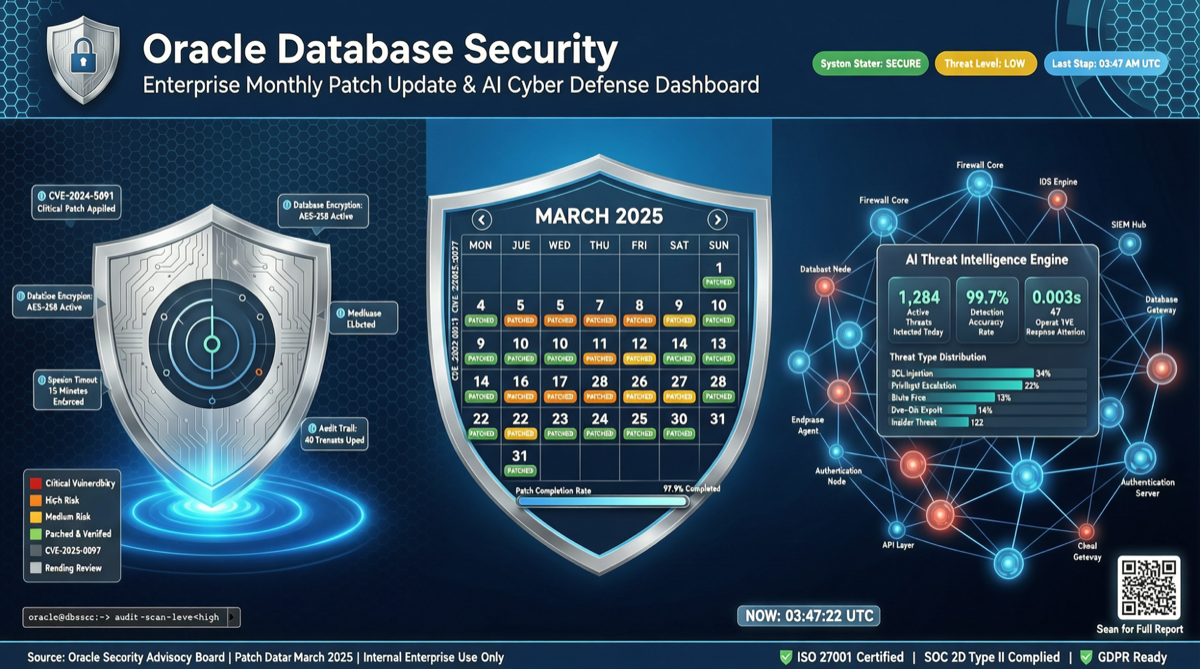
Oracle has officially announced: Starting May 2026, Critical Patch Updates (CPU) will shift from quarterly to monthly releases. This is the first time in over 20 years that Oracle has broken its fixed quarterly security patch cadence.
The company explicitly states that the direct driver of this change is the accelerated iteration of frontier AI models — the emergence speed of new AI attack vectors has far exceeded what the traditional quarterly patch cycle can handle.
Change Comparison
| Dimension | Old Cadence (Quarterly) | New Cadence (Monthly) | Impact |
|---|---|---|---|
| Release Frequency | 4 times per year | 12 times per year | Operations team workload 3x increase |
| Vulnerability Exposure Window | Up to 90 days | Up to 30 days | Attacker exploitation window dramatically shortened |
| Testing Cycle | ~60 days | ~20 days | QA process must be automated |
| Compliance Audit | Quarterly alignment | Monthly alignment | Compliance team needs to adjust reporting cycle |
Why Now
1. AI-Driven Attack Speed
Frontier large models are being used for automated vulnerability discovery and attack code generation. What traditionally took security research teams weeks to analyze, AI Agents can complete in hours. The quarterly patch cycle can no longer keep pace with this speed.
2. Enterprise AI Deployment Expands Attack Surface
As enterprises massively deploy AI Agents (Microsoft Agent 365 just went GA, Anthropic released financial industry templates), traditional enterprise software systems need deep integration with AI systems. This integration introduces a large number of new API endpoints and data flows, each a potential attack surface.
3. Oracle's Own AI Strategy
Oracle is heavily pushing its AI infrastructure business (OCI GPU cloud services, AI database features). As an AI infrastructure provider, its own software security directly impacts customer trust.
Ripple Effects from Other Vendors
Oracle is not the only vendor accelerating its security update cycle. The trend is spreading:
- Microsoft: Released an Agent security governance framework alongside Agent 365 GA
- Google: Participating in the CAISI pre-release testing program, proactively accepting government security review
- AWS: Emphasized zero-trust architecture for AI workloads at re:Invent
Action Recommendations
| Role | Impact Assessment | Recommended Action |
|---|---|---|
| Oracle DBA | Monthly patches mean higher operations pressure | Build automated testing pipelines, reduce manual intervention |
| Security Team | AI attack vectors require new defense strategies | Deploy AI-assisted intrusion detection systems |
| CIO/CTO | Security costs structurally increase | Shift security budget from "incident response" to "continuous defense" |
| AI Engineer | Agent security is no longer optional | Incorporate security assessment at Agent design stage |