There are two camps in the agent world right now.
One is still grinding on prompt engineering—tweaking system prompts, adding few-shot examples, adjusting temperature, hoping the agent suddenly clicks. The other has already moved on to reinforcement learning.
Prime Intellect Lab just went GA, ending its beta period. Its positioning is clear: stop writing prompts, let the system learn from experience.
Traditional Fine-Tuning vs Continuous Learning
Traditional model fine-tuning works like this: collect labeled data, run one training pass, deploy. The moment training finishes, the model's capabilities are frozen. New scenarios, new feedback—it does not update itself.
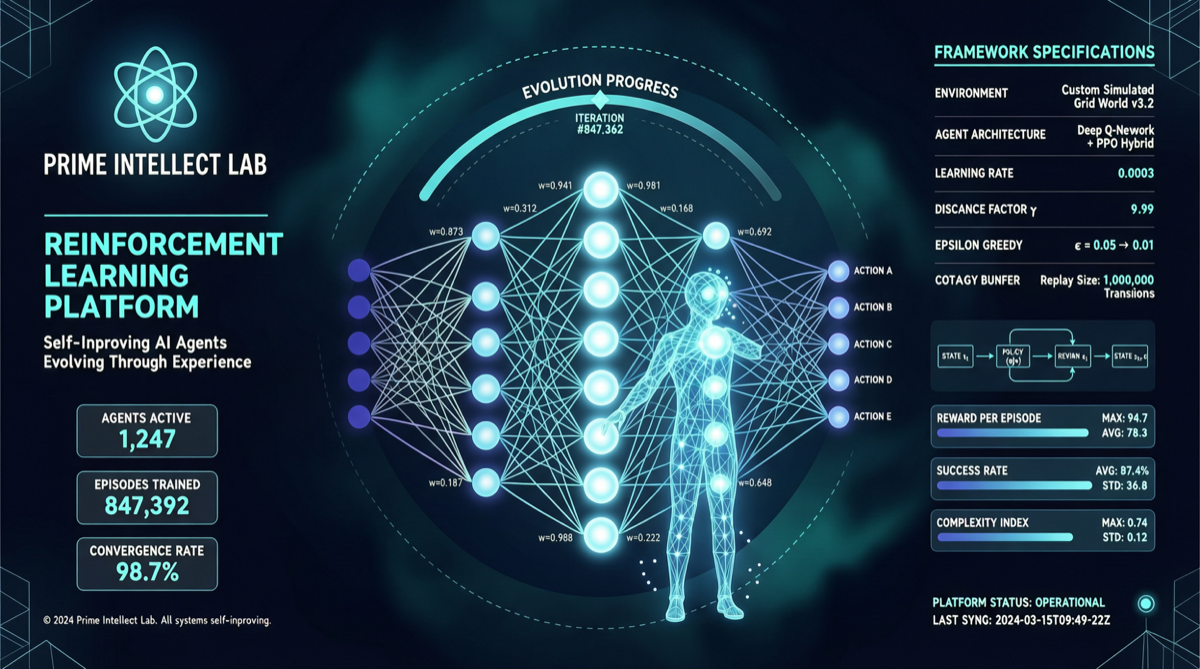
What Prime Intellect does is online reinforcement learning: the agent executes tasks in the real environment, gets outcome feedback, and automatically updates its policy. Good results get reinforced, bad ones get adjusted. Same logic as humans "learning by doing."
In their own words: "STOP PROMPTING, START TRAINING."
Platform Capabilities
Prime Intellect Lab provides a complete RL training pipeline:
- RL environment construction: Define the agent's task space and reward function
- Evaluation system: Run automated benchmarks to quantify agent performance
- Post-training: RL fine-tuning on top of pre-trained models
- Deployment: Trained agents deploy as callable services
End-to-end means: from defining a task to deploying an agent, no jumping between multiple tools.
Why This Direction Matters
A consensus is emerging in the agent space: the best agents are not prompt-written, they are trained.
Claude's Dreaming feature (reviewing past sessions to extract patterns), Anthropic's Outcomes (rubric-driven auto-iteration), even self-learning mechanisms in various open-source projects—they are all walking in the same direction: giving agents the ability to improve from their own experience.
Prime Intellect has productized this path. It is not some big model company's internal tool—it is an open RL training platform anyone can use.
Where the Barriers Are
Reinforcement learning is not new, but applying RL to agent training has real barriers:
- Reward function design: How do you define "doing well"? This is one of the hardest parts of RL
- Training stability: Online learning is prone to catastrophic forgetting (learning new things, forgetting old ones)
- Compute cost: RL training eats significantly more compute than supervised fine-tuning
Prime Intellect Lab's value is packaging these engineering problems. Developers do not need to build an RL pipeline from scratch—they can start by defining tasks and reward functions directly.
Who Should Use This
- Agent framework developers: Want to add self-improvement to agents without building RL pipelines from scratch
- Vertical application teams: Have clear business scenarios and feedback signals (e.g., customer satisfaction for support agents) to continuously optimize with RL
- Research teams: Need a standardized RL agent training environment for experiments
Not a good fit if your agent tasks are static, the environment does not change, and feedback signals are unclear. In that case, RL training is probably overkill.
Hermes Agent Cross-Session Memory
Agent Infrastructure Convergence
Primary sources: Prime Intellect official announcement, X/Twitter community discussion