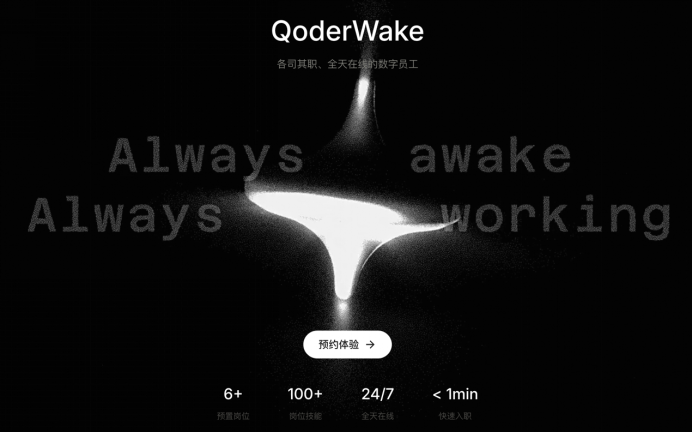
Alibaba just played another card.
On the morning of April 30, Alibaba officially released its production-grade digital employee product QoderWake alongside the Qoder mobile app. This is not yet another chatbot — QoderWake is positioned as a “digital employee” capable of taking on real job responsibilities such as software engineer, operations specialist, and analyst. It is now open for invite-only testing.
What deserves even more attention is that it tackles a core pain point in the Agent space: forgetting everything after a task is done.
Harness-First Architecture: Five-Dimensional Self-Evolution
The biggest problem with general-purpose Agents is that they don’t accumulate experience after completing a task — the next time they encounter a similar problem, they have to start from scratch. QoderWake’s Harness-First architecture is designed precisely to address this.
After each task execution, experience is categorized and crystallized across five dimensions:
| Dimension | Purpose |
|---|---|
| Memory | Stores execution context and historical records |
| Skills | Reusable capability modules |
| Strategies | Task decision-making logic |
| Verification Rules | Quality assurance mechanisms |
| Workflows | Complete business process templates |
This design gives QoderWake “continuous evolution” capability — the more it’s used, the smarter it gets.
Not Just Execution — Also Reflection
Two design details of QoderWake are worth noting:
- Autonomous Execution: Completes tasks independently based on preset rules, without requiring step-by-step guidance from users
- Automatic Reflection: Retraces task trajectories and proactively corrects errors, rather than waiting for users to point out problems
Additionally, it includes a built-in Anti-Rot mechanism to prevent capability degradation over time.
First Role: Digital Programmer
QoderWake has already launched its “Digital Programmer” role:
- When code is updated, automatically compiles change summaries
- When errors occur, performs diagnosis first and outputs an initial assessment report
- Already deployed internally at Alibaba, autonomously completing tasks like feedback classification and log analysis
This means it’s not a proof of concept — it’s a product that has already been tested in real production environments.
The Qoder Product Matrix Takes Shape
With today’s release of QoderWake, Alibaba’s Qoder product line has formed a complete layout:
| Product | Positioning | Status |
|---|---|---|
| Qoder IDE | Agentic programming platform (VSCode-based) | Public preview |
| QoderWork | Desktop AI agent (office scenarios) | Available |
| QoderWake | Digital employee (job-level Agent) | Invite-only testing |
| Qoder Mobile | Mobile agent | Released simultaneously |
QoderWork addresses personal efficiency (“you state the requirement, it delivers results”), while QoderWake addresses job-level delivery (directly taking on job responsibilities). The two lines complement each other, covering the full spectrum from individual to enterprise scenarios.
Competitor Landscape: How Crowded Is the Digital Employee Track?
QoderWake is not the first product to propose the “digital employee” concept. The Agent track in 2026 is already packed with players pursuing different approaches:
Software Engineering Direction
Cognition Devin (Valuation: $10 billion)
The world’s first “fully autonomous AI software engineer.” You give it a task, and it analyzes requirements, writes code, runs tests, and deploys — all on its own. In July 2025, it acquired an AI programming tools company to further strengthen its capabilities. Devin’s core advantage is full-stack autonomy in software engineering — from order to delivery, end to end.
Comparison: Devin is a pure coding specialist, while QoderWake’s “Digital Programmer” currently remains at the change summary and initial diagnosis stage. However, QoderWake covers a broader range of non-coding scenarios such as operations and analytics.
Personal Digital Employee Direction
MuleRun (Released March 2026, received early investment from Alibaba Cloud)
A personal AI Agent platform centered on “self-evolution,” positioned as an “AI digital labor marketplace.” Core capabilities: at the individual level, it continuously learns users’ work habits, decision logic, and aesthetic preferences; at the group level, it builds an open Agent network ecosystem, enabling “shared collective intelligence.”
Comparison: MuleRun and QoderWake share a highly similar self-evolution philosophy, but MuleRun focuses more on personal scenarios and a creator ecosystem, while QoderWake emphasizes enterprise-level, job-level delivery.
Enterprise Agent OS Direction
OpenAI Frontier (Released February 2026)
An enterprise-grade AI agent platform positioned as an “enterprise operating system.” It connects databases, CRMs, HR systems, and ticketing tools, enabling multiple AI agents to collaborate and divide work like a human team. A $5 billion strategic partnership with AWS has been announced.
Microsoft Copilot Agent
Leveraging the Microsoft 365 ecosystem, it deeply embeds AI agents into core office applications like Word, Excel, and Teams.
Comparison: Frontier and Copilot follow a “platform + ecosystem” approach, while QoderWake takes a “job-level delivery” route — directly hiring a digital employee rather than building an Agent platform.
Open Source Direction
OpenClaw (280K+ GitHub Stars)
An open-source, local-first AI agent framework that directly operates file systems, email, and calendars, with unlimited extensibility via Skills plugins. The community describes it as “a digital employee, not a chatbot.”
Comparison: OpenClaw targets technical users and developers, while QoderWake targets enterprise decision-makers and business personnel — the former requires deployment and configuration, the latter is ready out of the box.
Harness Multi-Agent Direction
Nextie (2 funding rounds in 4 months, backed by Kai-Fu Lee and Qi Lu)
Focused on the Harness multi-agent collaboration track, led by former Zhihu CTO Li Di. The Harness architecture has become the consensus direction for multi-agent collaboration — which is precisely why QoderWake chose a Harness-First approach.
Market Competitiveness Forecast
Let’s pull the major players into a comparison table:
| Dimension | QoderWake | Devin | MuleRun | OpenAI Frontier | OpenClaw |
|---|---|---|---|---|---|
| Positioning | Job-level digital employee | AI software engineer | Personal self-evolving Agent | Enterprise Agent OS | Open-source local Agent |
| Self-Evolution | ✅ Five dimensions | ❌ | ✅ Individual + group | ❌ | ❌ |
| Multi-Role | ✅ Engineer / Ops / Analyst | ❌ Coding only | ✅ Multi-scenario | ✅ Customizable | ✅ Extensible |
| Enterprise-Grade | ✅ Custom / Invite-only | ⚠️ Limited | ⚠️ Primarily personal | ✅ Strong | ❌ Self-deployed |
| Ecosystem Moat | Alibaba ecosystem | Cognition technology | Agent network | OpenAI + AWS | Open-source community |
| Current Stage | Invite-only | Commercialized | v2.0 | Early release | Mature |
Key Judgments
1. Harness-First Is the Right Direction — But Not Exclusive
QoderWake’s choice of a Harness-First architecture follows the trend — companies like Nextie have already validated Harness’s effectiveness in multi-agent collaboration. But this means the technical barrier isn’t particularly deep; the real moat lies in how well the five-dimensional self-evolution performs in practice.
2. The Alibaba Ecosystem Is the Biggest Wildcard
If QoderWake can deeply integrate with DingTalk, Alibaba Cloud, Taobao/Tmall, and other business lines, its job-level delivery capabilities will far surpass independent vendors. Ecosystem integration is something OpenAI Frontier and Devin will struggle to replicate.
3. Short-Term Challenge: Bridging from “Digital Programmer” to Multi-Role
Currently, only the Digital Programmer role is live. Roles like operations specialist and analyst require more real-world scenario validation. Devin’s maturity in the coding space currently holds the lead.
4. Market Window: 12–18 Months
Gartner predicts that by the end of 2026, 40% of enterprise applications will embed AI agents — up from less than 5% in 2025. This means the next 12–18 months are the explosion window for enterprise-grade agents. QoderWake must make the leap from invite-only testing to scaled delivery within this window.
Final Thoughts
The digital employee track has moved past “who proposes the concept first” into the deep waters of “who can truly deliver job-level capabilities.”
QoderWake’s technical approach (Harness-First + five-dimensional self-evolution) is the right one, and the Alibaba ecosystem is its unique advantage. But Devin’s maturity in coding, MuleRun’s self-evolving ecosystem in personal scenarios, and OpenAI Frontier’s enterprise platform-level positioning are not opponents that can be easily surpassed.
The digital employee war has only just begun.
Primary Sources: Leiphone, 36Kr, National Business Daily, QbitAI, Tencent Developer Community, Fortune China