Core Conclusion
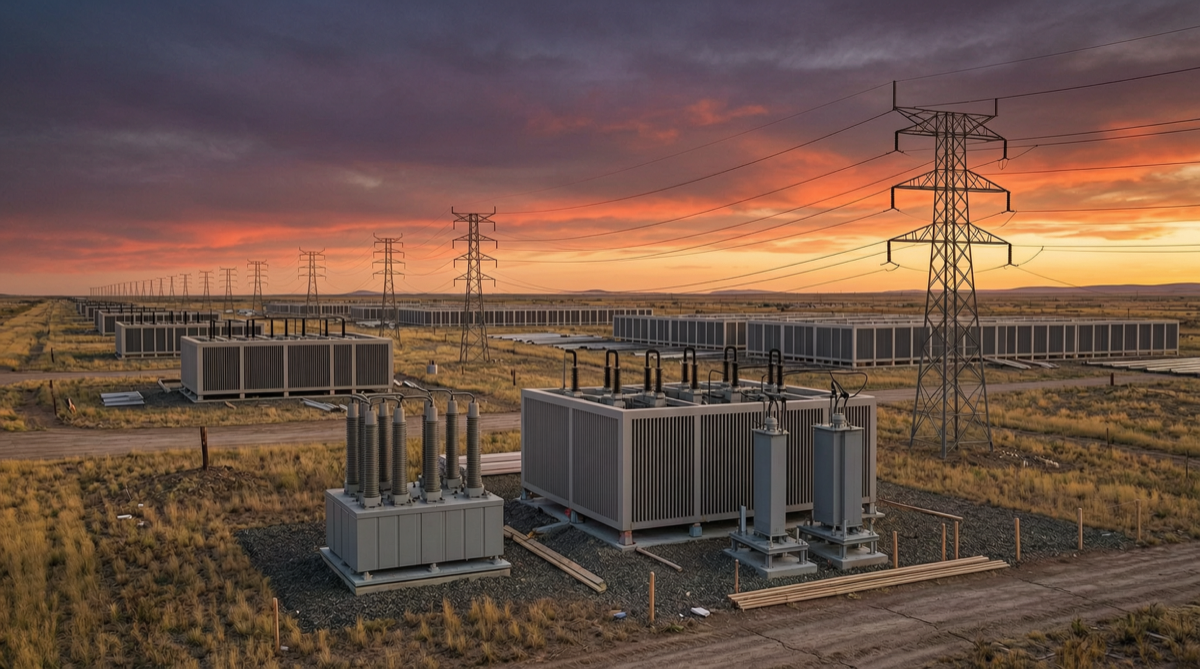
The AI data center construction crisis is not about chips, land, or capital - it is about grid transformers. Sightline Climate tracked 140 data center projects announced in the US for 2026, totaling 12GW capacity, and found:
- Only 5GW actually under construction (42%)
- 11GW stuck at “announced” stage with no physical construction activity
- Grid transformer delivery backlog of up to 5 years, becoming the biggest bottleneck for AI infrastructure
This is not a short-term problem - it is a structural crisis.
Data Overview
Project Status Distribution
| Status | Capacity | Percentage | Physical Progress |
|---|---|---|---|
| Under Construction | 5 GW | 42% | Construction underway |
| Announced | 11 GW | 58% | No physical construction |
Transformer Crisis Transmission Chain
AI demand surge -> Data center planning spike -> Grid expansion demand -> Transformer orders explode
    |
Transformer manufacturing capacity limited (12-18 month production cycle)
    |
Delivery backlog -> 5 year wait
    |
Data centers cannot get power connection -> Projects stall
Why Transformers?
Large transformers are core grid equipment with these characteristics:
- High customization: Each project has different voltage levels, capacity, and size requirements
- High manufacturing barriers: Requires special steel, insulation materials, professional assembly lines
- Transportation difficulty: Large transformers weigh hundreds of tons and need dedicated transport routes
- Concentrated supply chain: No more than 10 major global manufacturers
Why It Matters
Direct Impact on AI Industry
- Compute expansion slowdown: Even with unlimited GPUs and capital, data centers cannot run without power
- Geographic concentration intensifies: Only regions with existing adequate power infrastructure can attract new data centers
- Cost structure shifts: Power acquisition costs will exceed hardware costs as the deciding factor for data center siting
Industry Signal Interpretation
| Signal | Interpretation |
|---|---|
| 58% of projects stuck at “announced” stage | Many “AI compute investment” news may be PPT projects |
| 5-year transformer backlog | Even planning now, relief will not come until 2031 |
| Labs competing with hyperscalers for x86 capacity | CPU shortages are compounding on top of GPU shortages |
Geopolitical Dimension
The US grid transformer crisis could affect its AI competitiveness:
- If data center construction pace falls below expectations, US AI compute advantage could weaken
- China’s advantage in grid infrastructure could translate to AI infrastructure advantage
- Middle East sovereign wealth fund-backed data center projects may get faster power access
Landscape Judgment
Short-term (2026-2027)
- Power acquisition becomes core data center competitive factor: Who can get power, who can build
- Gap between “announced” and “under construction” will widen: More projects will remain stuck at PPT stage long-term
- Edge computing and small models will benefit: AI solutions that do not need massive data centers will gain relative advantage
Medium-term (2028-2030)
- Transformer capacity expansion: Manufacturers will increase capacity but need 2-3 years to relieve
- Alternative solutions emerge: Modular transformers, solid-state transformers, microgrids may become alternatives
- Nuclear and renewable energy integration: Self-built nuclear plants and large solar projects may bypass public grid
Long-term (2030+)
- AI compute and energy deeply intertwined: Data center siting will redistribute around energy-rich regions
- “Power as a Service” may become new business model: Energy companies offer integrated power + compute solutions
Action Recommendations
Data Center Operators
- Reassess project viability: Prioritize sites with existing power access over “greenfield” projects
- Explore microgrid solutions: Build self-contained solar + storage systems to reduce reliance on public grid
- Consider overseas siting: Build data centers in regions with more complete grid infrastructure
AI Startups
- Optimize compute efficiency: Achieving maximum output with limited compute will become core competitiveness
- Focus on edge AI: AI application scenarios that do not need massive data centers will receive more attention
- Consider China market: China’s advantage in power infrastructure may become long-term competitiveness
Investors
- Beware of “PPT compute” narratives: Distinguish between “announced” and “under construction” projects
- Focus on power infrastructure investment: Transformer manufacturers, grid equipment suppliers, energy infrastructure
- Position in alternative energy solutions: Nuclear, storage, microgrid-related companies may become hidden winners
Final Judgment
The AI industry has focused on chips, models, algorithms - but the real bottleneck may be in the wires. When 58% of “announced” projects cannot start construction due to lack of transformers, the entire industry expansion narrative needs to be reassessed.
The essence of the compute race is an energy race. Whoever solves the power problem holds the lifeline of AI infrastructure.