Video, images, audio, text—each modality used to require its own model pipeline. ByteDance wants to replace that with one.
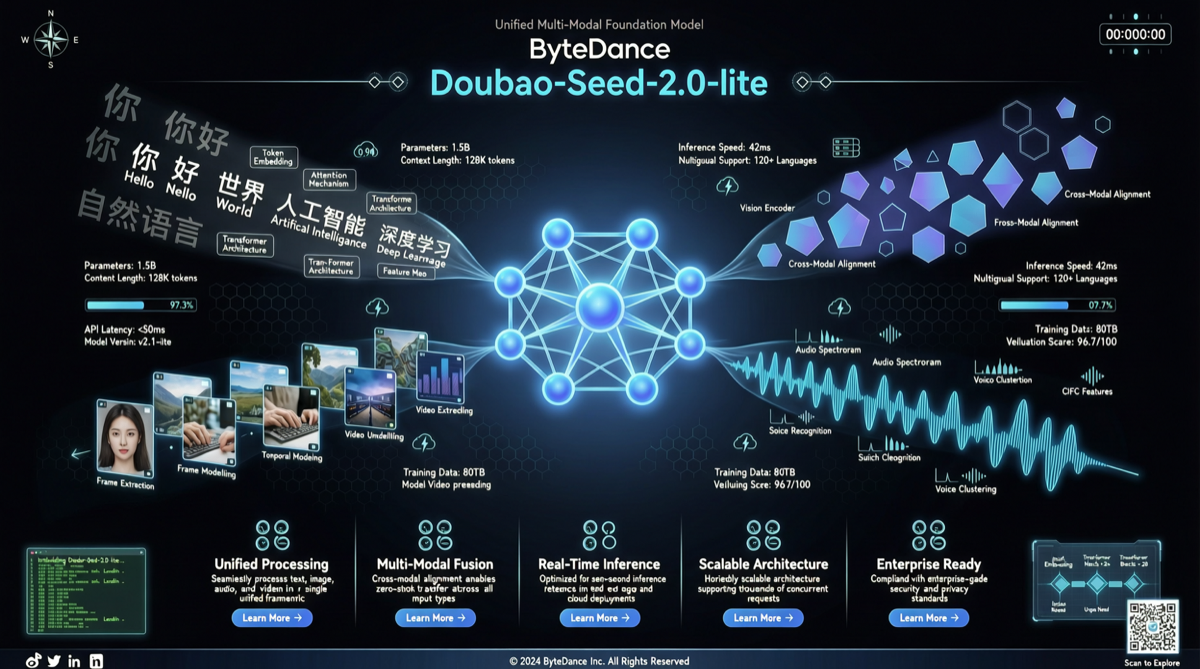
Volcengine today released Doubao-Seed-2.0-lite, the Doubao family's first "full-modal understanding model." The core pitch is straightforward: video, image, audio, and text all handled in a unified pipeline, no model switching required.
What Changed
A few upgrade points worth noting:
Audio-visual joint reasoning. This isn't a simple "video frame extraction + speech-to-text" pipeline. The model performs inference simultaneously on raw video and audio streams. That means it can pick up voice emotion and ambient sounds—someone coughing in the background, traffic noise outside—and factor those into its understanding, not just transcribe what was said.
19-language transcription + 14-language translation. Coverage expanded significantly from the previous generation. Multi-language scenarios no longer require a separate translation model attachment.
Advanced reasoning and fine-grained perception. No specific benchmark numbers were released, but demos suggest a qualitative leap over Seedance 1.0 in video scene understanding. Esports coaching, education, and e-commerce scenarios are already seeing commercial deployment.
Real-World Use Case: AI Esports Coach
One interesting case from the community: someone built a CS2 AI esports coach using the Harness Agent framework + Doubao-Seed-2.0-Lite. Drop in match recordings, and it analyzes positioning, movement, gunfights, pre-aiming, utility usage, economy, and more—then delivers recommendations and training direction.
ByteDance officially retweeted this demo after it went viral, which signals their strategy: "full-modal + vertical scenarios" rather than building a general-purpose model and hoping for the best. Find a scenario where full-modal capability clearly wins, then go deep.
Positioning
Doubao-Seed-2.0-lite's positioning is clear: it's not competing with GPT-5.5 or Claude Opus 4.7 on general text capability. It's staking out a "full-modal" label in the multimodal understanding lane.
Seedance 2.0 already ranks #1 on the LMArena video leaderboard (ahead of Kling and Happy Horse). With Seed-2.0-lite adding audio and cross-modal capability, ByteDance is clearly leading on the multimodal front.
But text capability remains the foundation. If Doubao can't catch up to GPT and Claude on the LMArena text leaderboard, multimodal strength is a bonus, not a core competency.
The next thing to watch: Doubao-Seed-2.0-lite's API pricing and whether it'll be integrated into the Doubao paid subscription tiers. Doubao has already been testing paid tiers, and this model release could be a key bargaining chip for that.
Sources
- Volcengine official announcement
- X community user reports
- Doubao paid subscription testing