Key Takeaways
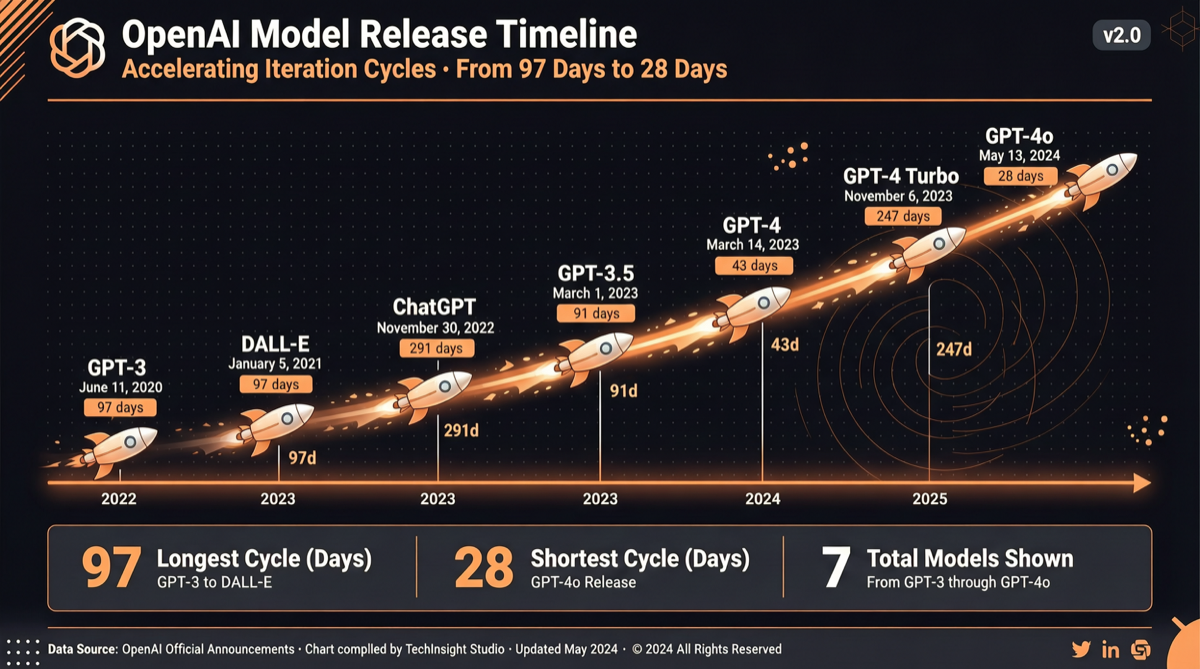
OpenAI’s model iteration pace is undergoing unprecedented acceleration. In the 8 months from GPT-5 to GPT-5.5, the interval between versions has compressed from 97 days to 49 days—halving the time. This is not an accidental optimization, but a strategic adjustment driven by competitive pressure.
Release Cycle Data
| Version | Release Date | Interval from Previous | Key Changes |
|---|---|---|---|
| GPT-5 | 2025-08-07 | — | Fifth-generation base model |
| GPT-5.1 | 2025-11-12 | 97 days | Enhanced reasoning capabilities |
| GPT-5.2 | 2025-12-11 | 29 days | Rapid iterative fixes |
| GPT-5.3 Codex | 2026-02-05 | 56 days | Specialized coding capabilities |
| GPT-5.4 | 2026-03-05 | 28 days | Shortest interval |
| GPT-5.5 | 2026-04-23 | 49 days | Strong Terminal-Bench performance |
| GPT-5.6 | Expected mid-June | ~50 days | Pending release |
Drivers Behind the Cycle Compression
1. Competitive Pressure
- Anthropic released 28 new features in Q1 2026, with Claude Opus 4.7 leading in multiple benchmarks
- Google is preparing Gemini 3.5 Pro, rumored to launch around Google I/O (May 19)
- On the domestic front, models like GLM 5.1 and Kimi K2.6 have entered the entry-level tier, with the gap narrowing
2. Maturation of Infrastructure
- Optimization of training pipelines has accelerated iteration speeds from a “monthly” to a “weekly” pace
- Increased automation in RLHF and Agent RL
- Standardization of evaluation systems, reducing bottlenecks in manual assessment
3. Shifts in Business Logic
- The API revenue model requires continuous feature updates to maintain customer retention
- Enterprise clients are starting to use “latest model” as a procurement criterion
- The catch-up by open-source models forces closed-source models to maintain rapid iteration
Potential Release Windows for GPT 5.6
Scenario A: Mid-June Release (Baseline Forecast)
- Following the ~50-day interval pattern
- Allows sufficient time for data collection on GPT-5.5
Scenario B: Around May 19 Google I/O (Accelerated Forecast)
- If Google releases Gemini 3.5 Pro, OpenAI might launch early to capture attention
- This represents a “defensive release” strategy
Scenario C: Around July AMD Advancing AI Event
- Aligning with hardware release cycles
- Showcasing GPT-5.6’s optimized performance on AMD chips
Impact on Developers
Technical Aspect:
- Model updates are becoming more frequent, increasing the cost of “chasing the latest”
- It is recommended to build automated model-switching mechanisms rather than manually adapting to each new version
- Monitor API compatibility changes—rapid iteration may introduce breaking changes
Business Aspect:
- If OpenAI releases a new version every 50 days, enterprise procurement decisions must factor in “how quickly this model will become obsolete”
- Consider adopting model abstraction layers (e.g., Sim, LangChain) to reduce switching costs
- API pricing may adjust with version iterations; monitor cost fluctuations
Industry Landscape Assessment
The compression of model release cycles means that competition in “Model-as-a-Service” has evolved from a battle of performance to a race of speed. Whoever can translate research into products faster will gain an early advantage in the developer ecosystem.
Anthropic follows a “quality-first” approach—fewer features, but highly refined. OpenAI adopts a “speed-first” strategy—rapid iteration and incremental progress. Google pursues an “ecosystem integration” path—embedding model capabilities into existing products like Search, Cloud, and Android.
There is no absolute superiority among these three paths, but the advantage of the speed-focused route lies in this: in the rapidly evolving AI landscape, speed itself is a moat.
Actionable Recommendations
- Don’t wait for GPT 5.6: GPT-5.5 is already a mature and production-ready version; start using it now
- Build a model abstraction layer: Use tools like LangChain, LiteLLM, etc., to reduce switching costs
- Monitor API changelogs: Rapid iteration implies more frequent breaking changes
- Consider a multi-model strategy: Don’t put all your eggs in one basket; GLM 5.1, Kimi K2.6, and DeepSeek V4 Pro are all strong alternatives