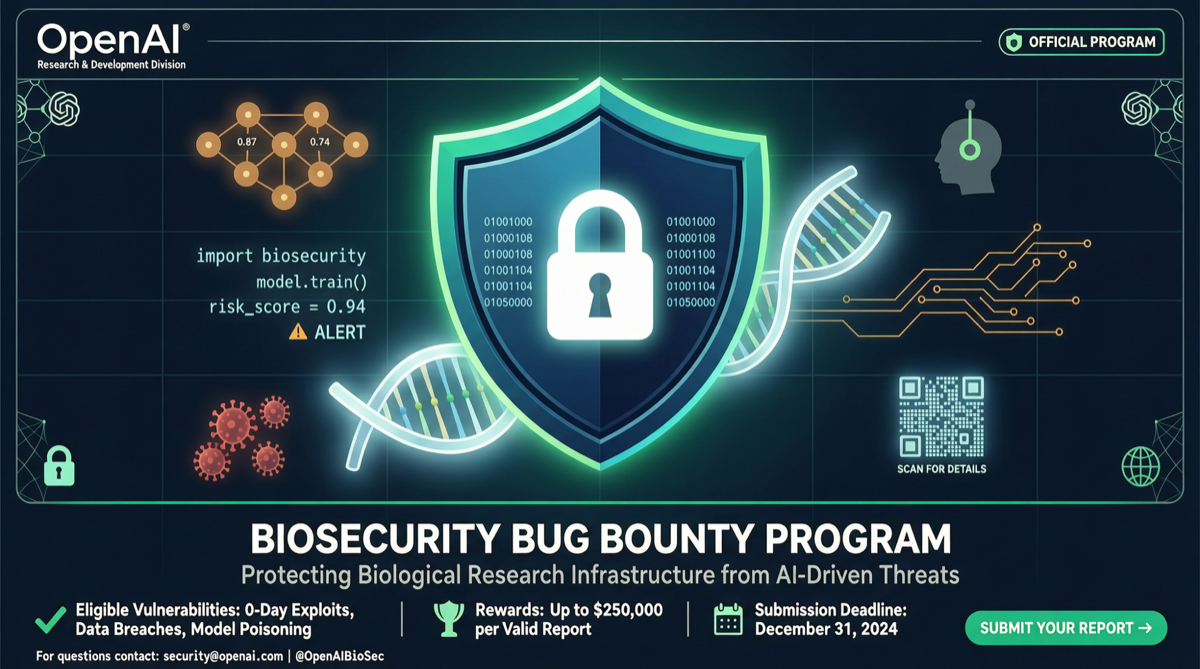
On April 26, 2026, OpenAI announced the GPT-5.5 Biosecurity Bug Bounty Program, open to researchers worldwide, with the goal of finding a universal method to bypass the model’s “five biosecurity challenge questions.” The maximum prize is $25,000, with testing limited to the Codex environment.
The Five Challenges
The program’s core is five biosecurity challenge questions covering different difficulty levels from basic knowledge queries to operational instructions. Participants need to find a universal method that can bypass all five defenses simultaneously, rather than a single-question-specific solution.
This design reflects OpenAI’s systematic understanding of biosecurity risks: one-off prompt bypasses are not the concern; what’s truly dangerous is a universal jailbreak path that can be repeatedly exploited.
Why GPT-5.5
GPT-5.5 was officially released on April 23, 2026, as the first public version of OpenAI’s new “Spud” pre-training architecture. Compared to GPT-5.4, it shows significant improvements in code self-check iteration, deep research assistance, and cross-tool collaboration.
Greater capability means higher potential risk. A smarter model, if misused for synthesizing harmful biological agents or designing dangerous compounds, could cause harm far exceeding previous model versions. OpenAI’s decision to launch the bounty program just three days after GPT-5.5’s release shows that biosecurity is a priority in its product launch process.
Industry Trends
AI model biosecurity has become a core topic in AI governance in 2026. As models’ capabilities in science, coding, and cross-domain reasoning rapidly improve, academia and policymakers are increasingly concerned about AI being misused in biological, chemical, and other high-risk domains.
Previous GPT-5.4 and Claude Opus 4.7 already have built-in biosecurity guardrails, but proactively inviting external researchers to find vulnerabilities through a bounty program reflects a “red team testing” strategy—better to pay security experts to find vulnerabilities than wait for them to be maliciously exploited.
The $25,000 prize is not outstanding in traditional software bug bounty territory, but for a targeted challenge in a specific vertical domain, it’s enough to attract professional AI security research teams.
Market Outlook
OpenAI’s biosecurity bounty program sends a clear signal: frontier model companies are shifting security from “reactive patching” to “proactive defense.” For developers, this means that when using GPT-5.5 for tasks involving biological, chemical, or other high-risk domains, they cannot rely solely on the model’s built-in safety guardrails—additional review and control layers are needed.
For the industry, this “open challenge” model may become the standard practice for AI safety evaluation—not just internal testing, but inviting the global security community to participate jointly.
Sources
- OpenAI GPT-5.5 Biosecurity Bug Bounty Program
- X platform Chinese community discussion