Core Data
| Metric | Kimi K2.5 | Comparison |
|---|---|---|
| Total Parameters | 1 trillion | GPT-5.5 est. ~10T |
| Active Parameters | 32 billion | Only 3.2% active |
| Sub-Agent Coordination | Up to 100 parallel | Industry typical 5-10 |
| Modalities | Text + Image + Video native | Comparable to GPT-5.5 |
| Open-Source | Weights open | Like LLaMA series |
| Inference Cost | 1/7 of Claude | Extremely cost-effective |
MoE Architecture Significance
MoE (Mixture of Experts) isn’t new, but achieving 1 trillion total parameters while keeping active parameters at 32 billion requires:
- Efficient routing: Each token activates only the most relevant experts
- Expert load balancing: Preventing some experts from being overloaded
- Inference memory management: 1 trillion parameters need to be loaded, but only 32B compute
100 Sub-Agents Parallel — What Does This Mean?
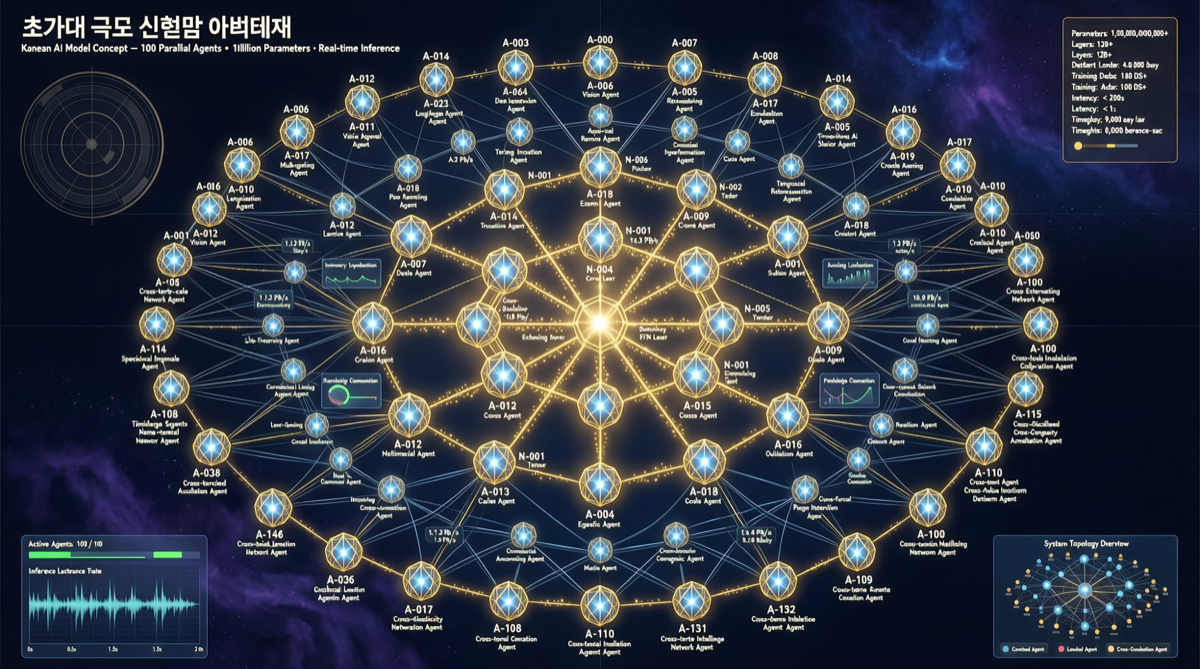
Kimi K2.5 can coordinate up to 100 AI sub-agents in parallel within a single request. This isn’t simple “batch calling” — it’s internal multi-threaded inference.
Example scenario: analyzing a 500-page financial report. K2.5 dispatches 100 sub-agents simultaneously for data extraction, industry comparison, risk identification, and more — all running in parallel, then integrated by the routing layer.
Comparison with Existing Solutions
| Approach | Agents | External Framework Needed | Cost |
|---|---|---|---|
| LangChain + GPT-4 | 5-10 | Yes | High |
| CrewAI + Claude | 5-20 | Yes | Medium-high |
| Kimi K2.5 Built-in | 100 | No | Low |
Key advantage: Multi-agent capability is built into the model, eliminating external orchestration complexity.
Open-Source Significance
Kimi K2.5 is open-source. Against the backdrop of Meta Muse Spark going closed-source and Anthropic locking its models, Kimi K2.5’s open strategy stands out.
Landscape Assessment
Kimi K2.5 represents a trend: models are evolving from “single-thread inference engines” to “multi-agent coordination systems.”
In this trend, traditional Agent frameworks (LangChain, CrewAI) may gradually be replaced by models’ built-in multi-agent capabilities.
Action Recommendations
- Developers: Try Kimi K2.5 API for multi-step parallel inference scenarios
- Enterprises: Evaluate migrating LangChain/CrewAI workloads to Kimi K2.5 built-in multi-agent
- Researchers: Study Kimi K2.5’s MoE routing mechanism from open-source weights