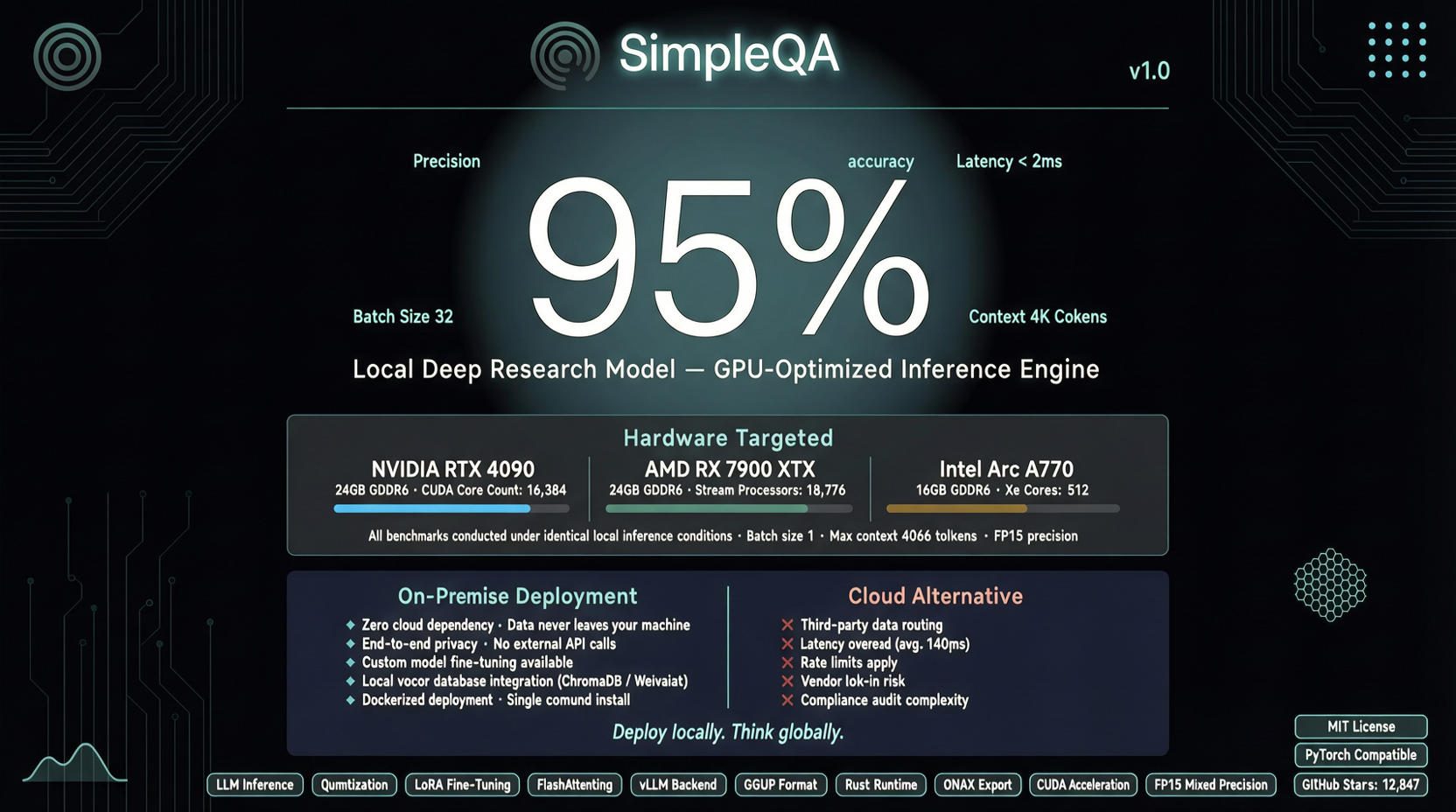
The Bottom Line
SimpleQA is a factuality-focused question-answering benchmark introduced by OpenAI—designed specifically to evaluate whether a model knows the correct answer, not whether it can fabricate a plausible-sounding one. A 95% score means that, on consumer-grade hardware, a locally run model now approaches—or even surpasses—the factual accuracy of many cloud-based APIs.
What Makes This Project Stand Out
1. 95% SimpleQA Is Not Just Marketing
The project uses Qwen3.6-27B deployed on an RTX 3090 (24 GB VRAM). Achieving this level of performance with a 27B-parameter model demonstrates remarkable maturity in quantization and inference optimization. For context: OpenAI’s own GPT-4o scores just above 80% on SimpleQA (per publicly available data). While benchmark conditions may differ, a result at this scale is undeniably significant.
2. Integration with 10+ Search Engines and Data Sources
This goes far beyond wrapping Google Search. It natively integrates arXiv, PubMed, and private document repositories—enabling automated, unified retrieval from academic paper archives, biomedical databases, and your personal notes—eliminating the need for manual tool-switching during research.
3. Fully Local & Encrypted
In privacy-sensitive domains—including medical research, legal analysis, and enterprise knowledge management—keeping data strictly local is non-negotiable. From its core architecture onward, this project embraces a local-first philosophy: all inference and retrieval occurs entirely on-device.
Engineering Maturity
6,432 commits, 155 tags, and 439 branches—this is no weekend hackathon project. Its weekly gain of 2,449 stars reflects rapidly growing community momentum.
Recent traction stems from several key features:
- Source-tagged citations with global counter (#4012): Critical for academic integrity and traceability
- Pre-commit hooks validating settings key namespaces: Strong engineering discipline
- Robust CI/CD permission management
But Don’t Get Too Excited—Yet
A few important caveats:
95% SimpleQA ≠ 95% General Research Capability
SimpleQA measures factual recall—not deep reasoning, literature synthesis, hypothesis generation, or cross-domain analytical integration. These higher-order research tasks fall outside its scope.
Real-World Experience Running a 27B Model on an RTX 3090
Running a 27B model on 24 GB VRAM necessitates aggressive quantization—most likely 4-bit. Actual inference latency and precision trade-offs require empirical validation. End-to-end pipeline latency—spanning document retrieval, reasoning, and response generation—may reach the minute range.
187 Open PRs
High community activity is encouraging—but 187 pending pull requests also suggest maintainers may be stretched thin. Before adopting, verify whether your required functionality is already available in the stable branch.
How to Choose Between Local and Cloud Solutions
| Scenario | Recommended Approach |
|---|---|
| Privacy-sensitive use cases; strict data-locality requirements | local-deep-research |
| Need for lowest possible latency | Cloud APIs (e.g., Claude, GPT) |
| Large-scale batch research workflows | local-deep-research (no API costs) |
| Requirement for cutting-edge model capabilities | Cloud APIs (local models inevitably lag in release timing) |
In One Sentence
This project proves that, for well-defined research tasks, medium-scale models deployed locally can now deliver factual accuracy rivaling that of large cloud-hosted models—not as a wholesale replacement for cloud APIs, but as a compelling, privacy-preserving, cost-effective alternative when API expenses and data sovereignty become hard constraints.
Primary Sources:
- LearningCircuit/local-deep-research GitHub
- SimpleQA benchmark: OpenAI’s factuality-focused question-answering evaluation suite