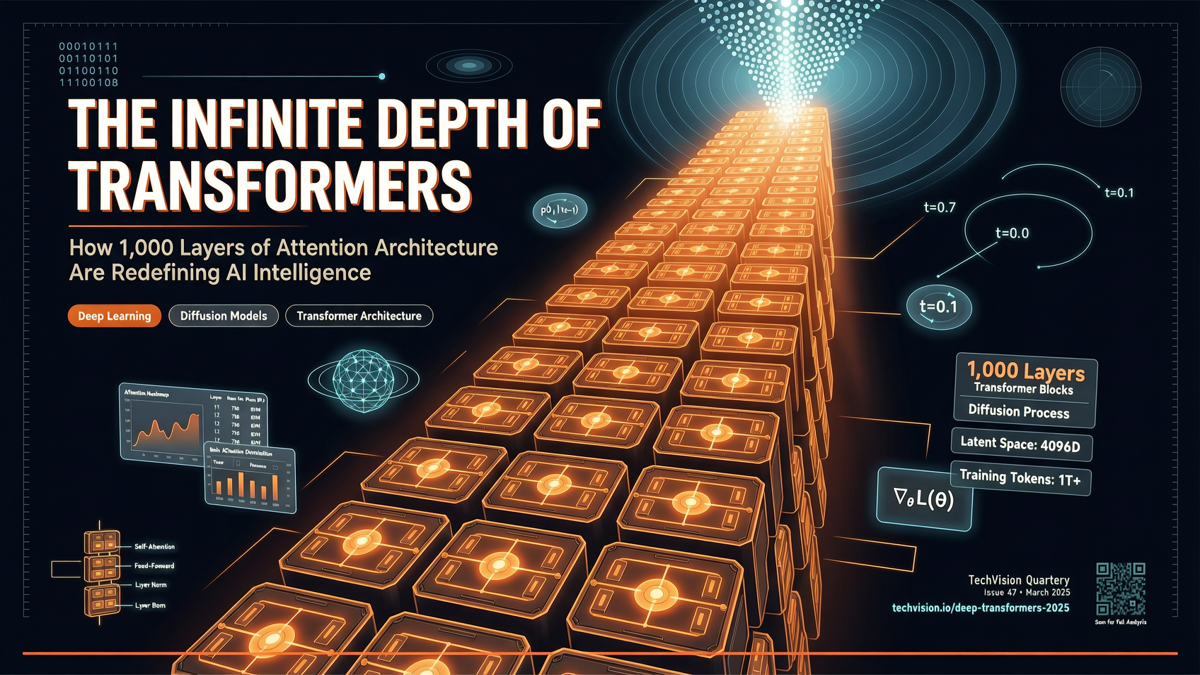
The paper is titled “Mean Mode Screaming: Mean–Variance Split Residuals for 1000-Layer Diffusion Transformers.”
With 101 upvotes, it ranked #1 on Hugging Face Daily Papers the same day.
At first glance, the title—“Mean Mode Screaming”—sounds whimsical. But its underlying technical idea is rigorous and consequential: How do we scale Diffusion Transformers from the typical 28–64 layers to 1,000 layers—without collapsing training stability?
Why Diffusion Transformers Are Hard to Scale Deeply
While Transformer architectures routinely reach over 100 layers in large language models (LLMs), Diffusion Models rarely exceed 28–64 layers.
There are two primary reasons:
First, vanishing/exploding gradients. Diffusion model training is inherently less stable than LLM training. It requires computing loss across multiple timesteps, and gradients must backpropagate through the entire denoising process. As depth increases, gradient propagation paths lengthen—and instability intensifies.
Second, standard residual connections fall short. Though residual connections effectively mitigate training difficulties in deep networks, their conventional formulation proves insufficient in diffusion settings.
This creates an awkward asymmetry: LLM Transformers scale freely, but DiTs (Diffusion Transformers) remain stubbornly shallow.
What Are Mean–Variance Split Residuals?
The paper’s central innovation is a novel residual connection design: the mean–variance split residual.
In standard residual connections, the output is computed as y = x + F(x)—the input x is added directly to the transformed output F(x).
Under the mean–variance split scheme, feature channels are partitioned into two groups: one dedicated to learning the mean mode, the other to learning the variance mode. Each group applies its own residual update independently; only then are the outputs merged.
The intuition is straightforward: In deep networks, mean and variance signals exhibit fundamentally different propagation dynamics. Mean signals tend to decay (vanish) across layers, while variance signals tend to accumulate (explode). By decoupling them, the architecture can optimize each signal’s propagation path separately.
What Does 1,000 Layers Actually Mean?
Scaling from 64 to 1,000 layers is far more than just “adding more blocks.”
A >15× increase in depth implies, in theory, exponential growth in representational capacity—but only if the model remains trainable.
The word “Screaming” in the title likely alludes to the extreme behavior observed at such depths: models either perform exceptionally well—or fail catastrophically. The mean–variance split residual’s role is to ensure the model screams rather than falls silent—preserving signal vitality throughout ultra-deep networks.
A Comparison with LLM Depth
An illuminating contrast emerges:
- LLMs (e.g., GPT-4): ~100 layers
- DiTs (e.g., Stable Diffusion 3): Typically 28–64 layers
- This work: 1,000-layer DiT
If a stable, high-performing 1,000-layer DiT proves viable—and demonstrably outperforms shallower variants—it suggests diffusion models’ scaling laws remain significantly underexplored.
Crucially, however, depth in LLMs and DiTs is not equivalent. LLM layers operate on sequence-level self-attention, whereas DiT layers apply spatial attention over image patches—entailing distinct computational complexity profiles and information densities.
Open Questions
The 101 upvotes reflect strong community interest—but several critical questions remain open for validation:
Does generation quality improve monotonically with depth? Many architectural innovations appear promising in isolation but yield marginal gains on standard benchmarks. Concrete metrics—FID, Inception Score (IS), etc.—are essential.
What is the inference cost? Inference latency for a 1,000-layer model is roughly an order of magnitude higher than for a 64-layer counterpart. Even if successfully trained, is the deployment overhead acceptable?
Is the mean–variance split truly indispensable? Could 1,000-layer DiTs train successfully using other techniques—e.g., improved initialization or learning-rate scheduling—without this specific residual design? Rigorous ablation studies are needed.
Assessment
This is a bold architectural exploration. Pushing DiTs to 1,000 layers—regardless of whether it becomes mainstream—sheds vital light on the fundamental scaling limits of diffusion models.
Should the mean–variance split residual concept prove robust, its applicability may extend beyond DiTs—to any domain demanding ultra-deep network architectures.
Worth watching closely.
Primary sources:
- Hugging Face Daily Papers – May 11, 2026
- “Mean Mode Screaming: Mean–Variance Split Residuals for 1000-Layer Diffusion Transformers”