Why This Matters
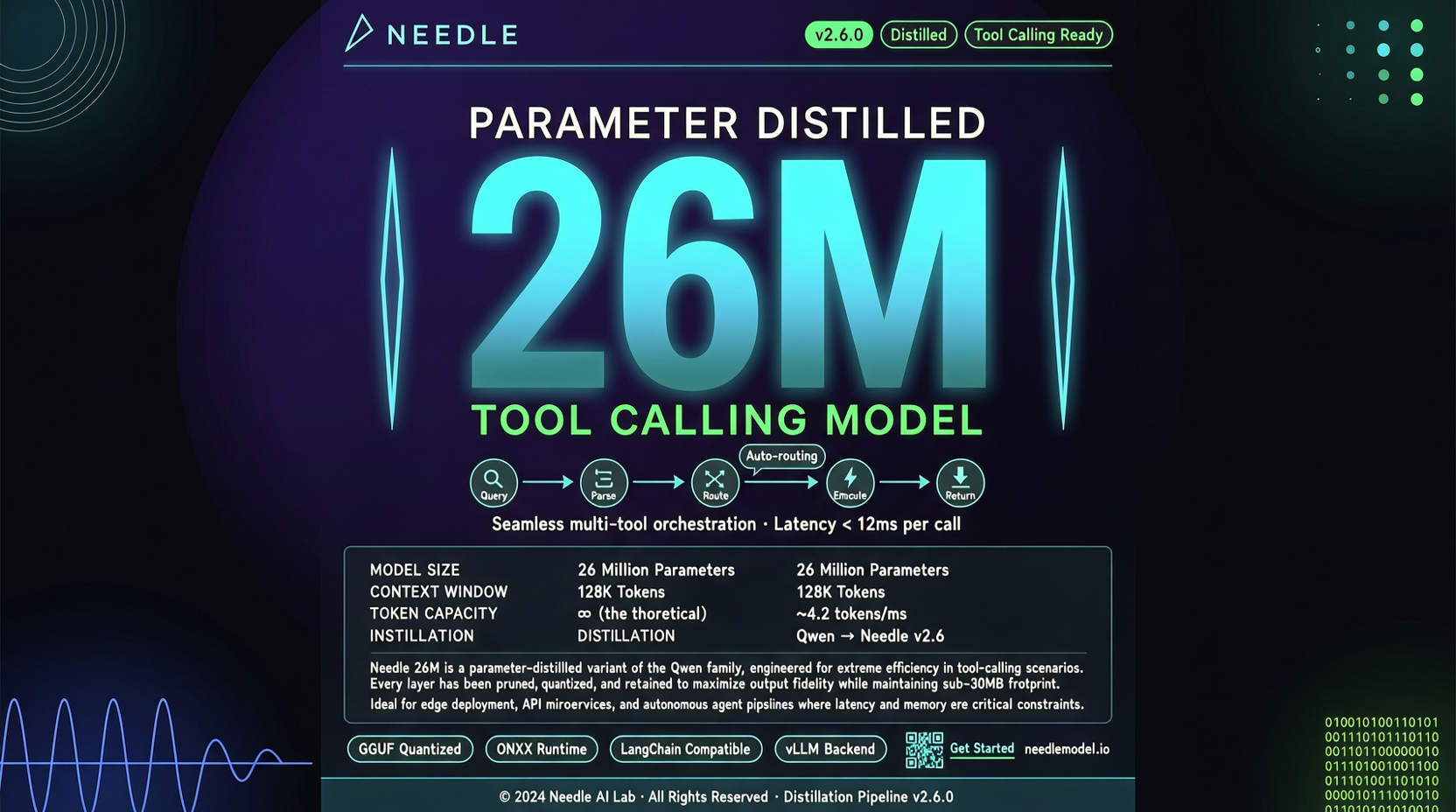
While most efforts today chase ever-larger models—hundreds of billions or even trillions of parameters—Cactus Compute takes the opposite approach: building a highly focused, ultra-compact model with only 26M parameters, dedicated exclusively to function calling (also known as tool calling).
How small is 26M parameters? Roughly the size of a single high-resolution photo on your smartphone. It runs efficiently on Raspberry Pi devices, smartphones, and even certain microcontrollers.
Technical Approach
Needle’s core methodology is knowledge distillation:
- Use Gemini (a large foundation model) as the teacher to generate extensive, high-quality training data for tool-calling tasks.
- Train a compact 26M-parameter model—the student—to replicate the teacher’s tool-calling behavior.
- Key insight: Tool calling is fundamentally a structured output task—given a user’s intent, predict the correct function name and its arguments. The information density required for this mapping is relatively low, making it well-suited for small models.
This intuition holds up in practice: think of an expert craftsman mentoring an apprentice. The master (Gemini) understands how to select the right tool across countless complex scenarios—but the apprentice (Needle) doesn’t need to absorb all that contextual knowledge. It only needs to learn the precise mapping: “Under what conditions do I call which tool?”
Practical Value
1. AI Agents on Edge Devices
If you want to deploy a tool-calling agent on a smartphone or IoT device, you no longer need to embed a full LLM. Needle runs entirely locally and only invokes cloud-based large models when actual reasoning or generation is required—enabling a classic “edge-cloud hybrid” architecture.
2. Reduced API Costs
In complex agent workflows, tool-calling decisions are often the most frequent operation. Relying on GPT-4 for every such decision incurs substantial token costs. Replacing that step with a local 26M-parameter model reduces decision latency cost to nearly zero.
3. Latency Optimization
Local inference with a 26M model typically takes just a few milliseconds—orders of magnitude faster than cloud API round-trips, which often exceed hundreds of milliseconds. For latency-sensitive applications—such as voice assistants or real-time control systems—this difference is decisive.
Caveats to Consider
212 stars vs. 228 commits
The project is very new (it underwent a major restructuring just 11 hours ago) and lacks broad community validation. With only one open issue and eight open pull requests, it remains in an early, fast-paced development phase.
Narrow Functional Scope
Needle performs only tool calling. It cannot chat, reason, or generate code. It is ideal for use cases where tool calling is the sole requirement—but for general-purpose capabilities, a full-featured LLM remains necessary.
Distillation Quality Depends on the Teacher
Gemini’s own tool-calling capability continues to evolve. If the teacher exhibits systematic errors, the student will inherit them. Ultimately, the ceiling of Needle’s performance is bounded by the quality of its teacher.
Comparison with Alternative Approaches
Current strategies for lightweight tool calling fall into three main categories:
- Distillation-based (e.g., Needle): Learns behavior from a large teacher model; achieves the smallest parameter count but relies heavily on teacher quality.
- Fine-tuning-based: Adapts open-weight models (e.g., 7B–14B parameter variants) for tool calling via fine-tuning—moderate parameter count and high flexibility.
- Architecture-first: Designs novel, purpose-built small-model architectures from scratch—most ambitious, yet highest technical risk and uncertainty.
Needle adopts the most pragmatic path: first demonstrate feasibility using distillation, then explore architectural enhancements down the line.
In One Sentence
A 26M-parameter model for tool calling signals a meaningful shift in AI agent infrastructure—from reliance on a single, monolithic “Swiss Army knife” LLM toward a modular, hybrid architecture composed of multiple specialized small models. If this path proves viable, it could dramatically lower the barrier to deploying capable AI agents at the edge.
Primary Sources: