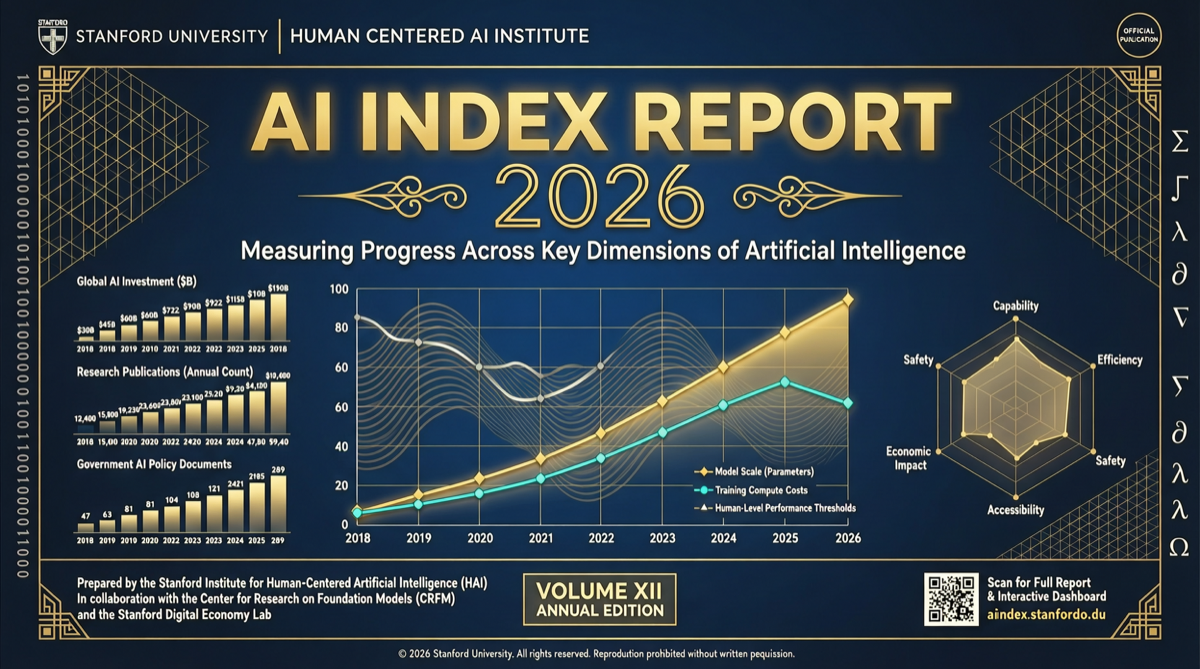
Stanford University’s Institute for Human-Centered Artificial Intelligence (Stanford HAI) released The 2026 AI Index Report on April 13, 2026. This is the ninth annual report since 2017, spanning 423 pages, comprehensively tracking AI development across R&D, technical performance, responsible AI, economic impact, scientific applications, medicine, education, policy governance, and public opinion.
Key Findings
Model capabilities continue to accelerate. The report demonstrates the rapid evolution of AI model capabilities through multiple benchmark data sets. Compared to previous years, the pace of model improvement in reasoning, coding, multimodal understanding, and long-text processing significantly accelerated between 2025-2026. However, evaluation systems and governance frameworks have not kept pace.
Leading AI companies accelerate toward IPO. The report notes that leading AI companies such as OpenAI and Anthropic are preparing to submit initial public offering (IPO) applications in the second half of 2026. This means 2026 could become the “IPO year” for the AI industry, and capital market participation will further reshape the competitive landscape.
AI optimism contrasts with regulatory trust. Public optimism about AI technology continues to rise, but trust in AI regulatory frameworks has not grown correspondingly. This contrast reflects both public期待 for AI benefits and concerns about the effectiveness of governance frameworks.
Key Data
The report presents key trends in AI development through 12 core charts:
- AI R&D investment and paper publication volumes continue to grow
- Top models continue to refresh scores across multiple benchmark tests
- AI-related patent numbers and commercial application expansion accelerate
- Global AI policy legislative activity significantly increases
- AI talent mobility and employment market changes
Market Assessment
The value of the Stanford AI Index Report lies in its data-driven rather than narrative-driven presentation of industry state. The 2026 report描绘s an industry landscape of “accelerating capabilities but lagging governance” — model capabilities iterate on a monthly basis, but evaluation standards, safety frameworks, and policy regulatory construction cycles often span years.
This “capability-governance” gap may be the core challenge the AI industry faces in the near future. For practitioners, this means maintaining prudence in a rapidly changing technical environment and关注the applicability boundaries and potential risks of models.
Action Items
- Researchers and practitioners can use the report’s data for industry analysis and market judgment reference. -关注the AI governance and evaluation framework building progress mentioned in the report, which may affect future industry standards and compliance requirements.
- Track the IPO progress of OpenAI, Anthropic, and other companies to understand capital market impact on the AI industry.