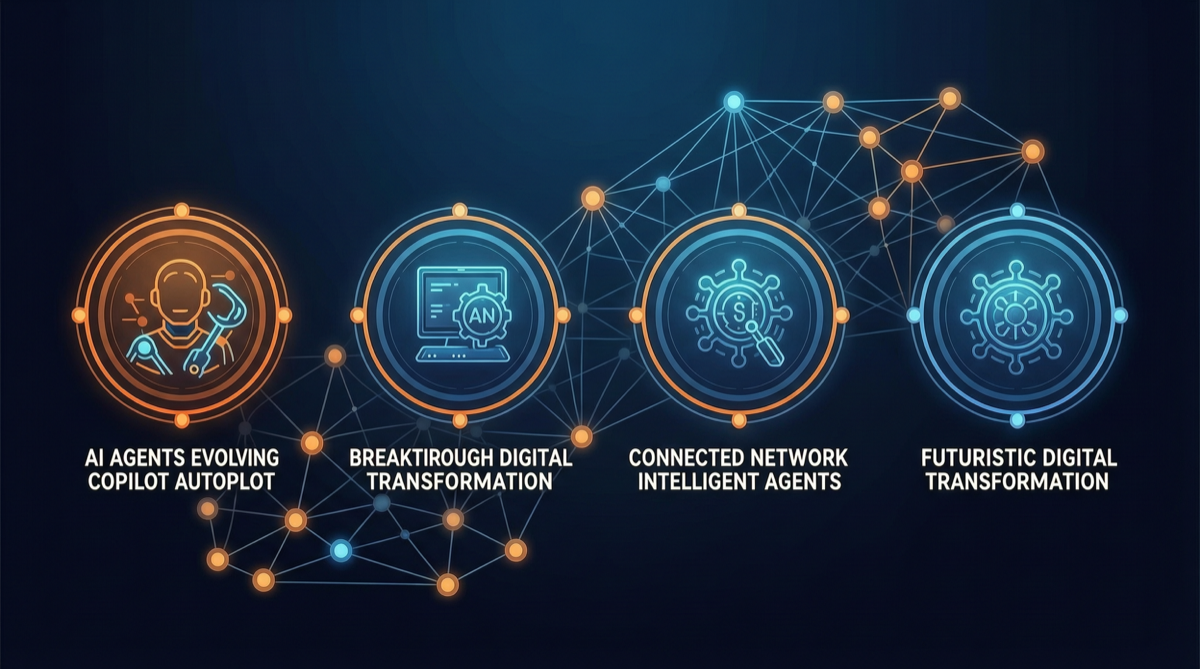
The Chatbot Era Has Ended
If you’re still using the concept of “AI assistant,” you may already be behind.
The keyword for 2026 isn’t “conversation” — it’s “execution.” Previously, you asked AI a question and AI gave you an answer. Now, you give AI a task and AI executes it and delivers the result. This is the shift from Copilot to Autopilot.
Supporting this transformation are four technological breakthroughs that erupted this year.
Breakthrough One: MCP + A2A Standardization — The “USB Port” for Agents
Model Context Protocol (MCP) and Agent-to-Agent (A2A) protocols completed standardization in the first half of 2026.
What does this mean? Think of it this way:
- Before USB standardization, every device had its own connector and you needed a pile of adapters.
- MCP+A2A is the “USB standard” for AI Agents — any agent can connect to any tool, any agent can talk to any agent.
This solves the biggest obstacle to multi-agent collaboration: interoperability.
| Protocol | Problem Solved | Analogy |
|---|---|---|
| MCP | How agents connect to external tools and APIs | USB port |
| A2A | How agents communicate and coordinate with each other | Human language |
Breakthrough Two: From Copilot to Autopilot — Crossing the Trust Threshold
The core of Copilot mode is “human leads, AI assists.” The core of Autopilot mode is “AI leads, human supervises.”
Several landmark events happened in 2026:
- GitHub Copilot’s autonomous PR (Pull Request) feature is beginning to be widely accepted.
- Claude Code can independently complete the full workflow from requirements analysis to code deployment.
- Coze 2.5’s Agent World lets users build digital employee teams that can autonomously execute tasks.
The key to this shift isn’t that AI got much smarter — it’s that human trust thresholds for AI have dropped. When AI error rates fall to acceptable levels, people are willing to hand over the steering wheel.
Breakthrough Three: Agent Swarm — From “One Super Agent” to “A Team of Specialized Agents”
Agent Swarm is the most disruptive paradigm shift of 2026.
Traditional approach: train one all-powerful super model that can do everything. Swarm approach: build a group of specialized agents, each expert at one thing, completing complex tasks through collaboration.
| Dimension | Single Super Agent | Agent Swarm |
|---|---|---|
| Capability coverage | Broad but not deep | Specialized and complementary |
| Fault tolerance | Single point of failure | Distributed fault tolerance |
| Cost | High per-call cost | On-demand combination, more economical |
| Interpretability | Black box | Each agent’s behavior is traceable |
| Applicable scenarios | General conversation | Complex workflows |
This paradigm is exploding especially in industrial scenarios: one agent handles data collection, one handles analysis, one handles report generation, one handles distribution — each doing their own job.
Breakthrough Four: Thread-Level Isolation — Key Infrastructure for Agent Safety
As agents are increasingly granted execution permissions (writing files, calling APIs, operating databases), security has become the biggest bottleneck.
The solution in 2026 is thread-level isolation:
- Each agent runs in an independent sandbox environment.
- Communication between agents goes through controlled message queues.
- All operations have audit logs.
- Any agent’s execution can be terminated in real-time.
This gives enterprises the confidence to deploy agents in production — because even if one agent fails or is attacked, the impact is contained within a single thread.
Market Outlook: The Agent Race of H2 2026
These four breakthroughs combined mean:
- Agent platform competition shifts from “whose agent is smarter” to “whose agent collaboration ecosystem is better”
- Adoption speed of MCP and A2A will determine platform market share
- The Agent Swarm paradigm will spawn new startup directions: agent orchestration tools, agent monitoring platforms, agent security auditing
Action Recommendations
- Technology selection: Prioritize platforms and tools that support the MCP protocol — this is the foundation for future interoperability.
- Architecture design: Shift from single-agent to Agent Swarm — build complex capabilities through composition rather than a single point.
- Security strategy: Before deploying any autonomous agent, ensure thread-level isolation and audit mechanisms are in place.
- Talent reserve: Cultivate talent who understand agent orchestration and collaboration — this will be the most sought-after skill in 2026.
The “iPhone moment” for AI Agents is arriving. The difference: iPhone changed how humans interact with phones, while Agents change how humans interact with work.