Bottom Line First
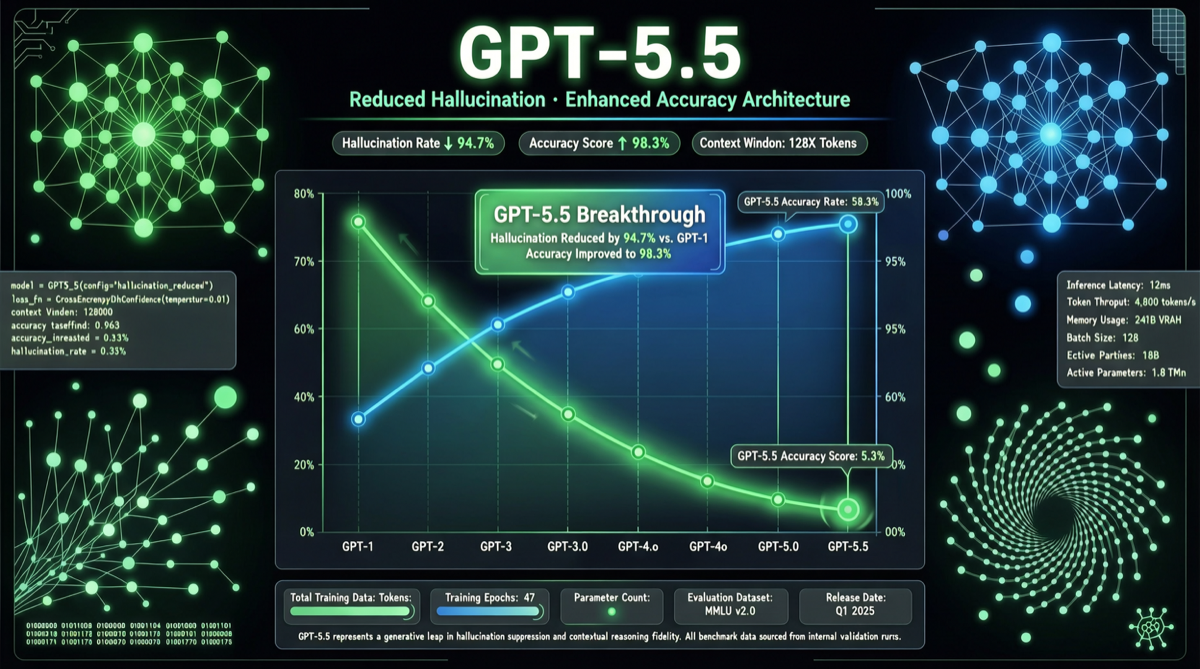
The most notable change in GPT-5.5 isn’t parameters or benchmark scores — it’s the dramatic reduction in hallucination rate and fundamental change in reasoning behavior. But this brings an unexpected consequence: the prompts you used to write smoothly may no longer work.
On May 1, 2026, OpenAI and Anthropic nearly simultaneously released official prompt engineering guides — this itself is a strong signal: model behavior patterns have changed, and users need to relearn how to talk to AI.
Test Data
Hallucination Rate Comparison
| Scenario | GPT-5.1 | GPT-5.5 | Improvement |
|---|---|---|---|
| Game guide queries | Occasional fabrication | Near-zero hallucination | Significant |
| Equipment optimization advice | Inaccurate data | Detailed and accurate | Significant |
| Search + reasoning tasks | 20s response, occasional deviation | 10s response, consistent data | Significant |
| Self-review tasks | Requires multiple follow-ups | Proactively reviews output | Significant |
Cross-Comparison with DeepSeek-V4 Pro
| Dimension | GPT-5.5 | DeepSeek-V4 Pro |
|---|---|---|
| Response Speed | ~20 seconds | ~10 seconds |
| Search + Reasoning Quality | Rigorous, consistent data | Rigorous, consistent data |
| Intuitive Feel Difference | No obvious advantage | No obvious disadvantage |
| Output Price | $30/M tokens | $3.48/M tokens |
The Truth About “Getting Dumber”
Community feedback broadly reports “GPT feels worse” and “Claude got dumber.” But the simultaneous prompt guide releases from OpenAI and Anthropic reveal a counterintuitive fact:
The models didn’t get dumber — they got smarter. But smarter in a way you don’t expect.
Specific behaviors:
- No longer catering to vague instructions: Previously models tended to “guess what the user wants and give an answer”; now they’re more likely to “point out the instruction is unclear and wait for clarification”
- Longer but more reliable reasoning chains: Instead of giving quick but potentially wrong answers, they spend more time on correct reasoning
- Reduced sycophancy: Anthropic previously analyzed 1 million conversations and found Claude has systematic bias toward catering to user preferences; GPT-5.5 has similar adjustments
A typical case: ChatGPT’s “nerdy” personality mode was only 2.5% of all responses but caused 66.7% of “goblin” mentions. After the GPT-5.1 upgrade, usage of the word “goblin” jumped 175%. This exposed a real product issue: fine-tuned behavior patterns can produce unexpected outputs in extreme corner cases.
How to Change Your Prompts
Don’t Do
- ❌ Vague instructions: “Help me write something about X”
- ❌ Rely on the model’s “guessing” ability
- ❌ Wrap simple requests in lengthy prose
Should Do
- ✅ Define clear task objectives and output format
- ✅ Provide specific constraints and evaluation criteria
- ✅ Use structured prompts (step-by-step, role-based)
- ✅ Enable the model’s “slow thinking” mode in critical scenarios
Action Recommendations
| Your Situation | Recommendation |
|---|---|
| Heavily rely on GPT/Claude for daily tasks | Spend 2-3 hours reading the official prompt guide, rewrite frequently-used prompt templates |
| Enterprise agent systems using OpenAI API | Evaluate GPT-5.5 compatibility with existing prompts, prepare rollback plans |
| Personal user, occasional use | Pay attention to output format specificity; when you encounter “uncooperative” behavior, first check if your prompt is specific enough |
| Developer, building AI applications | Incorporate “prompt version management” into engineering practices, maintain prompt libraries adapted for different model versions |
GPT-5.5’s hallucination reduction is real progress, but “smarter” models require “smarter” instructions. This isn’t a step backward — it’s an inevitable stage in the maturation of AI tools.