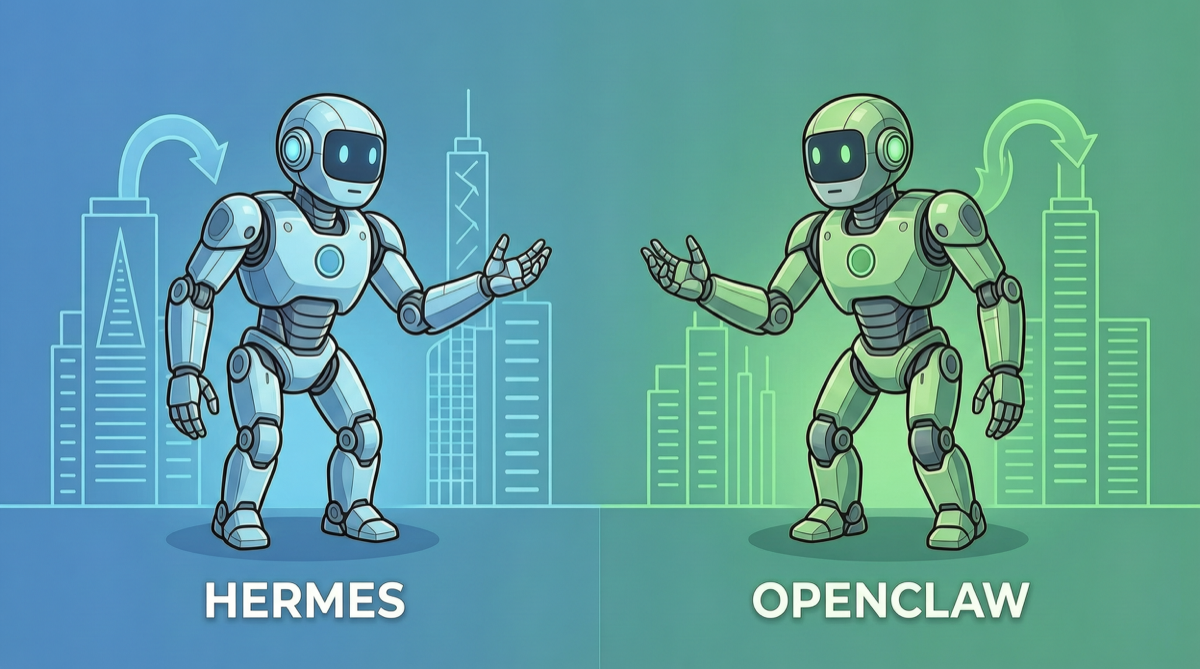
The AI Agent ecosystem in 2026 has evolved from “can it work?” to “which one suits me better?” Hermes Agent and OpenClaw represent two completely different technical routes. Understanding their differences matters more than blindly chasing the new.
Conclusion First
| If you value more | Choose Hermes Agent | Choose OpenClaw |
|---|---|---|
| Self-learning/autonomous evolution | ✅ Core design | ❌ Requires manual configuration |
| Unified Gateway management | ❌ Requires additional integration | ✅ Native support |
| Plugin ecosystem richness | ✅ Community growing fast | ✅ More mature |
| Local deployment simplicity | ✅ Docker one-click deploy | ✅ Docker + Alpine image |
| Enterprise-grade reliability | Developing | ✅ Significantly improved in 2026.5.4 |
In one sentence: Hermes Agent suits developers pursuing autonomy and evolvability; OpenClaw suits teams needing Gateway-first architecture and a mature plugin ecosystem.
Testing Dimensions
1. Autonomy
Hermes Agent’s core selling point is self-learning. It can accumulate experience from interactive feedback during operation, adjusting its behavioral strategies. This means:
- No need to configure prompts from scratch for every task
- As usage time increases, the Agent gets better at “understanding you”
- Suitable for long-running automation scenarios
OpenClaw’s philosophy is Gateway-first: a unified entry point managing multiple models, tools, and services. Its autonomy manifests at the orchestration level:
- Multi-model routing: automatically selecting the most appropriate model based on task type
- Toolchain orchestration: chaining multiple MCP servers to complete complex workflows
- Suitable for scenarios requiring fine-grained control over Agent behavior
2. Deployment Difficulty
Both support Docker deployment, but through different paths:
| Dimension | Hermes Agent | OpenClaw |
|---|---|---|
| Docker Image | nousresearch/hermes-agent:v2026.4.16 | alpine/openclaw:2026.4.15 |
| Startup Command | docker run nousresearch/hermes-agent | docker run alpine/openclaw |
| Configuration Complexity | Low (environment variables primarily) | Medium (requires Gateway route configuration) |
| Resource Usage | Medium | Lightweight (Alpine base image) |
OpenClaw’s 2026.5.4 version fixed numerous reliability issues: smoother plugin installation, faster Gateway startup, clearer diagnostic information. If you were previously deterred by OpenClaw’s deployment problems, it is worth trying again now.
3. Ecosystem Integration
Hermes Agent’s community resources are growing rapidly:
- GitHub stars have surpassed 127K
- Community has contributed numerous custom tools and integrations
- Good adaptation with domestic models like Qwen and DeepSeek
OpenClaw’s integration is more enterprise-oriented:
- Native support for 50+ MCP servers (including Google Cloud Run hosted version)
- Integration with Anthropic Skills Blueprint
- Enterprise-grade monitoring and logging
4. Cost
| Scenario | Hermes Agent | OpenClaw |
|---|---|---|
| Self-hosted deployment | Free (open source) | Free (open source) |
| API calls | Depends on connected models | Depends on connected models |
| Operations cost | Low | Medium (Gateway management) |
| Learning cost | Low | Medium |
Both are open source and free; the real cost difference lies in the models and infrastructure you connect to.
Selection Recommendations
Choose Hermes Agent if you:
- Need the Agent to have self-learning and continuous evolution capabilities
- Prefer a “set it and forget it” automation mode
- Care about domestic model ecosystem (good Qwen/DeepSeek adaptation)
- Have a small team and need to get started quickly
Choose OpenClaw if you:
- Need unified management of multiple AI models and tools
- Value the scalability of Gateway architecture
- Are in an enterprise scenario, needing a reliable plugin ecosystem
- Need integration with enterprise-grade tools like Anthropic Skills
Hybrid Approach
In practice, the two frameworks are not mutually exclusive. A common pattern is:
- OpenClaw as the Gateway layer: Unified management of model routing and tool calls
- Hermes Agent as the execution layer: Handling specific autonomous tasks and continuous learning
- MCP Server as the connection layer: Both connect to external services through the MCP protocol
This architecture combines the strengths of both: OpenClaw’s orchestration capability + Hermes Agent’s self-learning ability.
Three-Judge Assessment
Increment: Both sides have had major updates in the 2026.5.x series. OpenClaw fixed reliability pain points, Hermes Agent community surpassed 127K stars. Comparative analysis is more meaningful than ever.
Noise: Both are iterating rapidly; today’s comparison conclusions may be outdated in 3 months. Focus on their respective changelogs rather than static reviews.
Signal: When the community starts discussing “which Agent framework is better” rather than “can Agent frameworks be used,” it means this track has entered the mature competition stage.
Sources: Hermes Agent GitHub | OpenClaw GitHub