Bottom Line First
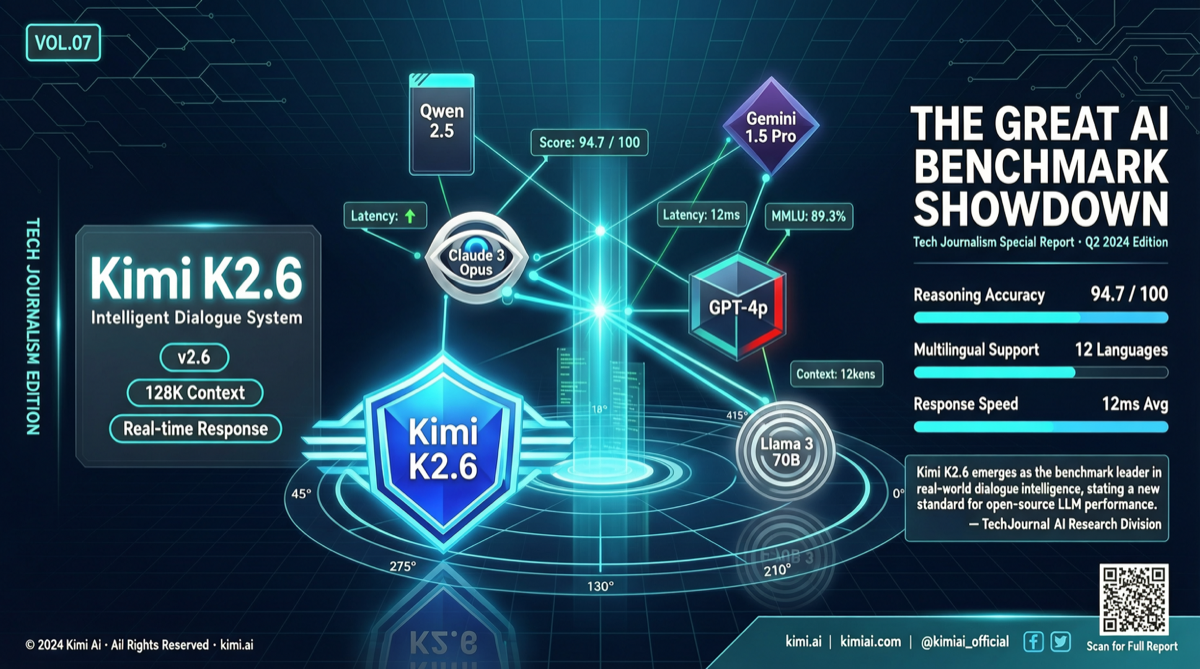
Kimi K2.6 is no longer just a “cost-effective alternative”—it is now beating or matching top US models on two critical benchmarks:
- Design Arena: Outperforms GLM 5.1 and GPT-5.5
- SWE-Bench Pro: On par with Claude Opus and GPT-5.5
- Cost advantage: Inference cost is roughly one-third of Claude/GPT-5.5
For teams selecting a backend model for coding agents, Kimi K2.6 has graduated from “backup option” to “a serious contender worth serious evaluation.”
What Happened
Over the past week, multiple independent signals have cross-validated Kimi K2.6’s capability leap:
-
Design Arena surge: A well-known AI creator tested K2.6 live on stream, confirming it beats GLM 5.1 and GPT-5.5 on design tasks. This sparked substantive discussion in the developer community.
-
SWE-Bench Pro parity: The State of AI May 2026 report shows that Kimi K2.6, alongside DeepSeek V4, has reached parity with Claude and GPT-5.5 on SWE-Bench Pro. This is not a one-off breakthrough—it represents systematic catching-up in engineering capability.
-
Open-source + low-cost dual advantage: K2.6 is released with open weights, supports self-deployment, and its API pricing is significantly below comparable closed-source models.
Data Comparison
| Dimension | Kimi K2.6 | GPT-5.5 | Claude Opus | GLM 5.1 |
|---|---|---|---|---|
| Design Arena | ★ Leading | Behind | Unknown | Behind |
| SWE-Bench Pro | Parity | Parity | Parity | Slightly Lower |
| Open Source | ✅ Yes | ❌ No | ❌ No | ✅ Yes |
| Self-Deploy | ✅ Supported | ❌ No | ❌ No | ✅ Supported |
| Relative Cost | 1x | ~3x | ~3x | ~1.2x |
Why It Matters
1. The “Parity Alternative” Narrative Is Materializing
In 2025, many said “Chinese models are cost-effective but lag in capability.” K2.6’s performance shows that on hardcore software engineering benchmarks like SWE-Bench Pro, the gap has narrowed to within statistical error.
2. What Design Arena Leadership Means
Design Arena tests a model’s understand-generate-iterate loop, involving visual understanding, layout reasoning, and creative execution. K2.6 surpassing GPT-5.5 here signals it’s not just “good at code”—it has gained real competitiveness in multimodal creative workflows.
3. The Compound Effect of Open-Source Strategy
K2.6’s open weights mean:
- Enterprises can self-deploy, avoiding data cross-border compliance risks
- Communities can fine-tune for specific domains (legal, medical, finance)
- Researchers can analyze internal mechanisms, driving subsequent iterations
How to Use This
If You’re a Technical Decision-Maker
- Evaluation path: Run Kimi K2.6 vs. your current primary model on an SWE-Bench Pro subset, validating against your own codebase
- Cost calculation: If Kimi K2.6 achieves 95%+ relative quality on your tasks, the 60-70% API cost savings translate directly to margin improvement
- Hybrid strategy: Use Claude/GPT-5.5 for critical tasks, Kimi K2.6 for batch workloads—optimal cost/quality ratio
If You’re a Developer
- Self-deploy Kimi K2.6 as the backend for your local coding assistant
- Use Kimi K2.6 for bulk code generation/refactoring, reserving Claude for deep reasoning tasks
- Watch for the next Kimi version (K3 is on the roadmap)—open-source ecosystems typically iterate faster than closed-source
Risk Notes
- SWE-Bench Pro parity doesn’t mean parity across all scenarios—performance in specific domains (math, creative writing, security red-teaming) needs separate validation
- Design Arena leadership comes from community testing, not yet large-scale statistical verification
- Open-source models require self-deployment operations—hidden costs (GPUs, personnel) must be factored into total cost of ownership