Bottom Line First
Kimi K2.6’s pricing strategy is tearing open a crack: when open-weight model performance approaches closed-source flagships, price is no longer a synonym for “low-end” — it’s a fundamental difference in business model.
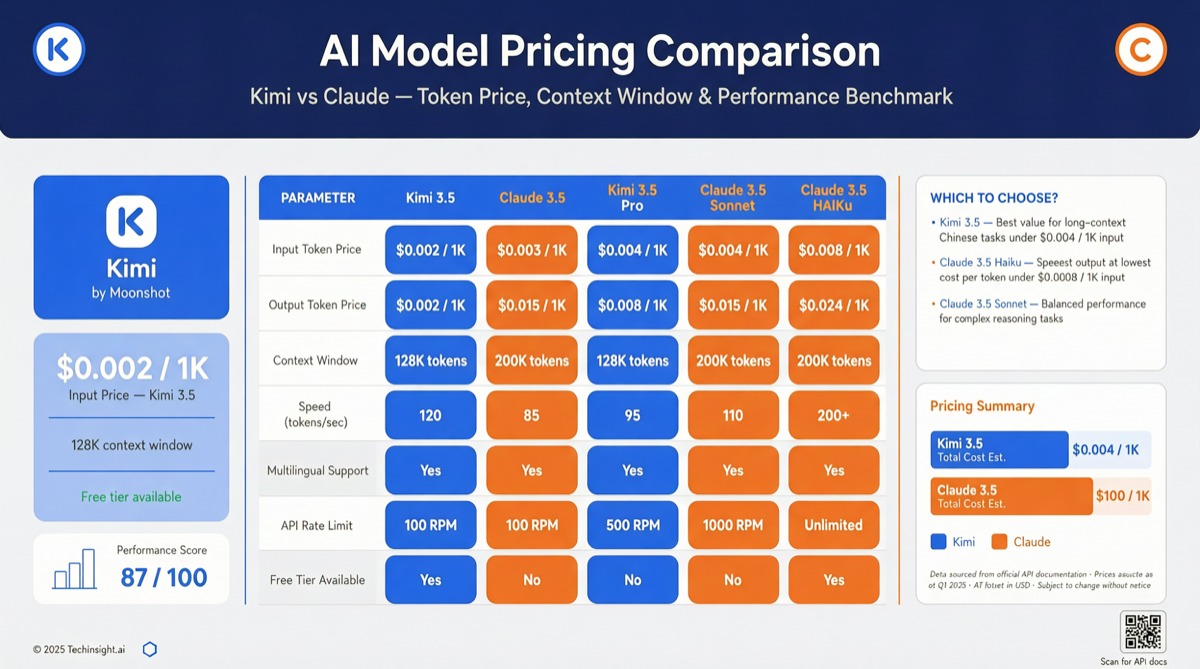
| Dimension | Kimi K2.6 | Claude Opus 4.7 | Gap |
|---|---|---|---|
| API Input Price | $0.15/MTok | $1.50/MTok | 10x |
| API Output Price | $0.60/MTok | $7.50/MTok | 12.5x |
| Design Output Quality | Near Opus 4.7 | Industry benchmark | Substitutable |
| Overall Cost-Performance | Baseline | — | 7-9x advantage |
What Happened
In late April 2026, Kimi K2.6 made moves across multiple dimensions simultaneously:
- Pricing: API prices roughly 9x cheaper than Claude Opus 4.7, directly targeting cost-sensitive enterprise scenarios
- Design capability: In design output tests, K2.6 delivers near-comparable quality at 7x the cost-performance of Claude
- Ecosystem binding: OpenClaw 2026.4.20 has set it as the default model, signaling Agent ecosystem adoption at scale
This is not a “cheap means bad” story. Multiple developers on X report making Kimi K2.6 their daily driver across coding, design, and analysis scenarios.
Why It Matters
1. Open Models’ “Cost Moat” Is Taking Shape
Kimi K2.6’s foundation is a 1T MoE architecture (32B activated), with open-sourced weights meaning:
- Enterprises can deploy locally, escaping API vendor lock-in
- Opus 4.7-level capability runs on 2 Mac Studios with 512GB each
- Inference costs can be compressed further to 1/20 or lower of API pricing
2. Anthropic’s Compute Bottleneck Is Amplified
Anthropic’s compute expansion pace can’t keep up with user demand:
- Amazon partnership for 5GW compute, but first 1GW arrives end of 2026
- Pro users already experiencing “dumbed down” experiences — shorter code replies, missing code interpreters
- Ban waves catchingmass numbers of normal users on proxy IPs
Maintaining high prices while supply-constrained is rational short-term but leaves a window for competitors long-term.
3. Pricing Wars Are Reshaping Developer Choice Logic
Previously: “Pick the strongest model, price is secondary” Now: “Pick the best cost-performance model, as long as performance is adequate”
This shift matters especially for AI startups and SMBs. $200/month Claude subscription vs $25/month Kimi API — when quality gaps shrink to acceptable ranges, the decision tilts naturally.
Landscape Assessment
Short-term (1-3 months):
- Kimi K2.6 continues to eat into Claude’s mid-to-low tier market share
- Default model switches in Agent frameworks like OpenClaw accelerate this trend
- Anthropic may be forced to adjust pricing or launch a “light” version
Medium-term (3-6 months):
- MiniMax M3 (May release), Qwen 3.6 and other Chinese models join the fray
- API pricing systems may drop 30-50% across the board
- Local deployment becomes enterprise standard
Long-term signal: Closed-source models’ “intelligence premium” is being diluted by open models’ systemic cost advantage. This is not zero-sum — the market is expanding, but pricing power is shifting.
Actionable Advice
| Your Role | Recommended Action |
|---|---|
| Independent Developer | Trial Kimi K2.6 API, compare output quality to Claude, evaluate switching costs |
| Enterprise CTO | Evaluate ROI of local Kimi K2.6 deployment — Mac Studio + MLX-LM is a low-barrier option |
| Agent Framework Users | OpenClaw has built-in K2.6 support, switch directly |
| Claude Power Users | Track Anthropic’s 5GW compute deployment timeline; consider hybrid usage strategy in the meantime |
Bottom line: Kimi K2.6 is not replacing Claude in premium scenarios, but it’s good enough and cheap enough that you no longer need to pay “brand premium” for most everyday use cases.